



How much does SEO cost?
SEO cost depends on three variables: whether your site is new or established, how competitive your industry is, and whether you work with a professional or handle it yourself. For most businesses, SEO is an ongoing investment rather than a one-time project, because search engine algorithms update continuously and competitors keep optimizing. An SEO analysis at the outset maps your current position, identifies achievable keywords, and gives you a realistic seo cost estimate before you commit to any budget.
SEO pricing at a glance
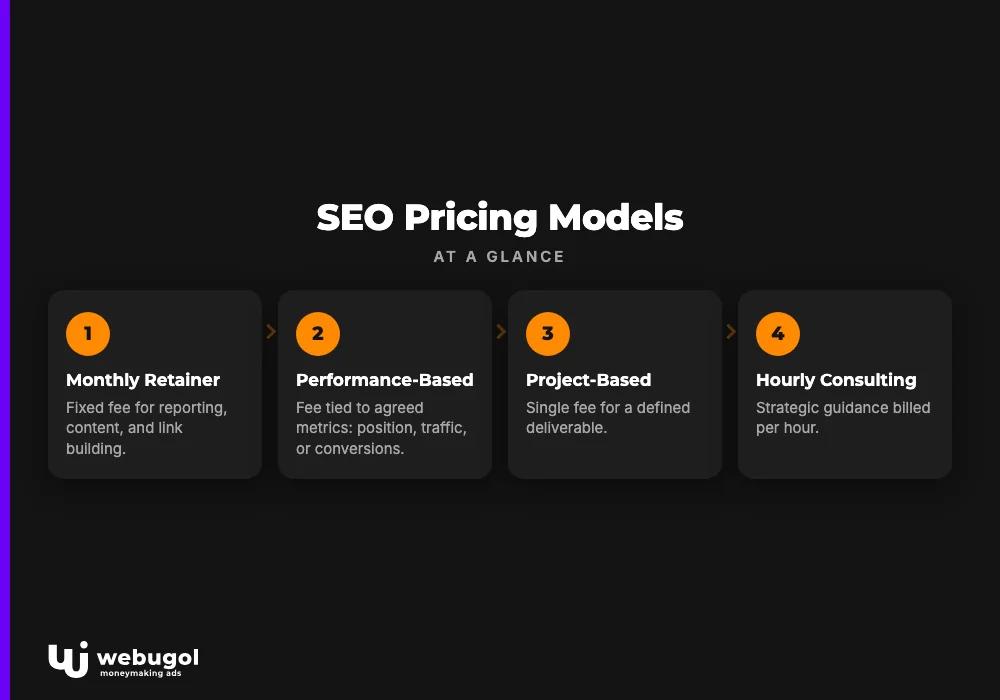
Before examining each driver in detail, here is a quick-reference breakdown of the main service models and what each covers.
| Pricing model | Best suited for | What you pay for |
|---|---|---|
| Monthly retainer | Sustained growth campaigns | Fixed seo retainer fee covering reporting, content, and link building |
| Performance-based | Results-tied engagements | Fee tied to agreed metrics: position, traffic, or conversions |
| Project-based | One-time audits or migrations | Single scoped fee for a defined deliverable |
| Hourly consulting | In-house teams needing direction | Strategic guidance billed per hour |
Most businesses working on sustained organic growth use a monthly retainer as their core model. Performance-based pricing shifts risk to the agency but requires precise upfront definitions of success. Project work is clean and finite but leaves no ongoing support once the deliverable is complete.
How much does SEO cost per month?
Monthly SEO pricing is not one number because no two sites start from the same position. Maintaining current rankings requires less ongoing effort than actively building new positions in a competitive space. Recovering from years of neglected optimization requires more still. The right question is not what SEO generically costs, but what your specific situation requires.
Monthly seo pricing typically covers three categories of work, and your actual spend reflects how much of each applies to your site.
The first is technical monitoring and reporting: tracking keyword positions, analyzing traffic changes, identifying new crawl or indexation issues. This is the baseline that any ongoing SEO relationship includes, and it is the least variable component of the monthly cost.
The second is content production: articles, service pages, and updates to existing pages. The more content your site needs to compete for its target terms, the higher this portion of the monthly fee. An industry with thin topical coverage requires sustained content output; a mature site with strong existing content needs less.
The third is link acquisition: building the referring domain count that signals authority to search engines. This component scales directly with how competitive your target keywords are, and it is the hardest to cap because link-building effort is driven by what competitors are doing, not just your own goals.
A concrete benchmark from the original research behind this article: the seo cost of competing in an industry with roughly 197,000 Google results is incomparably lower than competing in a category with close to 2 million results. Any reliable monthly estimate starts from your specific competitive environment, not an industry average.
Maintenance costs, once the initial investment phase is complete, are substantially lower. The input phase is front-loaded because it covers the analysis, structural fixes, and content buildout that set the foundation. Once that work is done, the ongoing monthly spend covers monitoring, incremental content, and continued link activity at a lower intensity.
What factors affect SEO pricing?
SEO cost is not arbitrary. Four factors consistently determine what a project actually requires, regardless of which agency or freelancer you work with.
New site vs. established site
New websites benefit from lower initial seo cost when developers build with clean, valid code and SEO-friendly URL structure from the start. Keyword research and content development can run in parallel with the build itself. The site launches with SEO already considered, which eliminates a whole category of remediation work.
Established websites face a different cost structure. Before any optimization can produce compounding results, a thorough analysis identifies existing shortcomings: technical issues in the source code, content that was never written with keyword research in mind, and a backlink profile that may be weak or unbalanced. Then those shortcomings must be fixed. Both the analysis phase and the remediation phase carry costs that could have been avoided with proper planning at the outset.
One important distinction for established sites: content that exists but lacks keyword optimization can often be restructured rather than rewritten from scratch. Adding relevant keywords, improving heading hierarchy, and incorporating lists and formatting costs less than producing entirely new content. The subject matter expertise stays in the article; the structure becomes better aligned with how search engines process information. If the backlink profile is weak, though, link acquisition investment is unavoidable regardless of how well the content work is executed.
Industry competition level
Competition is the factor most business owners underestimate when setting an seo budget. The same monthly investment that achieves strong rankings in a low-competition niche may barely register in a high-competition sector. The original research behind this article put specific numbers to this: optimizing for the field of medical devices, with roughly 197,000 Google results, costs incomparably less than optimizing for a field like sports equipment, with close to 2 million results.
The practical response to high competition is not to spend more indiscriminately. It is to target more specific keyword phrases first. Longer-tail terms attract a smaller but more motivated audience and require far less effort to rank for. As those positions are established, broader and more competitive targets become more achievable over time.
Professional vs. DIY
Self-managed SEO is possible, but the time cost is real and the risk is significant. A non-specialist takes far longer to accomplish the same tasks as an experienced practitioner. More critically, someone without deep familiarity with search engine guidelines may apply techniques classified as violations without realizing it.
A penalty moves a site toward the end of search results, or removes it from them entirely. Recovery costs substantially more time and money than hiring a professional from the start. What initially appears to reduce seo cost can multiply it many times over if the wrong approach triggers a penalty.
Keyword specificity
More specific keyword phrases cost less to rank for and often convert at higher rates. A business targeting precise, long-tail terms sees faster progress at lower cost than one chasing broad, high-volume queries. A structured keyword analysis at the start of a project separates opportunities by achievability and expected return, so the seo budget goes toward positions that can actually be won.
New website SEO cost vs. established site: a closer look
The economics of these two starting points differ enough to treat separately.
New website: built-in efficiency
When a developer builds a site with clean code and SEO-friendly URLs, they eliminate an entire category of later remediation cost. The remaining SEO investment goes toward what actually generates rankings: keyword research, content written specifically for target terms, and initial link acquisition.
For new sites, building a backlink profile begins with registering in major directories and establishing early citations. These are modest costs relative to the link-building campaigns required to recover from a deficit. Because keyword research can happen before or during development, new site content can be structured for the right terms from day one, rather than edited after the fact.
If the keyword analysis and content are produced by an expert at the development stage, the cost is higher than DIY, but the quality of the output and the long-term efficiency of the investment are also higher. Front-loading expertise is consistently more cost-effective than remediation.
Established website: diagnosis before treatment
An established site that has operated without deliberate SEO attention has typically accumulated technical debt. The diagnostic process reviews source code for SEO-unfriendly patterns, assesses how current content aligns with keyword targets, and compares the existing backlink profile to competitors who already hold the positions you want.
Only after this assessment can accurate cost projections be made. The diagnostic itself is an investment, but it prevents the alternative: optimizing in the wrong direction for months before discovering that underlying technical issues are canceling out the content work.
For content that exists but lacks keyword optimization, modification is usually the lower-cost path. Restructuring articles, adding appropriate keyword coverage, and improving formatting costs less than full rewrites. The underlying information stays; the structure improves. But if backlinks are insufficient, link acquisition investment is required at the same scale as for a new site, regardless of how strong the content already is.
The constant across both scenarios: the more completely SEO is considered at the design stage, the lower the lifetime cost of maintaining and improving organic positions.

Is SEO worth the investment for small businesses?
The direct answer: yes, when two conditions are met. First, the business can sustain the investment through the compounding phase, which is typically several months before meaningful ranking movement appears. Second, real search demand exists for what the business offers.
SEO compounds over time in a way that advertising does not. Early months build the technical foundation and initial content. Later months see those investments pay off as positions improve and organic traffic grows. A business that abandons SEO after two months has spent on a foundation without ever seeing the structure built on top of it. Advertising produces immediate results that stop the moment spending stops; SEO produces slower results that continue after the investment tapers.
For businesses weighing seo cost against paid search spend, understanding how SEO compares to paid search across the full acquisition funnel helps make that decision with accuracy rather than assumptions.
For small businesses, local SEO offers a particularly favorable cost-to-return ratio. The competition in local search is defined by geography rather than the entire national market. That geographic boundary keeps keyword difficulty lower and makes ranking movement faster than in national or global campaigns. Local seo pricing reflects this narrower scope, making it accessible to businesses that cannot sustain the investment level required for national competition.
A practical starting point for any small business with a limited seo budget is a technical and content baseline assessment that identifies which problems to fix first. Not all SEO issues carry equal weight. Prioritizing high-impact fixes keeps costs in check while still building compounding momentum.
How much should I budget for SEO services?
No universal seo cost applies across all businesses, but there is a reliable method for arriving at a figure appropriate for your situation.
Start with an SEO analysis
Before setting an seo budget, you need a baseline. Where does your site currently rank? What keywords are achievable given your domain's current authority and your industry's competitive environment? Is the site technically sound, or are there structural problems that will limit the return on content and link investment? The analysis answers these questions and makes cost estimation grounded rather than speculative. Webugol provides this analysis at no cost, which gives you an objective starting point for any budget conversation.
Allocate across three priorities
Once you have a baseline, seo service rates and budget allocation typically follow this order of impact.
Technical foundation comes first. Site structure, crawlability, and load performance affect every other SEO investment you make. A technically broken site limits the return on content and link building alike. Our guide on website speed and its effect on search performance covers the specific areas to assess and address.
Content development comes second. Pages and articles aligned to keyword research address the specific queries your audience searches for. Service pages need to signal relevance and authority for commercial terms. Supporting articles build topical depth and capture informational queries that lead users toward service pages.
Link acquisition comes third. Growing the referring domain count signals to search engines that the site is worth ranking. The pace of this investment should match the competitive environment: a low-competition niche requires less sustained effort than a highly competitive sector.
Plan for two phases
The initial phase, while the foundation is being built, costs more than the maintenance phase that follows. Planning for this curve prevents budget surprises. Once the technical foundation is stable and core content is live, ongoing monthly spend drops to monitoring, incremental content, and continued link building at a sustainable pace. Businesses that plan only for the maintenance cost and not the setup cost routinely underfund the phase where the most important work happens.

What is a typical SEO retainer fee?
A typical seo retainer fee covers a monthly bundle: keyword position tracking and reporting, a defined volume of content production, link building activity, and ongoing technical monitoring. The fee reflects the scope of work included, not a commodity price for "SEO" as a category.
Before agreeing to any retainer, confirm what the fee covers and what falls outside it. Common exclusions include content creation (sometimes billed per article separately), link placement costs, and technical implementation when the agency does not have direct developer access to the site. An all-in retainer with a clearly defined scope is more predictable for budget planning than a base fee with variable add-ons.
The performance-based retainer is a meaningful alternative to the fixed monthly model. Instead of paying a set fee regardless of outcomes, the agency fee is tied to agreed metrics: a target search position, a defined increase in organic visitors, or a conversion benchmark. The fee for reaching those targets is established before the engagement begins. This approach aligns agency incentives directly with business results, but it requires precise metric definitions upfront to prevent disagreements about whether goals were reached. Webugol offers this option for businesses that prefer outcome-based seo agency pricing over a fixed monthly commitment.
When evaluating any retainer proposal, ask specifically what deliverables and reporting cadence are included. Agencies with poor reporting make it difficult to see what the monthly fee is actually producing. Transparent monthly reporting is a baseline expectation, not an upgrade.
Local SEO pricing: what changes for location-based businesses
Local SEO operates within a geographically bounded competitive environment, and its cost structure reflects that difference from national campaigns.
The competition in local search is limited to other businesses in the same area serving the same audience. This keeps keyword difficulty lower, makes ranking movement faster, and narrows the scope of work compared to national or global campaigns. Local seo cost tends to be more accessible for small businesses precisely because the target is smaller and more tractable.
The core work in local SEO covers maintaining accurate and consistent business listings across directories, building locally relevant content that addresses specific geographic queries, managing review signals, and ensuring name, address, and phone number consistency across the web. These tasks are methodical and operational, which makes them easier to scope and estimate than open-ended authority-building campaigns against national competitors.
For businesses in industries with higher content accuracy requirements, such as healthcare or financial services, local SEO content costs somewhat more because the standards for accuracy are higher. Our article on SEO for health and wellness businesses examines how specialized industries approach these content requirements in practice.
Once the foundational local SEO work is in place, maintenance costs are lower and more predictable than for nationally competing sites. The investment curve is less steep, and results tend to appear on a shorter timeline. For small businesses evaluating whether SEO is worth the investment, local campaigns often offer the most favorable entry point.
Get an accurate picture of your SEO cost before committing
The only reliable way to understand your seo cost is to start with an analysis of your specific situation. Broad estimates without knowledge of your site, your keyword targets, and your competitive environment are not useful for budget planning.
Webugol provides a no-cost SEO analysis that gives you a clear view of where your site stands, what keyword opportunities are realistic, and what investment level is required to produce meaningful results. Contact us to request yours and get an honest estimate before committing to any budget or seo agency pricing arrangement.
Frequently asked questions
What does a typical monthly SEO investment cover?
Monthly SEO pricing covers three categories of work: technical monitoring and reporting, content production, and link acquisition. The initial input phase is front-loaded because it includes the audit, structural fixes, and content buildout, so costs are higher early on and drop once maintenance begins. The scope of each category scales with your industry's competition level and how much existing work the site requires.
What makes SEO more expensive for some businesses than others?
Four variables determine actual SEO cost: whether the site is new or established, how competitive the target keywords are, whether you work with a professional or self-manage, and how specific the keyword targets are. A new site built with clean code and SEO-friendly URLs eliminates a whole category of remediation work, while an established site with technical debt requires a diagnostic phase before any optimization can produce results. Industry competition has the largest multiplier effect: the research behind this article found that a field with roughly 197,000 Google results costs incomparably less to optimize for than one with close to 2 million results.
Should small businesses invest in SEO?
SEO is a sound investment for small businesses when two conditions are met: the business can sustain the investment through the compounding phase, and real search demand exists for what it offers. Local SEO is particularly cost-effective because competition is geographically bounded, keyword difficulty stays lower, and results tend to appear faster than in national campaigns. A business that abandons SEO after two months has spent on a foundation without seeing the returns that compound over the following months.
What does a monthly SEO retainer typically include?
A monthly SEO retainer covers keyword position tracking and reporting, a defined volume of content production, link building activity, and ongoing technical monitoring. Common exclusions from the base fee include content creation, link placement costs, and technical implementation when the agency lacks direct developer access. Confirming exactly what falls inside and outside the retainer scope prevents budget surprises during the engagement.