



How SEO works: ranking factors, crawling, and optimization
SEO works by helping search engines find, understand, and rank your web pages above competing results. When you optimize a website, you adjust its content, code, and external links so that Google's algorithm scores your pages as more relevant and trustworthy than others targeting the same queries. Understanding how SEO works across three stages, crawling, indexing, and ranking, gives you a clear framework for deliberate improvement rather than guesswork.
How does Google crawl a website?
Google discovers pages using an automated program called a crawler, also referred to as a spider or robot. The crawler starts from a known set of URLs, follows the hyperlinks it finds on each page, and records each new URL it encounters. This process runs continuously: crawlers return to pages they have already indexed to detect updates, added links, and removed content.
After visiting a page, Google's indexer processes the text, images, and HTML structure to determine what the page covers. It stores this analysis in a database organized around words and their associated URLs. When a user types a query, Google retrieves the most relevant results from that index and orders them using its ranking algorithm.
Two situations block search engine crawling more than any other: pages accidentally set to noindex in their meta tags, and important pages that are not linked from anywhere a crawler can reach. Both prevent indexing entirely, regardless of how well-written the content is. If no page links to a new URL, the crawler may never find it.

What are on-page SEO factors?
On-page SEO factors are elements within your own website that influence how search engines interpret and rank your pages. Because you control them entirely, they are the starting point of any seo optimization process, and where the clearest gains are available earliest.
The core on-page SEO factors are:
- Content quality, quantity, and uniqueness. Pages with original, in-depth text that covers a topic thoroughly outperform thin or duplicated pages even when those competing pages carry more backlinks. Search engines evaluate how fully a page addresses the likely intent behind a query, not just whether it contains the target keyword.
- Keyword placement. The primary keyword should appear in the title tag, the H1 heading, the first paragraph, one to two subheadings, and naturally throughout the body. Forced repetition reduces quality scores; natural distribution across the full page text works better.
- Meta tags. The
<title>tag (under 60 characters) and<meta name="description">tag (under 145 characters) are the first things users see in search results. A descriptive title with the target keyword placed toward the beginning improves both click-through rate and relevance scoring. - URL structure. Clean, readable URLs containing the target keyword outperform long parameter strings. Because changing a published URL requires a redirect and may cost link equity, the URL structure should be decided before any pages go live.
- Internal linking. Hyperlinks between pages on the same site distribute authority and help crawlers discover content. Descriptive anchor text on those links strengthens the relevance signal further.
- Valid HTML. Code that meets W3C standards is parsed correctly by crawlers. Errors in HTML can cause sections of a page to be ignored during indexing, effectively hiding content from the algorithm.

What is the difference between on-page and off-page SEO?
On-page SEO covers everything you control directly on your own site: text, structure, URLs, meta tags, and internal links. Off-page SEO covers signals generated by other websites, primarily the backlinks pointing to your pages.
The distinction matters because search engines treat each type of signal differently. On-page factors determine relevance. Off-page factors, especially backlinks, function as an independent measure of credibility. Because you cannot fully control what other sites write about you or whether they link to your content, off-page signals are harder to influence, which is why Google weights them heavily in its ranking algorithm.
The two main off-page SEO signals are:
- Backlink count. A greater number of external pages linking to your site generally increases domain authority, provided those links come from varied, independent sources. A cluster of links from the same low-quality network carries little value.
- Backlink quality. Google's PageRank algorithm evaluates the authority of each page that links to yours and passes a fraction of that authority through the link. A single backlink from a high-authority, topically relevant page outweighs dozens of links from low-quality directories.
The practical consequence: on-page SEO lays the foundation. Without it, strong backlinks produce limited results. Off-page SEO becomes the differentiator once on-page fundamentals are solid.
What are the most important SEO ranking factors?
How SEO works at the ranking level involves hundreds of signals, and the precise weight of each is not public. What Google has documented is the overall framework: relevance (does the page match the query and intent?), authority (do trusted external pages link to it?), and usability (can users read it comfortably on any device?).
The table below organizes the main seo ranking factors by category:
| Category | Key signals |
|---|---|
| Content relevance | Keyword in title, headings, and body; topic depth; content uniqueness |
| Technical health | Crawlability, indexability, valid HTML, structured data markup |
| Page experience | Loading speed, mobile usability, Core Web Vitals |
| On-page SEO factors | Meta tags, URL structure, internal linking, image alt attributes |
| Off-page SEO | Backlink count, linking domain authority, anchor text variety |
No single factor controls the outcome. A page with few backlinks can reach position one by covering a topic more completely than competitors. A page with a strong backlink profile can sit on page three if its content does not match what users actually want when they search.
Page speed has a confirmed, direct effect on rankings through Google's Core Web Vitals. Slow-loading pages score lower on the page experience signal regardless of how well the rest of the page is optimized. A review of page loading performance and technical bottlenecks often uncovers fixes that unlock ranking improvements content improvements alone cannot achieve.
The SEO optimization process
How SEO works in practice differs based on whether you are building a new website or improving an existing one. Either way, the approach follows the same sequence: establish fundamentals, audit what exists, fix what blocks rankings, then build authority.
Website SEO basics: what to establish first
Before working on advanced tactics, any site needs these website seo basics in place:
- Every important page is reachable through internal links from somewhere on the site.
- Title tags and meta descriptions are unique per page and include the target keyword.
- URLs are readable, contain meaningful words, and were set before content was published.
- The site loads in under three seconds on mobile.
- No
noindexdirectives block pages intended to rank in search results.
When these fundamentals are missing, more sophisticated optimization has no foundation to build on. An organized review of your existing content and technical setup is the fastest way to identify which of these basics are broken and what to fix first.
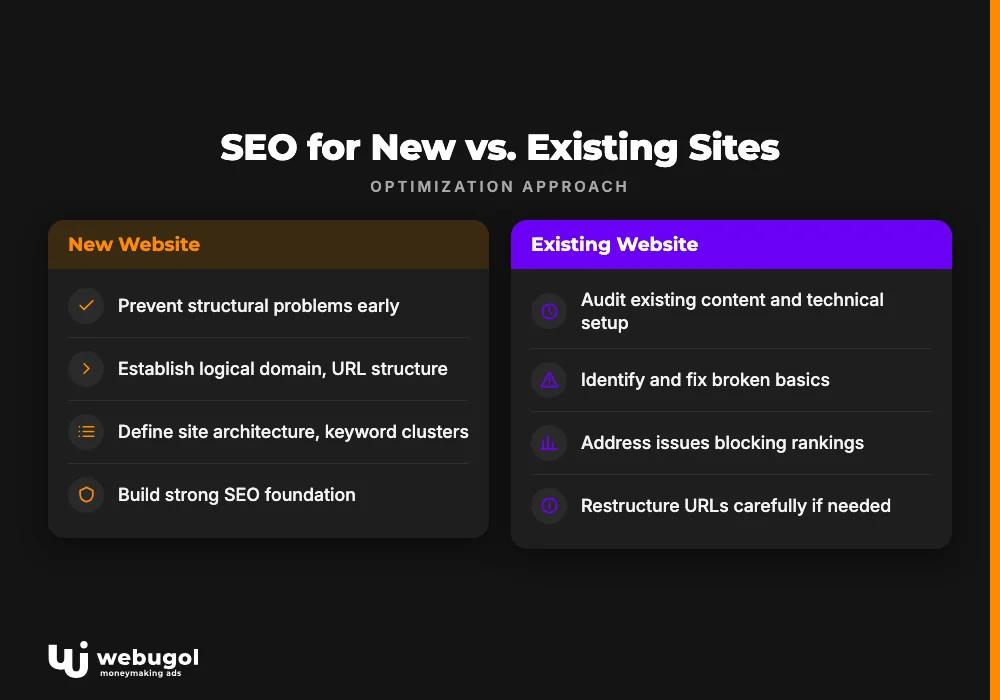
SEO for new websites
When an SEO specialist is involved from the beginning of a website build, expensive structural problems are prevented before they occur.
The specialist contributes in four areas during the build:
- Domain and URL structure. A logical hierarchy (example.com/services/mvp-development rather than example.com/page?id=42) is far easier to establish before any pages are published than to restructure afterward, since changing live URLs requires redirects and risks losing accumulated link equity.
- Site architecture. Which pages cover which topics, how they link to each other, and which keyword clusters each section targets. Getting this right determines whether the site can rank across a broad topic area or only for a narrow set of queries.
- Content direction. Text written for both users and search engines, with keywords placed naturally and content depth calibrated to what the top-ranking pages already cover.
- Code quality. Pages that produce valid HTML at launch are indexed correctly from the first crawl, without the remediation work required when errors accumulate over years of development.
Building SEO in from the start avoids the three most common structural traps: non-descriptive URLs that cannot be changed without breaking links, page architectures that bury important content, and pages that target keywords whose search intent they cannot match.
SEO for existing websites
For existing websites, understanding how SEO works means starting with a technical audit. The audit maps what is blocking or limiting rankings and prioritizes fixes by expected impact.
Common findings in audits of existing sites:
- Invalid HTML that prevents crawlers from reading sections of a page correctly.
- Duplicate or missing meta tags across multiple pages, which create conflicting relevance signals.
- URLs built around non-descriptive parameters, published before keyword research defined the content strategy.
- Thin or outdated content on pages targeting keywords where competitors publish significantly more thorough answers.
- Internal linking gaps where related pages are not connected, slowing both crawler discovery and authority distribution.
When a site lacks a content management system, routine changes such as updating a meta description or adding an internal link require a developer every time. Audits of older sites frequently surface this constraint, and it slows the entire seo optimization process significantly.
If the source code has significant errors or the site architecture is fundamentally disorganized, rebuilding on a modern CMS may cost less in the long run than ongoing patchwork fixes. A qualified SEO specialist evaluates this early so the team can make an informed decision before investing further in optimization on a broken foundation.
Off-page analysis runs alongside the technical review. This means counting the backlinks pointing to the site, assessing the authority of the linking pages using PageRank as a proxy, and comparing the backlink profile to the sites already ranking for target keywords. The output is a specific link-building plan: which pages to build links to, from what types of sources, and what anchor text to use.
Connecting the site to Google Analytics adds behavioral data to the audit. You can see which pages attract impressions without clicks, where users exit, and which queries trigger your pages but deliver no traffic because rankings sit too low. This layer helps prioritize which pages to fix first, since improving a page already ranking on page two often produces faster results than starting from zero visibility.
Many businesses run paid search alongside organic SEO. The two channels work differently and reward different disciplines. Understanding how organic rankings compare to paid placements across the full search funnel helps clarify how to allocate budget between them at each stage of growth.
How long does SEO take to work?
How SEO works over time follows a predictable curve: the process does not produce immediate results. The timeline depends on domain age, the existing backlink profile, and the competition level for target keywords.
A general framework that applies to most sites:
- Months 1 to 3. Technical fixes are implemented, content is published or updated, and crawlers begin reprocessing the changes. Rankings may not move visibly yet because Google reindexes pages on its own schedule, not yours.
- Months 4 to 6. Pages begin entering the top 30 for lower-competition keywords. Traffic starts growing, primarily from queries where keyword difficulty is low.
- Months 6 to 12. Consistent publishing and link-building compounds. Pages targeting keywords with difficulty below 15 often reach the top 10. Higher-competition keywords need more time and more external links before breaking through.
New domains face an additional trust gap. A brand-new site with no backlink history typically needs two to three extra months before optimization efforts show visible ranking movement. The practical response is to prioritize the lowest-difficulty keywords first, build topical credibility through thorough content, and layer in link-building once the site has established traction.
The long-term value of SEO is compounding. A page that reaches position three for a 1,000-search-per-month keyword generates ongoing traffic without additional spending per click. Paid search delivers traffic only while the budget runs.
Ready to see how SEO works for your website?
Webugol works through the full seo optimization process: technical audit, on-page SEO factors, content strategy, and link-building. If you want to understand where your site stands and what a realistic path to higher rankings looks like, start with a free technical analysis.
Contact us to request your free website audit and SEO strategy.
FAQ
What is "how SEO works" in plain terms?
SEO works by making your web pages easier for search engine crawlers to find and index, and more relevant to users searching for your target keywords. Search engines score pages using on-page and off-page signals, then rank the most relevant and trustworthy results at the top.
How does search engine crawling affect my rankings?
If a crawler cannot reach your page through links, the page cannot be indexed, and an unindexed page cannot rank. Ensuring all important pages are linked internally and carry no accidental noindex directives is the first step before any other optimization makes sense.
What is the difference between on-page and off-page SEO?
On-page SEO covers elements on your own site, content, keyword placement, meta tags, URLs, and internal linking. Off-page SEO covers signals from other websites, primarily backlinks. Both affect rankings, but off-page signals are harder to control, so search engines treat them as a stronger credibility indicator.
How long does SEO take to work?
Most sites see early ranking movement between months four and six, with meaningful organic traffic growth by months nine to twelve. New domains or highly competitive keywords take longer. Fixing technical issues quickly and publishing content consistently shortens the timeline.
When should a business rebuild a website instead of optimizing the existing one?
Rebuilding makes sense when source code errors would cost more developer time to fix than to rewrite, when there is no content management system to make changes efficiently, or when the site architecture is so disorganized that nearly every page would need to be restructured. A technical audit is what surfaces this decision clearly.