



SEO Techniques Explained: Types, Methods, and What Works in 2026
SEO techniques are the methods used to improve a website's position in unpaid search results. They fall into three primary categories: on-page SEO (content and HTML optimization), off-page SEO (link acquisition and authority signals), and technical SEO (crawlability, speed, and site structure). Within each category, some methods follow search engine guidelines (white hat SEO), while others attempt to manipulate rankings through deception (black hat SEO). Understanding this distinction determines whether SEO work builds lasting rankings or collapses when the next algorithm update ships.
What are the main types of SEO techniques?
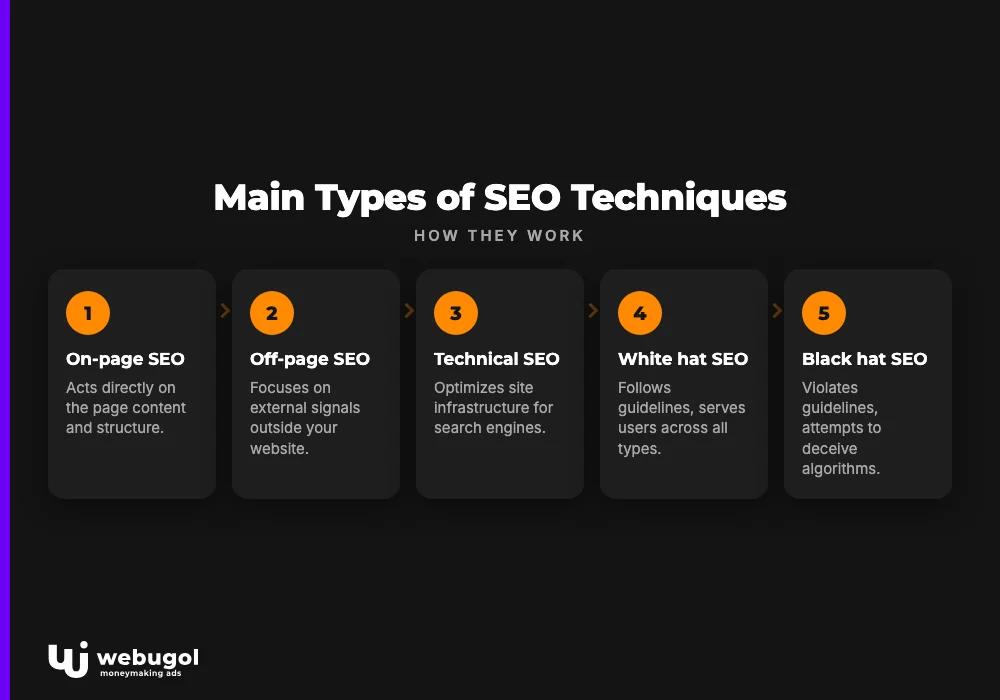
The clearest way to map SEO techniques is by where they act and whether they comply with search engine guidelines. Most practitioners organize their work around three types of SEO: on-page, off-page, and technical. The white hat versus black hat dimension cuts across all three.
| Type | Where it acts | Examples |
|---|---|---|
| On-page SEO | Directly on the page | Title tags, headings, body content, internal links, URL structure |
| Off-page SEO | Outside the page | Backlinks, brand citations, external authority signals |
| Technical SEO | Site infrastructure | Crawlability, site speed, mobile rendering, schema markup, XML sitemaps |
| White hat SEO | Any of the above | Methods that follow search engine guidelines and serve users |
| Black hat SEO | Any of the above | Methods that violate guidelines and attempt to deceive algorithms |
Each type addresses a different layer of how search engines find, evaluate, and rank a page. A complete strategy requires all three to work. Technical problems block indexation regardless of content quality. Off-page signals determine whether a page ranks for competitive queries regardless of how well on-page work is done. On-page SEO determines what queries a page can rank for in the first place.
White hat SEO techniques: on-page methods
White hat seo means using methods that search engines explicitly allow and recommend. In the early days of search, the distinction barely existed because algorithms were too simple to identify manipulative techniques. As Google's systems grew more sophisticated, the boundary became clearer and enforcement became consistent.
On-page seo covers every element within a page that publishers directly control. It is the starting point for any new piece of content because it determines relevance before any external signals matter.
Content writing and keyword placement
Written content is the core of on-page SEO. A page needs to answer the actual question behind a search query in enough depth that both users and crawlers can confirm its relevance. Effective SEO writing places the primary keyword in the title tag, the H1, the opening paragraph, and at least one or two subheadings. From there, the keyword and related terms appear throughout the body where they fit naturally.
A specific keyword density figure used to be a standard recommendation. That approach is now counterproductive. Modern search algorithms evaluate semantic relevance and overall topic coverage, not raw keyword frequency. Forcing a keyword beyond what natural writing produces triggers spam signals rather than ranking improvements.
Uniqueness is a requirement that has not changed: every page needs original text. Search engines detect duplicate content and typically index one version while ignoring the others. Sites that publish the same passages across multiple URLs lose relevance for each of those pages. When the same content appears at two URLs due to CMS behavior, the canonical tag resolves which version to index without triggering a penalty.
URL structure
URLs should be short, readable, and include the primary keyword where possible. A URL like /seo-techniques/ communicates the page topic clearly to both users and crawlers. Random strings of numbers and characters common in older CMS setups contribute nothing to relevance and make links harder to evaluate at a glance.
Once a URL is published and indexed, changing it requires a permanent (301) redirect to preserve the ranking signals attached to the original address. Changing URLs without redirects loses that equity entirely.
Heading hierarchy and HTML formatting
Search engines read heading structure to understand how a page is organized. An H1 tag marks the main topic. H2 tags identify primary subtopics. H3 tags cover secondary subtopics and specific questions. A heading marked only with font size or color, rather than the correct HTML tag, is treated as body text and given no structural weight.
This hierarchy also creates the structure that AI Overviews and featured snippet systems extract. A clearly marked H2 question followed by a direct answer in the first sentence is the specific format most likely to be pulled into an answer position in search results.
Meta tags
The meta description does not directly affect ranking position, but it influences how many users click a result. A description that includes the primary keyword and matches the intent of the query earns more clicks than a generic one. The meta robots tag controls indexation: noindex prevents a page from appearing in results, and nofollow tells crawlers not to pass authority through outbound links on that page.
Meta descriptions should accurately reflect the page content. Descriptions written to earn clicks but that mislead users about what they will find increase bounce rates and send negative behavioral signals back to the algorithm.

How do on-page and off-page SEO techniques differ?
On-page and off-page SEO techniques differ in where they originate and how quickly they take effect.
On-page seo techniques are actions taken directly on your own pages: choosing keywords, writing content, structuring headings, setting up meta descriptions, and building internal links. Because you control these elements, changes take effect as soon as a search engine re-crawls the updated page. On-page SEO tells a search engine what the page is about and which queries it should rank for.
Off-page seo techniques depend on the behavior of other sites and people. A backlink from a high-authority domain passes ranking power to your page. Brand mentions and citations in relevant contexts build authority signals that search engines interpret as third-party endorsement. These signals are slower to accumulate and harder to control, but they determine how a page ranks once it has established basic on-page relevance.
A useful frame: on-page SEO earns consideration, off-page SEO earns position. A page with strong on-page SEO but no backlinks will rank for low-competition queries. Competing in harder categories requires off-page authority as well. Knowing which gap to close first comes from running a systematic content gap and performance review before committing resources.
White hat SEO techniques: off-page methods
Link building
Backlinks remain the strongest off-page ranking signal. A link from a high-authority domain in a related subject area carries more weight than one from an unrelated low-authority site. A contextually relevant link, one from a page covering the same topic as the destination, outperforms a non-contextual link from an equally authoritative source. The three most reliable acquisition methods are:
- Earning links through content quality: creating an article, tool, or dataset valuable enough that other publishers link to it without being asked. Original research, comprehensive comparison pages, and free tools attract this type of link passively.
- Direct outreach: contacting site owners with a specific, relevant reason why their audience would benefit from a resource. This requires identifying sites whose content and audience overlap meaningfully with yours.
- Directory and profile listings: submitting to relevant industry directories, business associations, and professional profiles that include a followed link. These carry lower authority than editorial links but contribute to citation diversity. For guidance on which backlink sources matter most in different contexts, the guide to selecting backlinks that match your site's situation covers the core criteria.
The quality threshold matters throughout: acquiring links from thematically unrelated sites at scale triggers spam signals. Relevance is the primary filter for evaluating any potential link source.
Satellite content and microsites
One off-page technique worth examining carefully is the use of microsites. In the original model, a microsite is a small, keyword-dense website focused on a narrow product or service, designed to rank for specific queries and redirect users to the main site while providing a backlink.
This technique was effective in earlier search eras. Google now evaluates the full context of how links are created. A network of sites built primarily to generate backlinks for a main site, rather than to serve an independent audience, falls into the link scheme category under current guidelines. Microsites that function as independent resources for a specific audience can still be legitimate. Microsites whose primary purpose is to inflate a main site's link count now carry penalty risk.
Technical SEO: the foundation beneath everything else
Technical SEO techniques address the infrastructure that allows search engines to find, crawl, render, and index a site. A page that cannot be crawled will not rank, regardless of content quality or backlink profile. Technical problems are also the category most likely to cause sudden ranking losses without any obvious content-side explanation.
Core technical SEO methods include:
- XML sitemaps: a structured list of all important URLs submitted to Google Search Console, helping crawlers discover pages quickly, particularly in large sites where internal linking may not surface every page.
- Robots.txt: a file that tells crawlers which paths to index and which to skip. Incorrectly blocking important pages is among the most common and damaging technical SEO errors, and it is easy to introduce accidentally during site migrations.
- Mobile-first indexing: Google uses the mobile version of a page as the primary version for ranking evaluation. A page that renders correctly on desktop but breaks on mobile is at a structural disadvantage.
- Core Web Vitals: the three page experience metrics Google uses as ranking signals. Largest Contentful Paint measures load speed, Interaction to Next Paint measures responsiveness, and Cumulative Layout Shift measures visual stability. Each has defined thresholds. Measuring and improving page load times is one of the more directly attributable technical improvements a development team can produce.
- Structured data (schema markup): machine-readable annotations that tell search engines what type of content a page contains. FAQ schema, Service schema, and Article schema are eligible for expanded result formats in Google Search, which affect click-through rates independently of ranking position.
- Canonical tags: the
rel="canonical"tag tells crawlers which version of a page is the definitive one when near-identical content exists at multiple URLs. This resolves the duplicate content issue without requiring URL structure changes.
What is the difference between white hat and black hat SEO?
White hat SEO techniques comply with search engine guidelines and focus on providing genuine value to users. Black hat SEO techniques attempt to manipulate rankings through methods that deceive algorithms, users, or both.
The practical difference is risk exposure and time horizon. White hat seo builds cumulative equity: a page that earns its ranking through content quality and legitimate backlinks holds that position when algorithm updates roll out. Black hat SEO can produce fast ranking gains but carries near-certain penalty risk when the method is detected.
The timeline for detection has shortened considerably. In the early 2000s, manipulative techniques could operate for years before search engines identified and devalued them. Google's 2012 Penguin update, which targeted link manipulation, and the sequence of Helpful Content and spam updates from 2022 through 2024 demonstrate how quickly algorithmic responses now arrive. Practitioners who built rankings on black hat SEO methods found traffic wiped out at update release, often with no clear recovery path.

What SEO techniques are penalized by Google?
Google's Webmaster Quality Guidelines identify specific black hat seo methods that result in ranking demotion or complete removal from search results. Manual penalties are issued by Google's spam review team. Algorithmic penalties happen automatically when a site's patterns match known spam signatures.
Cloaking and doorway pages
Cloaking means showing different content to search engine crawlers than to human visitors. A server configured to serve keyword-dense content to Googlebot while displaying a different page to users is engaging in cloaking regardless of the reason. Doorway pages work similarly: a landing page is optimized with high keyword density specifically for crawler consumption and then redirects users to the main destination. Google treats both as deception.
Hidden content
Hidden text techniques include placing text behind images, using the same font color as the background, setting font size to zero, or using CSS to position text off-screen. Any content not visible to users but present in the HTML for crawler consumption qualifies. Search engines now parse rendered pages, not just raw HTML, which has made most hidden text methods detectable.
Duplicate content schemes
Duplicate content that results from technical errors, such as the same page loading at multiple URLs without a canonical tag, is handled by Google through indexation consolidation rather than penalties. Deliberate duplicate content, where the same text is republished across many pages or domains specifically to target multiple keyword variations, crosses into territory that can earn a manual action under the scaled content abuse policy.
Link schemes and link farms
Link farms are networks of websites linked together to inflate page rank artificially. Participating in link exchanges at scale, purchasing links, using automated link-building software, and creating sites primarily to provide backlinks to another site are all classified as link schemes under Google's current guidelines. Sites that receive backlinks from link farms can be penalized along with the source.
Which SEO techniques work best in 2026?
The seo techniques with the best risk-adjusted return share one characteristic: they give search engines accurate information about pages that genuinely serve users. Specific seo methods shift as algorithms update. That underlying criterion does not.
On-page content quality is the primary driver. Google's Helpful Content system directly targets pages that cover topics superficially or prioritize search engine signals over user value. Detailed, accurate content that answers the full intent behind a query is the foundation every other technique builds on.
Technical foundations are a prerequisite, not a differentiator. Crawl errors, slow Core Web Vitals, incorrect mobile rendering, and missing canonical tags prevent other work from functioning. These improvements are measurable, carry no manipulation risk, and have a direct documented connection to how Google evaluates pages.
Genuine link acquisition is the differentiator for competitive keywords. Backlinks remain the most influential off-page signal. Earning them through content quality or relevance-matched outreach scales better over time than any transactional approach. For businesses targeting geographic searches across multiple markets, organic search for multi-location businesses includes citation and link strategies specific to ranking in multiple cities simultaneously.
Structured data markup improves how results appear regardless of ranking position. FAQ, Service, and Article schema are eligible for rich result formats that increase click-through rates from the same position. This is one of the few technical SEO methods with a direct impact on traffic that does not require moving up in rankings.
Content refresh cycles compound existing work. Returning to established pages to close coverage gaps, update outdated information, and improve internal linking generates ranking improvements without creating new content. A page that ranks today drifts if competitors update while the page stays static.
Understanding where SEO investment fits against other acquisition channels also matters for prioritization. The comparison between organic and paid search channels is a practical starting point for deciding where to allocate budget before committing to a specific SEO approach.
Ready to apply these SEO techniques to your site?
Knowing which seo techniques exist is the starting point. Applying them in the right order against a site's actual gaps is where results come from. At Webugol, we build SEO strategies grounded in data: technical audits, keyword research, content planning, and link acquisition, prioritized by what the site needs next rather than what looks good on a checklist.
To discuss where your site currently stands and where SEO work would move the needle, fill out the form in the contact us section.
FAQ
What are SEO techniques?
SEO techniques are the methods used to improve a website's visibility in unpaid search results. They cover on-page practices like content optimization and heading structure, off-page practices like link building, and technical practices like improving crawlability and site speed.
What are the main types of SEO techniques?
The three main types of SEO are on-page SEO (content and HTML optimization), off-page SEO (backlinks and external authority signals), and technical SEO (crawlability, site speed, and structured data). A complete strategy requires all three to work together.
What is the difference between white hat and black hat SEO?
White hat SEO follows search engine guidelines and focuses on creating genuine value for users. Black hat SEO attempts to manipulate rankings through deception, using methods like cloaking, hidden text, or link schemes, and carries a high risk of ranking penalties or removal from search results.
How do on-page and off-page SEO techniques differ?
On-page SEO covers elements you control directly on your pages, such as content, headings, and internal links. Off-page SEO covers signals that originate from other sites, primarily backlinks. On-page SEO establishes what a page is about; off-page SEO determines how much authority it carries against competitive queries.
What SEO techniques does Google penalize?
Google penalizes cloaking, doorway pages, hidden content, purchased or exchanged links at scale, and deliberate duplicate content across multiple URLs. Penalties can reduce rankings or remove pages from search results entirely, and both manual and algorithmic penalties are in active use.