



Google Ads management that turns search spend into qualified leads
Google Ads management is the ongoing process of building, optimizing, and monitoring paid search campaigns so each dollar reaches people ready to act. A full ppc management service covers keyword selection, intent-based ad group structure, bid adjustments, negative keyword maintenance, conversion tracking, and monthly reporting. Webugol's search advertising agency team handles every layer daily across local, national, and global markets.
What Google Ads management actually covers
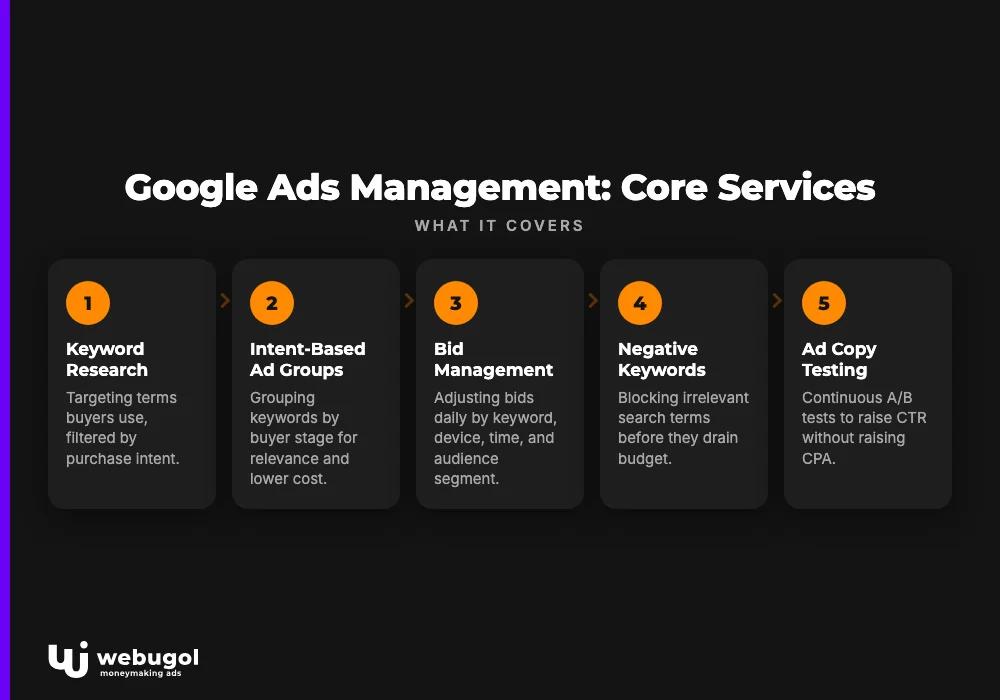
Running an account without active management means paying for clicks that never convert. A proper ppc management service addresses every variable that affects campaign profitability:
| Component | What it means in practice |
|---|---|
| Keyword research | Targeting exact and phrase-match terms buyers actually use, filtered by purchase intent |
| Intent-based ad groups (IBAG) | Grouping keywords by buyer stage for tighter relevance and lower cost per click |
| Bid management | Adjusting bids by keyword, device, time, and audience segment every day |
| Negative keywords | Blocking irrelevant search terms before they drain budget |
| Ad copy testing | Continuous A/B tests on headlines and descriptions to raise CTR without raising CPA |
| Extension configuration | Occupying maximum ad space on the results page using every available extension |
| Conversion tracking | Attributing calls, form fills, and purchases to the exact keyword that drove them |
| Monthly reporting | Budget, CPC, CTR, conversion count, and a call log with time, duration, campaign, and keyword per call |
| Google Shopping | Publishing product listings with pricing directly in search results for e-commerce clients |
This is the operational core of any credible google advertising agency. If your current provider is not covering every row, budget is likely being wasted.
What does a Google Ads manager do?
A Google Ads manager owns campaign strategy, account structure, daily bid adjustments, keyword expansion, and ad copy iteration. At Webugol, the work begins before a single ad runs: the team calculates a projected ROAS (return on ad spend) target based on your budget and target acquisition cost, then builds a keyword list and bid framework tailored to your market.
Once campaigns are live, the manager monitors keyword-level performance, adjusts bids based on conversion signals, and tests ad variants to keep click-through rates climbing. Underperforming ad groups get restructured or paused. New search terms appearing in the search term report are evaluated, added to the keyword list, or negated within days.
The manager also monitors keyword prices and watches for malicious clicks that can drain budget without producing leads. Clients have live access to their advertising account and can check campaign performance in real time without waiting for a monthly call.
Beyond the account itself, a google advertising agency manager coordinates remarketing audiences and Google Shopping feeds for e-commerce clients. The goal at every step is the same: more qualified traffic, fewer wasted impressions.
How paid search management works at Webugol
Building the campaign structure
Campaign profitability starts with architecture. Webugol builds intent-based ad groups (IBAG) that match each ad to the buyer's specific stage. A visitor searching for agency pricing has different intent from one asking what a product category even means, and placing both in the same ad group wastes budget while missing the conversion window. Read more about how to optimize Google Ads accounts by starting with the right structural foundation.
The build checklist, refined across ten years of running google search ads in competitive markets, covers:
- Webugol combines responsive search ads and call ads to maximize CTR without raising cost per acquisition.
- Ad extensions are configured to occupy maximum screen space on the results page.
- Keywords are sorted manually before launch to eliminate informational queries and non-converting search terms.
- IBAG structure keeps analytics clean and accelerates identification of which keywords drive revenue.
- Multiple bidding strategies run in parallel during the opening weeks to find the fastest path to profitability.
Daily bid optimization and negative keyword management
Bid management is where money is saved or lost. The Webugol sem management team adjusts bid modifiers by keyword, device, hour, and audience segment every day. High-intent searches receive higher bids; terms that generate clicks but no conversions get reduced or added to the negative list. Identifying new keyword opportunities through the search term report is a core part of this daily cycle, and knowing how to use the Google Ads keywords tool to surface those opportunities matters from the first week.
Negative keyword maintenance is not a one-time setup task. New irrelevant queries appear in every account every week, and without daily review they silently drain budget on traffic that will never convert.
Remarketing across search, display, and video
Remarketing shows your ads to people who visited your site but left without taking action. Webugol runs remarketing within google search ads for returning visitors and extends it to display banners and YouTube to maintain brand presence across the web. For clients who need broader awareness at low cost, the social media team adds Facebook and Instagram retargeting at roughly $2 to $4 per day, reaching warm audiences with personalized messages at the lowest possible cost per impression.
Reporting and monthly review

Every client receives a monthly report covering campaign budget, CPC, CTR, conversion count, and a full call log with time, duration, campaign, and keyword for each call. The monthly meeting translates those numbers into a prioritized plan for the following period. Clients also have live access to the advertising account and can check real-time performance without waiting for the scheduled review.
Is Google Search advertising worth it for small businesses?
For most small businesses, google search ads deliver faster results than organic SEO because ads appear at the top of results from the day campaigns launch. The key factor is whether your customer lifetime value justifies the cost per click in your market. Low-competition service keywords often run at CPCs where a single converted lead covers weeks of ad spend. Understanding what Google Ads can do for your business goals helps set realistic expectations before committing budget.
The risk lies in unmanaged accounts. Without negative keywords and daily bid management, budgets drain on irrelevant searches and return stays flat or negative. Tight campaign structure run by a dedicated Google Ads management team changes that dynamic: the same budget reaches fewer but far more relevant people, and conversion rates improve as a result.

How long does it take to see results from Google Ads?
Initial data appears within days: impressions, clicks, and early conversion signals. Automated bidding strategies need a meaningful volume of conversion data before they function accurately, which is why early-stage campaigns depend heavily on manual bid management. Once sufficient conversion data accumulates, optimization shifts from manual correction to systematic testing of what already works.
Webugol calculates a projected ROAS before campaigns launch, giving clients a clear benchmark to measure actual results against from week one rather than waiting to see what happens.
Ready to improve your Google Ads management results?
Webugol offers a free first month of cooperation so you can measure the difference before committing to an ongoing engagement. The search advertising agency team reviews your current account or builds one from scratch, sets realistic ROAS targets, and delivers a 30-day optimization roadmap. Contact Webugol to start the review.
FAQ
How much does Google Ads management cost?
Google Ads management costs include the ad spend paid directly to Google plus a management fee charged by the agency. Fees vary by model: flat monthly retainer, percentage of ad spend, or performance-based structure. Webugol offers a free first month so you can evaluate results before committing to an ongoing fee.
What is the difference between Google Ads and SEO?
Google Ads generates immediate paid traffic at a cost per click; SEO builds unpaid organic rankings over months without a per-click charge. Ads deliver faster results while SEO compounds over time. Running both together is the most efficient path to sustained search visibility.
How do negative keywords affect Google Ads management performance?
Negative keywords block your ads from appearing on irrelevant searches, preventing budget from draining on clicks that will not convert. Maintaining an active negative keyword list through daily review is one of the highest-ROI tasks in paid search management.
What is IBAG and why does it matter for campaign structure?
IBAG stands for intent-based ad groups, a structure that groups keywords by buyer intent rather than broad topic. Tighter grouping improves Quality Score, lowers cost per click, and produces cleaner data on which keywords drive actual conversions.