



Increase website traffic: 11 proven strategies for organic growth
To increase website traffic, combine three core elements: content that matches real search queries, a technically sound site that search engines can crawl and rank, and distribution channels that bring visitors back repeatedly. Organic traffic growth takes consistent effort, but the methods below have a clear track record across industries. This guide covers all the major website traffic sources, from search engines to email and social media, with practical steps you can apply to your site starting today.
What this guide covers
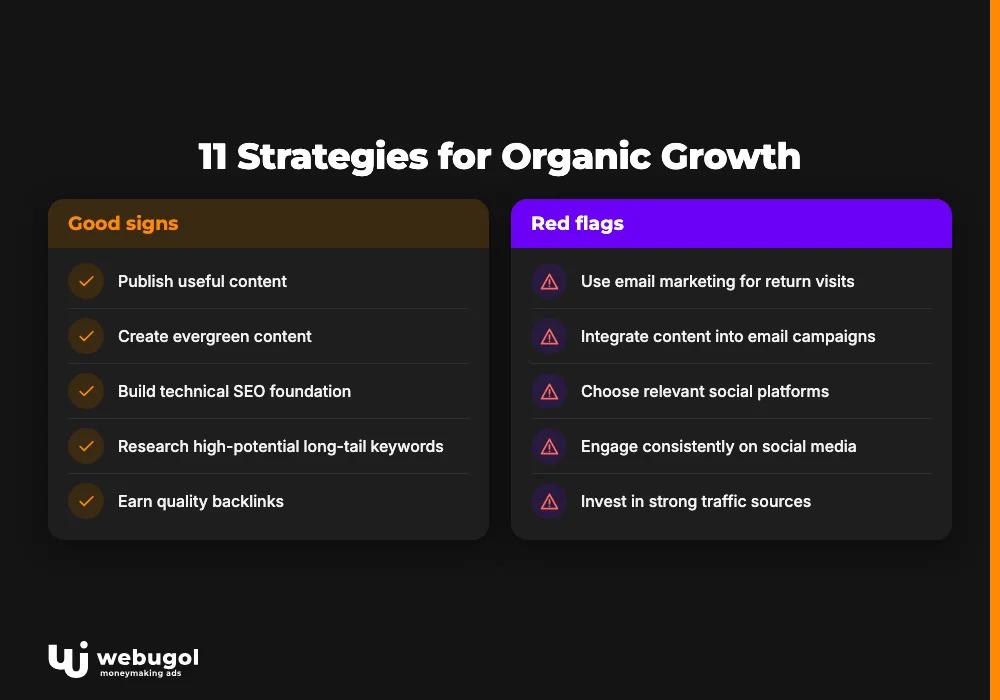
Here is the framework for the eleven strategies this article unpacks:
- Publish useful content that answers real search queries
- Create evergreen content for compounding, long-term traffic
- Build a technical SEO foundation for your site
- Research keywords, including high-potential long-tail terms
- Earn quality backlinks that build domain authority
- Use email marketing to drive return visits
- Integrate content into your email campaigns
- Choose the social platforms where your audience spends time
- Engage consistently and give followers reasons to visit your site
- Identify and invest in your strongest traffic sources
- Track performance so your strategy stays grounded in data
Each of these channels compounds over time. Combining several of them gives you a more resilient traffic base than relying on any single one, and each new strategy you add multiplies what the others already produce.
Build a content marketing strategy that compounds
A content marketing strategy is the foundation of sustainable organic traffic growth. Search engines rank pages that answer real questions thoroughly and accurately. Publishing on a consistent schedule signals that your site is active; covering topics with depth signals that it is worth surfacing to searchers.
Content includes more than written articles. Video, infographics, comparison tools, and downloadable guides all count toward increasing website traffic. The format that works best depends on how your audience prefers to consume information. A financial services company might find long-form articles most effective; a product business might see stronger results from video and visual content.
Useful content that earns and holds attention
Whatever your industry, you have knowledge your audience does not have. The more consistently you share that knowledge, the more entry points you create for organic search traffic. Each piece of content is an additional path into your site, and more paths mean more chances for the right user to find you.
The most effective content solves a specific problem. Vague, broad articles rarely satisfy a clear search intent, so they rarely rank well. A precise answer to a specific question outperforms a general overview in search rankings almost every time. Start planning each piece from the actual query your audience is typing into a search engine, then build the article around answering it completely.
Producing quality content consistently is one of the most reliable ways to increase website traffic over time. Regular publishing also keeps your domain active in Google's crawl queue, which means new content gets indexed faster as your site matures.
Evergreen content for long-term organic traffic growth
Evergreen content stays relevant long after it is published. How-to guides, step-by-step tutorials, product comparisons, and FAQ pages all fall into this category. Because the information remains accurate over time, these pages continue attracting organic search traffic for months or years after publication.
A single well-constructed evergreen page can generate more cumulative visits than a dozen short-lived trend pieces. Evergreen content also gives you an asset you can update periodically, keeping it fresh without rebuilding from scratch. Updating an established page with new information often produces a ranking improvement faster than publishing a brand-new page on the same topic.
Does blogging help increase organic traffic?
Yes, consistently. A blog gives search engines more pages to index, more keywords to associate with your domain, and more reasons to crawl your site regularly. Each post can target a different search query, which multiplies the number of ways users discover you through organic search.
Quality matters far more than volume. A blog post that comprehensively answers a specific question outperforms five thin posts on loosely related topics. Publishing one thoroughly researched article per week is more effective than five superficial ones. The goal is to become the most complete and useful source on the topics your audience searches for.
What types of content drive the most website traffic?
Detailed how-to guides and long-form articles consistently rank well because they satisfy informational intent with depth and specificity. Evergreen reference content, including glossaries, tutorials, and step-by-step processes, accumulates traffic over time because it stays accurate and useful to readers arriving months after publication.
Video content embedded on your site and optimized for search can appear prominently in Google results, adding a visual entry point alongside standard text listings. FAQ pages and comparison articles attract search traffic by matching the specific phrasing users type into search engines. Each format targets a different type of search intent, so a mix of formats covers a wider range of queries.
For a practical look at turning documented client outcomes into search-optimized content, see our guide on turning client results into a content asset.
SEO for websites: technical and editorial foundations
Choosing the right keywords and writing relevant content is one part of a complete SEO strategy to increase website traffic. Search engines also evaluate your site's technical health, page experience, internal link structure, and the quality of external links pointing to it. All of these factors determine whether your pages get crawled, indexed, and ranked in search results.
Technical site health: the prerequisite for ranking
A technically sound site loads quickly on both desktop and mobile, uses a valid SSL certificate, has a responsive design that works across screen sizes, and contains no broken links or error pages. These conditions are the baseline for search engine crawling and indexing. A page that fails on any of these points will struggle to rank regardless of how good the content is.
Site speed warrants particular attention. Slow-loading pages frustrate users and earn lower rankings as a result. Google's page experience signals include loading speed, visual stability, and interactivity, all of which affect where your pages appear for competitive queries. Regular technical audits using webmaster tools help you catch and correct problems before they affect your traffic.
Internal linking, meaning links between related pages on your own site, is another factor that often gets overlooked. It helps search engines understand your content structure and distribute authority from your best-ranking pages to newer or lower-ranked ones. A well-linked site is easier to crawl and faster to index.
Keyword research: targeting queries that matter
Keyword research identifies the exact words and phrases your target audience uses when searching for what you offer. The goal is to find terms with meaningful search volume and manageable competition, then create content that addresses those queries more thoroughly than what is currently ranking.
High-potential topics sit at the intersection of strong search volume, clear audience relevance, and achievable competition levels. Targeting topics where your content can realistically rank gives you organic traffic growth that builds on itself as your library of ranked pages expands. Tracking which keywords send traffic from Google Search Console shows you where to focus next.
Long-tail keywords and higher conversion rates
Long-tail keywords, typically four or more words, carry lower individual search volume but attract more qualified visitors. A user searching a specific, detailed phrase is further along in their decision process than someone searching a broad term. That specificity corresponds to higher conversion rates and more engaged visitors.
Long-tail traffic is also less competitive, which means new pages can rank for these terms faster than for broad, high-volume keywords. Building a base of long-tail traffic creates a stable foundation of engaged visitors while you work toward ranking for more competitive terms over time. This layered approach to SEO for websites is what drives steady, compounding organic traffic growth.
Backlinks and external trust signals
External links from other websites to yours tell search engines that your content is credible and worth referencing. The authority and relevance of linking domains matter far more than raw link count. A single link from a respected, topically relevant publication carries considerably more weight than dozens of links from low-quality directories.
Effective backlink strategies include guest posting on industry publications, being cited as a source in journalism or research, and creating content that others naturally reference, such as original data summaries, comprehensive guides, or tools that solve a common problem in your niche.
Email marketing to drive traffic to your site
Email marketing is one of the most reliable channels to drive traffic to your site, and it is a channel you own entirely. Unlike social media platforms or search rankings, your email list is not subject to algorithm changes or platform policy shifts. That ownership gives you consistent access to your audience regardless of what happens in channels outside your control.
Email marketing remains one of the most effective strategies to increase website traffic because it targets people who are already familiar with your brand. Subscribers have visited your site, shown interest in what you offer, and opted in to hear from you. That existing relationship makes them significantly more likely to return when you send the right message at the right time. The cost efficiency is also a practical advantage: email delivers your content to a large, warm audience at a low per-contact cost, which makes it one of the highest-return channels available.
Using content inside your email strategy
Content and email work together naturally. Sharing a new article, guide, or resource in a regular newsletter gives subscribers a concrete reason to return to your site before they are ready to buy. Repeated, useful contact keeps your brand present throughout a longer decision process and reduces the chance that subscribers forget you exist.
Rather than using email only for promotional messages, treat it as a content distribution channel. Each send can link to one or two pieces of content on your site, bringing a consistent flow of return visitors back through your most important pages. Subscribers who arrive from email tend to be more engaged than cold organic visitors, which also improves your overall site engagement metrics in analytics.
Social media traffic tips: reaching your audience where they are
Social media is part of most users' daily habits, which makes it a meaningful driver of website visitors growth when paired with a deliberate strategy. The approach that works is not to be present on every platform simultaneously, but to be effective on the platforms where your specific audience actually spends time.
Different platforms attract different demographics and favor different content formats. A B2B company often finds LinkedIn most productive for driving qualified traffic; a consumer brand may see stronger results from Instagram or Pinterest. Spreading effort too thin across many platforms reduces impact on each one. Identifying two or three that match your audience profile and investing in those consistently produces better results than a shallow presence across many, and it makes social media traffic tips easier to act on without burning out your team.
Choosing platforms and building an active presence
Once you identify the right platforms, consistency drives results. Create content that fits the specific format and culture of each platform rather than posting identical content everywhere. Video performs differently on TikTok than on LinkedIn; long-form text that earns strong engagement on LinkedIn falls flat on Instagram.
Engaging with comments and conversations, rather than only broadcasting content, increases your visibility within platform algorithms. When users interact with your posts, those posts reach a wider audience at no additional cost. Giving your audience genuinely useful or shareable content extends reach beyond your existing following, helping you increase website traffic across multiple touchpoints without proportionally increasing your effort.
Social media traffic is most durable when it reinforces your other channels. A social post linking to a blog article brings visitors to your site; an email signup prompt on that article converts that social traffic into subscribers on your owned channel. That loop, from social to content to email, is how social media contributes to long-term organic traffic growth rather than just one-off spikes.

What is the fastest way to get traffic to a website for free?
The fastest free methods to increase website traffic are social media engagement and email to your existing list. Posting on active platforms and joining relevant conversations can send visitors to your site within hours of publishing. An email to a healthy list can produce a measurable traffic increase the same day it is sent.
Updating high-performing existing pages is another fast-acting approach. Search engines re-crawl updated content, and strengthened pages can improve their rankings faster than a brand-new page still building authority from zero. Reviewing your top-ranking pages and expanding thin sections often produces improvements within a few weeks rather than the months a new page typically requires.
Organic search takes longer to respond, but it builds the most durable traffic base. New pages can appear in search results within days of being indexed, though competitive rankings typically take months to achieve. Starting with updates to existing content and layering in new content gives you both short-term and long-term returns from the same effort.
How long does it take to increase website traffic?
Organic traffic growth through SEO generally takes three to six months before meaningful results appear, and twelve months or more before a site reaches its potential for competitive keywords. This timeline reflects how long it takes search engines to index your content, assess your site's authority, and move pages upward through rankings.
Social media traffic can arrive faster but requires continuous posting to sustain. Email traffic is the most immediate, delivering results the day a campaign is sent. No channel produces lasting results without sustained effort, and the channels that feel slowest early tend to produce the most durable returns over a longer horizon.
The more accurate framing is that increasing website traffic is a compounding process. Early months produce modest results. As your content library grows, your domain accumulates authority, and your email list expands, each new piece of content performs better than the last because it lands on a stronger foundation. Strategies that produce slow results in months one through three often become a site's dominant traffic source by month twelve or eighteen. Planning for a twelve to twenty-four month horizon, while reviewing shorter-term signals weekly, is the most practical way to stay calibrated and keep the effort consistent.
How do I track where my website traffic comes from?
Analytics platforms, most commonly Google Analytics, show exactly which website traffic sources are sending visitors to your site. The standard channel breakdown covers organic search, direct, referral, email, and social. Each channel report shows how many visitors arrived, how long they stayed, and what actions they took while on your site.
Knowing which channels help you increase website traffic most efficiently lets you allocate time and budget where returns are highest. A channel that sends fewer visitors but drives more conversions or longer session times is often more valuable than one with high volume and low engagement. Raw traffic numbers are a starting point, not the conclusion.
For SEO specifically, connecting your analytics to Google Search Console shows which queries triggered your pages, which pages rank, and where improvements are already happening organically. That data lets you invest more in what is already working rather than guessing at priorities. Reviewing your traffic source breakdown at minimum monthly keeps your content marketing strategy grounded in actual performance.

Optimizing for your strongest website traffic sources
Not every channel performs equally for every business, and investing effort evenly across all of them spreads resources without concentrating results. Your analytics data identifies which sources consistently deliver engaged, converting visitors; once you know, the right move is to invest more in those and pull back from channels that are not producing.
If organic search drives your highest-converting visitors, the priority is more content and stronger technical SEO for websites. If email generates the best return-visit behavior and purchase rates, the priority is list growth and more consistent sends. If one social platform consistently sends qualified visitors while others send minimal or low-quality traffic, consolidating makes sense.
This kind of channel optimization is not a one-time decision. As your site grows and your audience changes, the best-performing sources shift. Revisiting your source analysis monthly keeps your approach grounded in current performance rather than outdated assumptions. Acting on data consistently is what separates traffic growth that plateaus from traffic growth that compounds year over year.
For businesses in specialized sectors where audiences are narrower and content needs differ from general markets, our article on building campaigns for niche markets covers how to adapt these strategies to industry-specific contexts.
Ready to increase website traffic for your business?
Growing your traffic requires a combination of strong content, sound SEO for websites, consistent email outreach, and deliberate social engagement. None of these channels produces results immediately, but each one compounds over time as your content library grows and your domain builds authority in your niche.
The Webugol team works with businesses on exactly this combination: content strategy, technical SEO, email planning, and channel optimization that builds sustainable traffic with measurable outcomes. If you want a clear plan for your site, reach out and we can start with an audit of where you stand and what to prioritize first.
FAQ
How long does it take to increase organic traffic through SEO?
Meaningful organic traffic growth from SEO typically begins appearing after three to six months of consistent effort. Competitive keywords and newer domains often take twelve months or more to reach their full ranking potential.
What is a realistic goal for website visitors growth in the first year?
Growth varies by industry, starting baseline, and investment level. Sites that publish quality content consistently, earn relevant backlinks, and maintain good technical health can see substantial visitor growth within twelve months, though exact figures depend on competitive conditions in your niche.
Does social media directly increase website traffic?
Social media can drive meaningful traffic to your site, but volume depends on your audience size, content quality, and platform algorithm. It works best as a content distribution channel that supports a broader organic traffic growth strategy rather than as a standalone source.
Is paid advertising necessary to increase website traffic?
No. Organic channels including SEO, email marketing, and social media can generate significant traffic without paid ads. Paid advertising can accelerate early-stage results, but a well-executed organic strategy builds more durable traffic over time.
How do website traffic sources affect which visitors convert?
Different sources bring visitors with different intent levels. Organic search visitors arriving through specific long-tail queries often convert at higher rates because they arrived with a defined need. Email subscribers and direct visitors tend to have higher brand familiarity, which also supports conversion.