


Digital marketing water treatment: a B2B strategy guide
Digital marketing water treatment companies use targets a specific audience: engineers, procurement managers, and municipal buyers who research solutions online before speaking with any vendor. The right mix of SEO, content, and paid campaigns generates qualified leads and builds lasting authority in a technically complex market. This guide covers what works and how to prioritize it. Results compound over time.
How to market a water treatment company online?
Water treatment companies that grow online share one approach: they show up where buyers are already searching. That means organic search rankings, targeted paid campaigns, and content that addresses real technical questions.
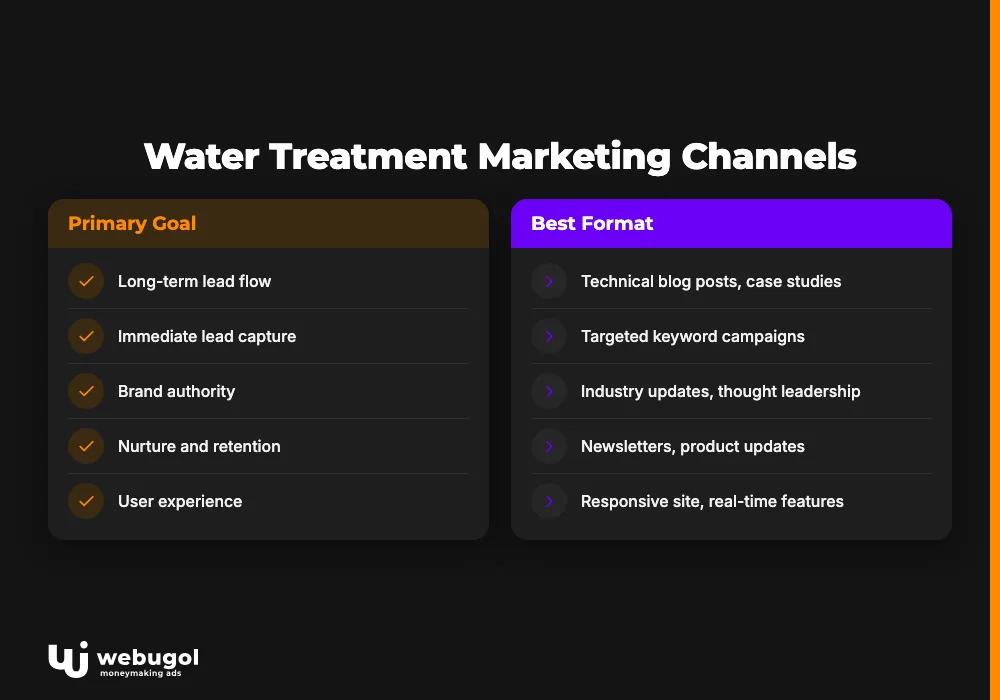
The core channels and their primary roles:
| Channel | Primary goal | Best format |
|---|---|---|
| SEO and organic search | Long-term lead flow | Technical blog posts, case studies |
| Paid search (PPC) | Immediate lead capture | Targeted keyword campaigns |
| LinkedIn and social media | Brand authority | Industry updates, thought leadership |
| Email marketing | Nurture and retention | Newsletters, product updates |
| Mobile optimization | User experience | Responsive site, real-time features |
Each channel reinforces the others. A company with strong water treatment company SEO sees lower cost-per-click on paid campaigns because brand recognition already exists among searchers. Starting with SEO and content, then layering in paid, is the standard order for sustainable growth.
Digital marketing water treatment strategies that generate leads
Content marketing and thought leadership
High-quality blog posts, whitepapers, and explainer videos educate the procurement teams and engineers who research water solutions before any sales conversation begins. Publishing authoritatively on topics like industrial filtration requirements, regulatory compliance, or aging infrastructure challenges builds credibility that outbound sales calls cannot replicate. That gap keeps growing.
The goal is depth, not volume. One well-researched guide on wastewater industry marketing challenges will outperform ten thin posts on general topics. Thought leadership positions a company as the reliable source buyers return to when they are ready to make purchasing decisions.
Social media for industrial buyers
B2B marketing water companies use relies heavily on LinkedIn. The platform allows targeting by job title, company size, and industry sector, reaching the industrial buyers and procurement teams that actually make purchasing decisions.
Sharing regulatory updates, technical comparisons, and application-specific content builds authority with these audiences. Facebook and Instagram support brand awareness but rarely convert industrial buyers directly. A focused LinkedIn strategy consistently outperforms broad social presence for water treatment businesses in the B2B space. Most companies learn this late.
AI-powered customer support and personalization
AI chatbots have improved how water treatment companies handle first-contact inquiries. They respond to common questions immediately, qualify inbound leads, and route complex requests to the right team members without requiring sales staff to be continuously on call.
Personalization adds another dimension. Using customer data, companies deliver targeted email marketing, customized water quality reports, and product recommendations matched to a client's specific application. Each touchpoint strengthens the relationship before a formal proposal is submitted.
What SEO tactics help water treatment companies rank higher?
Search engine optimization underpins the digital marketing water treatment companies depend on for sustainable, compounding lead flow. Organic rankings built today keep generating traffic years from now. That long-term return separates SEO from paid advertising. Organic keeps paying off.
Core priorities for water filtration SEO:
- Keyword research identifies the specific phrases industrial buyers and municipal engineers use when searching, not just broad water-related terms.
- Informative, keyword-rich content satisfies search engines and the technically sophisticated audience reading each page.
- Mobile-friendly optimization matters because engineers and field staff increasingly research from mobile devices.
- Meta tags and descriptive page titles communicate relevance to search engines and improve click-through rates in results.
- Local SEO and technical optimization help companies appear in regional searches where many industrial and municipal water contracts originate.
The same compounding effect that drives long-term search authority for niche technical service businesses applies in water treatment: accurate information across all online listings plus a technically sound site structure that search engines can index without friction.
Water filtration SEO differs from general B2B search marketing because buying cycles are longer and queries are more technical. Optimizing for mid-funnel terms like "industrial water treatment systems for food processing" reaches buyers closer to a purchasing decision than broad awareness terms do. For companies ready to invest in on-page and technical SEO, the returns compound over months as each new ranking brings qualified inbound traffic.
How to generate B2B leads for a water treatment business?
Water company lead generation depends on matching the right message to the right stage of the buyer's journey. Most industrial and municipal buyers complete significant online research before engaging any vendor. The goal is to be present and credible throughout that research process. Credibility wins contracts.
PPC advertising fills the visibility gap while organic SEO builds momentum. Targeted campaigns reach potential clients when they are actively searching. They also deliver insights into user behavior and campaign performance that feed back into the overall strategy over time.
Mobile apps extend the lead-generation funnel for existing clients. Real-time water quality updates, conservation guidance, and product recommendations inside a branded app keep clients engaged and generate referrals. User reviews within the app build public credibility for prospective buyers doing vendor research.
How do water treatment companies attract industrial clients?
Industrial clients respond to demonstrated expertise. Case studies showing measurable operational results for comparable facilities carry more weight than any general marketing claims. Specifics close deals. Testimonials from municipal or industrial clients who can speak to actual outcomes close the credibility gap faster than promotional content.
Industrial water marketing also needs to address the misconceptions that slow purchasing decisions. Buyers sometimes assume existing infrastructure is adequate or that alternative options suffice. Educational content that addresses these assumptions with clear evidence moves prospects through the funnel more efficiently.
In a saturated market, local search optimization for service businesses in regulated industries follows the same logic that applies to industrial water: it is not enough to have the right solution. Buyers need to find it. A cleantech marketing agency approach makes differentiators unmissable, putting certifications, environmental performance metrics, and proprietary technology features front and center across every channel.
Start building your digital marketing water treatment strategy
Webugol builds digital marketing programs for technical and industrial service businesses, including water treatment companies looking to attract more qualified B2B leads. The approach starts with the channels your buyers already use and builds a measurable pipeline from there.
Contact us to discuss what a focused industrial water marketing program looks like for your specific goals.
FAQ
What is digital marketing for water treatment companies?
Digital marketing water treatment companies use includes SEO, content marketing, paid advertising, and email campaigns designed to reach industrial and municipal buyers. These channels work together to build authority and generate qualified leads in a technically complex market. The approach differs from consumer marketing because buyers conduct extensive research before engaging any vendor.
What SEO strategies work for water treatment companies?
Water treatment company SEO focuses on ranking for the specific technical queries that engineers and procurement managers use when researching solutions. On-site content optimization, local SEO, and quality backlinks all contribute to ranking in competitive searches. Companies that invest in consistent, technically accurate content see the strongest long-term results.
How do water treatment companies generate B2B leads online?
Water company lead generation online combines organic search, PPC campaigns, and LinkedIn outreach to reach buyers at different stages of their research. PPC captures buyers with immediate purchasing intent while organic content builds authority over time. Mobile optimization and AI-powered support tools improve conversion rates by making the buyer experience faster and more responsive.
What makes wastewater industry marketing different from other B2B sectors?
Wastewater industry marketing addresses buyers with highly technical backgrounds and long procurement timelines, often involving multiple stakeholders and regulatory requirements. Content must demonstrate genuine technical expertise to earn trust. Generic B2B marketing frameworks tend to underperform because they do not address the specific operational concerns of water and wastewater procurement teams.
Is a cleantech marketing agency a better fit for water treatment companies?
A cleantech marketing agency brings familiarity with industrial and environmental regulatory language, typical buyer personas, and the longer sales cycles that water treatment companies face. General agencies can struggle to produce technically credible content or target the right procurement audiences. The fit between agency expertise and industry context matters more than agency size alone.