



The 4-cause triage every healthcare marketer needs before Monday's meeting
If you are asking why did my conversions drop, the fastest answer comes from one of four causes: a market shift, a platform policy change, a broken tracking implementation, or a site change that degraded the funnel. The 90-minute cross-check below uses data sources you already have read access to. Getting the diagnosis wrong means spending another two weeks chasing the wrong fix, and that damages your budget case in the meeting where you have to explain the number.
Did your conversions drop, or did your tracking stop firing?
The two look identical in every dashboard. Treating one as the other is the most expensive diagnostic error in healthcare paid media. Your ad platform can show zero conversions while every booking slot is full; your CRM can show a full pipeline while GA4 reports no events. The number that moved is not necessarily the number that matters.
Each platform fails differently. When GA4 tracking breaks, the ad platform's pixel keeps firing, so both numbers diverge. When the ad platform pixel breaks, attribution disappears but bookings continue in the CRM. When the CRM webhook breaks, your ads look expensive on paper while actual patients are real. Reading one dashboard in isolation guarantees the wrong diagnosis.
This is why the first step is not adjusting bids. It is running the cross-check below.
The 10-minute cross-check: platform vs. GA4 vs. CRM
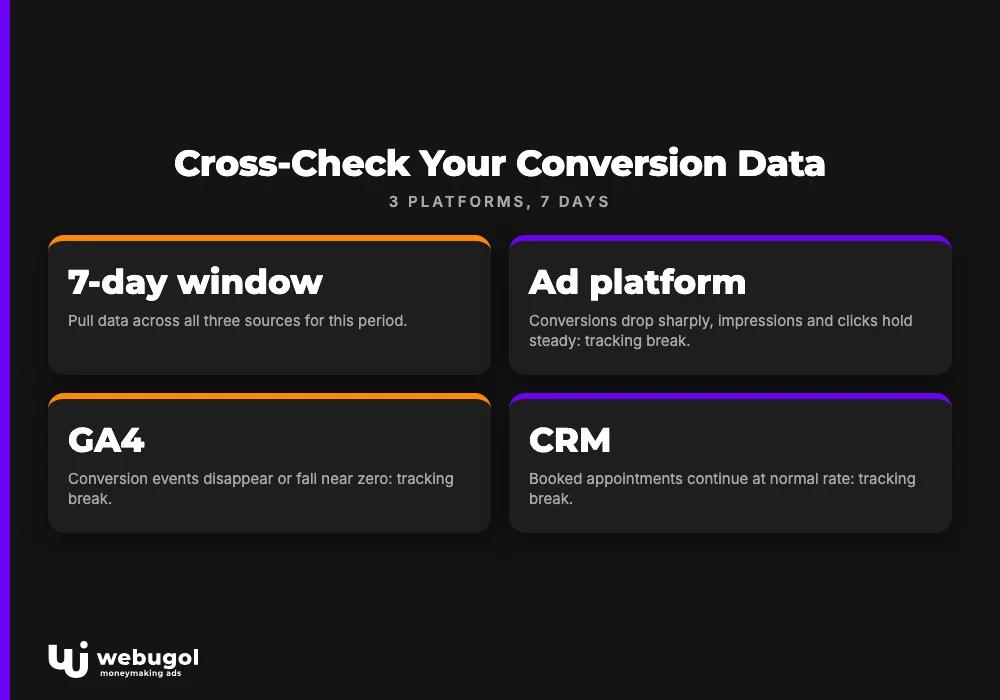
Pull the same 7-day window across all three sources before touching any campaign setting.
| Data source | What a tracking break looks like | What a real booking drop looks like |
|---|---|---|
| Ad platform (Google/Meta) | Conversions drop sharply; impressions and clicks hold steady | Conversions drop alongside click volume or CVR decline |
| GA4 | Conversion events disappear or fall near zero | Sessions drop and goal completions decline proportionally |
| CRM (HubSpot / GoHighLevel / ActiveCampaign) | Booked appointments continue at normal rate | Booked appointments decline and match the ad platform signal |
A divergence between ad platform and CRM is a tracking problem. Matching declines across all three signal a real funnel or demand problem. Any middle pattern tells you where in the handoff chain the break occurred.
The 4-cause differential: market, platform, tracking, site
Narrowing down why did my conversions drop to one of four causes takes about 90 minutes with the right data access. Each cause has a testable signature using only sources a Head of Marketing typically controls or can request without filing a dev ticket. The goal is a defensible written hypothesis before the meeting, not a full fix.
Cause 1: external demand shifted (market)
Check impression share trends in the ad account first. If budget is constant but impressions declined, demand in the auction dropped. Cross-reference with Google Trends for your service category and seasonal patterns from the same period last year.
Seasonal softness and structural demand shift require different language in Monday's briefing. Seasonal softness resolves on its own; structural shift means your offer or targeting needs recalibration. The key signal is whether competing advertisers also lost impression share or only your account was affected.
Can a platform policy change cause a conversion drop in healthcare ads?
Yes, and in healthcare it is the second most common silent cause after tracking breaks. Google and Meta health policy updates, consent mode enforcement, and PHI-adjacent audience restrictions cut attribution without touching account structure. The platform reports conversions down with no account-side explanation, because compliance owns the actual cause, not marketing.
Specific triggers include Google's health and medicines advertising policy updates, Meta's restrictions on healthcare audience targeting, and consent mode v2 enforcement that reclassifies previously attributed conversions. If your policy status changed in the last 30 days or a consent banner update went live, this is cause two rather than cause four.
Cause 3: tracking break after a deploy or CRM migration
This is the only cause where bookings are real but the numbers are wrong. It is also the cause most likely to have been silently running for weeks before the meeting forced the investigation.
Three things to check without needing developer queue access: the GA4 event stream in DebugView for missing or misfiring conversion events, the conversion event status in the ad platform's conversion action manager, and the correlation between any recent deploy and the first day numbers dropped. Ask your developer for the deploy log, specifically a date, not a code review. If the drop date matches a deploy within 24 hours, you have the diagnosis. For a clear picture of which GA4 roles allow conversion event inspection without elevated permissions, the Google Analytics roles and access breakdown outlines exactly what read-only access covers.
Cause 4: a funnel or site change degraded the conversion rate
Booking flow steps added. Landing page swapped. Required form field introduced. Phone number removed from mobile. These changes degrade conversion rate without touching ads, and in many healthcare marketing teams the marketer was not informed of the change until the reporting period ended.
Use read-only analytics to compare step-by-step drop-off in the booking funnel before and after the suspected change date. The most common version in healthcare is an intake question added to pre-qualify patients that also disqualifies otherwise good leads. Flag the drop date and the publish event to whoever manages site changes.
How do I know if my conversion tracking is broken?
Compare conversion event counts in GA4 versus the ad platform for the same 7-day window. A gap greater than 20 percent warrants tracking investigation before any campaign changes. Three checks to run before looping in a developer: GA4 DebugView against a live test booking, the conversion action test tool in Google Ads, and the offline conversion upload log if your CRM uses server-side attribution.
The most reliable anchor is the CRM. If it shows appointments and the ad platform does not, tracking is broken. If both are down, the problem is real.
If you have not mapped how the full journey connects from ad click to CRM record, the gap between ad platform and CRM widens at every team handoff. A patient journey handoff and attribution review shows exactly where attribution falls out between acquisition and confirmed booking, which is usually the first place the three numbers stop agreeing.
What to fix first, and what to stop blaming the ad account for
The reflex to pause campaigns before the cause is confirmed costs lead volume you cannot recover. Here is the priority order once diagnosis is in hand.
- Fix or escalate the tracking break before touching campaign settings. Running on broken data makes every optimization decision directionally wrong.
- Flag a platform policy attribution cut to whoever manages compliance reporting. This is not a marketing fix; misrouting it costs two weeks.
- File a specific, dated bug report for any funnel or site change that correlates with the drop. Vague reports go to the bottom of the dev queue.
- Document a confirmed market shift as an external baseline for the next reporting period. It belongs in the brief as context, not as a gap to close.
The ad account is the most visible number in the room. It is rarely the cause.
What to bring to Monday's meeting
Buyer 2's job in that meeting is not to confess a problem. It is to demonstrate a diagnosis. That distinction is the difference between defending a budget and losing one.
The root question every stakeholder is asking is why did my conversions drop; the briefing that answers it names a cause, names an owner, and gives a timeline in days. Lead with the three-source cross-check result: "GA4 and CRM show different patterns, which points to a tracking break rather than a real decline in bookings." That one sentence repositions the conversation from "performance is bad" to "we identified a measurement problem and here is who fixes it."
If the cause is a confirmed tracking break, the sentence that matters most is: "Bookings have not dropped. Attribution has." That distinction defends the budget and the channel at the same time.
Webugol builds acquisition systems where tracking integrity is a first-week foundation, not a periodic audit item. When this meeting happens, it usually means a structural gap got exposed, not that a campaign underperformed.
Stop diagnosing in spreadsheets: get a system that owns the numbers
If the 90-minute triage uncovered a tracking or attribution gap that has been silently running, it is a structural problem in the acquisition system. One-time fixes defer the problem to the next deploy or platform update.
The pattern across telehealth clients is consistent: diagnostic uncertainty is the first thing removed, not the last. Tracking integrity, funnel visibility, and CRM attribution get established in weeks one and two, before campaign optimization and before scaling spend. What that removes is not just a bad dashboard number. It removes the weekly coordination cost of reconciling three sources of truth that were never designed to agree.
If your cross-check surfaced a gap you do not have system access to close, a tracking-first acquisition sprint starts with exactly that audit. Book a strategy call to see where the gap sits in your specific setup.
FAQ
Why did my conversions drop overnight?
An overnight drop almost always points to a tracking break, a platform policy enforcement event, or a site change that went live the previous day. Check whether your CRM shows the same drop before treating the number as real. If the CRM is flat while the ad platform dropped, bookings did not decline; the attribution did.
How do I know if my conversion tracking is broken?
Compare GA4 conversion events against your ad platform conversions and your CRM bookings for the same 7-day window. A gap larger than 20 percent between any two sources is the threshold for a tracking investigation. The fastest confirmation is GA4 DebugView run against a live test booking.
Can a site deploy cause a conversion drop without any changes to the ads?
Yes. A deploy that modifies the booking flow, removes a tracking tag, changes a URL structure, or updates consent mode settings can break attribution without touching the ad account. The clearest indicator is a drop that starts within 24 hours of a deploy timestamp.
Which conversion number should I trust: Google Ads, GA4, or my CRM?
Trust the CRM for actual bookings, GA4 for funnel behavior, and the ad platform number for optimization only after it aligns with both. When all three disagree, start with the CRM as the source of truth for what actually happened, then work backward to find where attribution broke.
How long does it typically take to fix a tracking break in a healthcare ad account?
A simple tag misfiring gets resolved in one to two hours once identified. A server-side attribution gap or CRM webhook break typically takes one to three days depending on developer availability. The longer timeline is almost never the fix itself; it is the diagnosis queue, and running the 10-minute cross-check cuts that queue before it starts.

