



B2B mobile marketing: strategy guide for business growth
B2B mobile marketing is the practice of reaching business buyers and decision-makers through mobile channels: SMS, push notifications, mobile-optimized websites, and client-facing apps. Without a deliberate mobile approach, competitors reach buyers in the research windows that determine the shortlist before you get a chance to present. This guide covers which channels matter for B2B, how the approach differs from consumer tactics, and what building a strategy that generates actual pipeline looks like.
What is mobile marketing for B2B companies?
B2B mobile marketing applies mobile touchpoints to complex, multi-stakeholder purchase decisions. The full scope covers SMS marketing for business outreach, push notification campaigns inside client products, mobile-friendly website design built for search and conversion, location-based marketing at conferences and trade events, and mobile app engagement tools tied to ongoing client relationships.
The business logic is direct. B2B buyers research vendors, compare solutions, and respond to outreach on their phones during travel, between meetings, and outside office hours. It meets those buyers in those moments. Done consistently, this approach shortens evaluation cycles and keeps your brand present throughout. Miss those windows and a competitor picks up the conversation instead.
For companies on a growth trajectory, this is not a new channel to stack on top of existing activity. Mobile is already where most buyer interactions happen. The only question is whether those interactions are working for your pipeline.
How does B2B mobile marketing differ from B2C?
B2C mobile campaigns target a single buyer making a fast, often emotional purchase. B2B mobile marketing must reach a buying committee where each member evaluates your offer through a different lens.
A CFO weighs cost justification. A department head assesses workflow fit. A procurement team checks compliance documentation. All three use their phones. None of them should receive the same message.
That structural difference changes every lever. B2B mobile marketing requires lower send volume, tighter targeting, and longer cycle planning than consumer campaigns. One well-timed SMS to a decision-maker mid-evaluation carries more weight than a hundred generic broadcasts. Role-specific content, meaning messages that reflect whether the recipient is an economic buyer, a technical evaluator, or an end user, is what separates campaigns that advance deals from campaigns that get deleted.
Privacy requirements apply to B2B programs without exception. GDPR and equivalent regional data protection regulations treat business contact data the same as consumer data. Many B2B companies build mobile programs without the consent infrastructure consumer-facing teams already have in place. That gap creates real legal exposure.
What are the best mobile marketing channels for B2B?
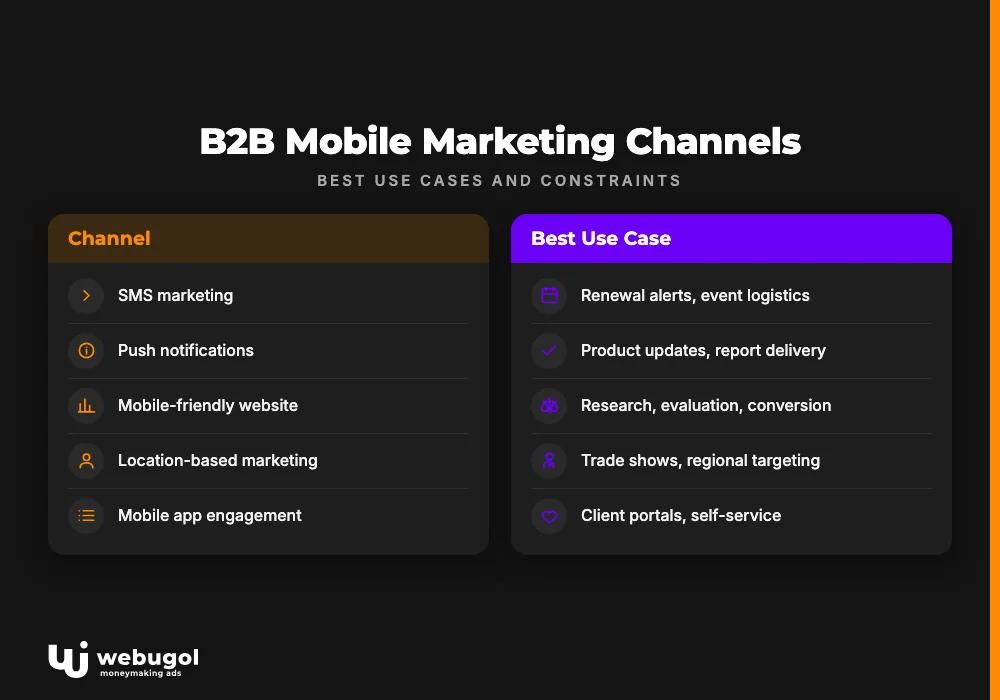
The right channel depends on the stage of the buyer relationship and what action you are trying to drive. Here is a practical breakdown of the five that matter most:
| Channel | Best use case | Key constraint |
|---|---|---|
| SMS marketing for business | Renewal alerts, event logistics, urgent follow-up | Low volume; explicit permission required |
| Push notification campaigns | Product updates, report delivery, re-engagement | Requires app or web-push opt-in |
| Mobile-friendly website | Research, evaluation, and conversion at all stages | Speed and UX must match desktop quality |
| Location-based marketing | Trade shows, conferences, regional targeting | Requires GPS opt-in |
| Mobile app engagement | Client portals, self-service, onboarding | High build cost; ROI depends on active usage |
A well-built B2B mobile marketing program layers these channels by buyer stage, not by which are easiest to deploy.
SMS marketing for business outreach
SMS reaches contacts directly, bypassing inbox clutter. For time-sensitive communication, text messages consistently outperform email in open and response rates across active B2B deployments. That advantage disappears if frequency gets too high. SMS marketing for business works best for appointment reminders, event day logistics, contract milestones, and one-to-one follow-up sequences triggered by specific sales activity.
Keep messages short. A message that requires the recipient to figure out what to do with it gets dismissed.
Push notification campaigns for client retention
Push notification campaigns produce results inside environments where the buyer has already committed: a SaaS product, a client portal, or a content subscription. A push saying "Your quarterly usage report is ready" is useful. A push to a cold prospect with no prior context is noise.
Once a contact dismisses a push and revokes permission, that channel closes for them permanently. There is no second chance.
Mobile-friendly website design as a revenue foundation
Most B2B vendor research starts on a phone. Search engines rank mobile-friendly websites above desktop-only counterparts, which means weak mobile UX hurts discoverability before a prospect reads a single word. A responsive design that loads in under three seconds, adapts to screen size, and presents CTAs a thumb can tap without zooming is a baseline requirement, not a competitive edge.
For companies on legacy CMS infrastructure, performance is the first obstacle. A headless CMS architecture decouples content delivery from the presentation layer, making it easier to serve fast, consistent mobile experiences without the constraints of a monolithic platform. That is where development and marketing converge. A fast, well-built site is the prerequisite for every mobile channel above it.
Location-based marketing at industry events
Location-based marketing uses GPS data to deliver messages when a buyer is near a relevant location: a conference floor, a regional trade show, or a client office. For B2B, the highest-value use cases cluster around industry events. An alert sent to registered attendees on event day drives booth traffic more reliably than a broadcast email sent two days before.
Explicit GPS opt-in is required. Business buyers grant it when the value is clear and the brand has already built enough trust to make the request reasonable.
How do you build a B2B mobile marketing strategy?
A B2B mobile marketing strategy starts with audience segmentation, not channel selection. Identify which roles in your target accounts use mobile for vendor research and work-related decisions before deciding where to show up.
A field operations manager behaves differently from a VP of Finance approving a purchase. Their mobile habits differ. Their content needs differ. Marketing directors who skip this step and choose a channel first end up with a program that reaches the right people with the wrong message at the wrong time.
A working build sequence:
- Audit existing touchpoints first. Open your website on three different phones. Open your outbound emails on mobile. If you have a client portal, use it on a small screen. Fix what is broken before adding channels.
- Segment by role and buying stage. Cold prospects need mobile-optimized landing pages. Active evaluators need fast document access and direct communication. Existing clients need service notifications and renewal nudges.
- Start with two channels. Splitting budget across SMS, push, in-app, and location programs simultaneously produces thin results everywhere. Pick two that match your highest-priority buyer segment. Run a 60- to 90-day pilot with defined metrics.
- Define ROI before launch. How many SMS messages converted to booked meetings? How many push notifications drove product activation? Connect those definitions to CRM data before the first message goes out.
- Build compliance from day one. Consent records, opt-out flows, and data retention policies belong in the architecture. Review GDPR and applicable regional requirements before launch, not after a complaint.
- Analyze and adjust each cycle. The analytics show which message types, send times, and content formats drive action from your specific audience. Cut what is not working. Scale what is.
Personalization compresses the cycle. Generic outreach gets ignored. A message that references the buyer's specific product tier, industry, or a prior interaction generates a different response than broadcast copy. Most SMS and email marketing platforms support basic dynamic fields. Use them.
Paid mobile search also belongs in the stack. Understanding how Google Ads fits a broader mobile strategy helps allocate budget between intent-driven acquisition and relationship-driven retention without overlap.

Do push notifications work for B2B marketing?
Yes, under specific conditions. They generate strong engagement when the audience has opted in through a product or portal they actively use. The condition is relevance: every notification must connect to something the recipient cares about, not a marketing goal wrapped as a system alert.
Push notification campaigns work well for:
- Feature release announcements to current customers
- Status updates on active service requests or open deals
- Content alerts for a subscribed knowledge base or report series
- Re-engagement of dormant users in a B2B SaaS product or client portal
Push does not work as cold outreach. B2B buyers who receive an irrelevant push will dismiss it and revoke permission permanently. In well-run programs, push is earned through mobile app engagement and product value first. The rule is consistent: earn the opt-in, then use push to extend that value. Not to create it from nothing.
Challenges that stop B2B mobile programs from scaling
Four problems show up consistently in B2B mobile marketing programs that stall before they generate pipeline:
Platform fragmentation. Android and iOS handle push permissions, notification rendering, and link behavior differently. What works cleanly on one operating system can break on the other. Test every mobile touchpoint across both platforms before any campaign goes live.
Privacy and consent gaps. A mobile program without proper consent documentation is a compliance liability. GDPR violations carry the same penalties for B2B mobile programs as for any other data handling failure. Consent records, opt-out flows, and data retention timelines need to be in the architecture before launch.
Messaging that misses. Business buyers are busy. A message not immediately relevant to their current priority gets deleted without a second look. Tight segmentation and direct language solve this. Your analytics show which message patterns correlate with action. Follow the data rather than assumptions about what buyers want to read.
ROI tracking gaps. Most teams can report send volume and open rates. Fewer can trace a closed deal back to the SMS sequence that kept the buyer engaged during a 90-day evaluation. Closing that loop requires connecting mobile engagement data to CRM deal records, not just marketing dashboards.
Resource constraints are real for most B2B teams. A focused pilot on two channels with clear metrics and a 90-day review date produces more actionable data than a broad deployment that generates inconclusive results across five channels at once.

Stop losing pipeline to mobile-ready competitors
B2B marketing directors whose mobile programs deliver weak results are usually missing the same thing: a connected system where mobile touchpoints feed back into the full growth engine rather than running in parallel to it. A well-timed SMS that links to a slow-loading page wastes the open. A push notification that sends a prospect into a poor mobile experience loses the click. The approach works when the entire path from first touch to conversion is designed together.
At Webugol, we build websites that grow and the marketing systems that drive them. From mobile-optimized web infrastructure to the marketing systems that connect it to your pipeline, we design and execute the full stack as one connected system. If it is not converting into pipeline, the problem is usually upstream. Talk to our team to find it.
FAQ
What is B2B mobile marketing?
B2B mobile marketing uses mobile channels, including SMS, push notifications, mobile-friendly websites, and client-facing apps, to reach business buyers across a multi-stakeholder purchase cycle. It targets complex, long-cycle decisions rather than impulse purchases, and requires tighter targeting and stricter compliance than consumer mobile programs.
How does mobile marketing improve B2B lead generation?
Mobile marketing places your brand in front of buyers during the research and evaluation phases, which increasingly happen on phones rather than desktops. Timely, role-specific messages through SMS and push notification campaigns reduce response lag and move qualified buyers toward a sales conversation faster than inbound-only approaches.
What compliance requirements apply to B2B mobile marketing?
GDPR and regional data protection laws apply to business contact data the same way they apply to consumer data. Consent records, clear opt-out options, and documented data retention policies are required before launching any mobile marketing program targeting business buyers.
Do small B2B businesses benefit from mobile marketing?
Yes. Mobile-friendly website design and SMS marketing for business produce results without large budgets or dedicated teams. A focused, permission-based SMS program targeting a defined buyer segment consistently outperforms higher-volume email campaigns for time-sensitive outreach.
How do you measure B2B mobile marketing ROI?
Connect mobile engagement data to CRM records and track business outcomes: meetings booked from SMS campaigns, deal velocity for contacts receiving active push notification campaigns, and conversion rates on mobile landing pages. Cost per qualified opportunity matters more than open rates or click volume.

