



Launching an Online Peptide Clinic: Compliance, Funnel Architecture, and Patient Acquisition That Scales
An online peptide clinic is a telehealth business where licensed prescribers consult patients remotely, review lab results, and route prescriptions to 503A or 503B compounding pharmacies for direct-to-patient delivery. Every founder entering this model faces three problems simultaneously: establishing telehealth compliance and state prescribing authority, navigating compounding pharmacy constraints on which peptides are legally prescribable, and running paid acquisition on Google and Meta platforms whose health policies reset on a short cycle. Getting any one of these wrong before launch does not create a temporary delay. It creates a structural dependency that costs revenue from the first week.
What is an online peptide clinic?
It is a telehealth operation where a licensed clinician evaluates a patient remotely, reviews labs, and prescribes peptide protocols that a 503A or 503B compounding pharmacy compounds and ships directly to the patient. The model has no physical intake point, no on-site dispensing, and no geography tied to a single address.
That structural difference from an in-clinic setup is also a compliance variable. What it requires from day one: a HIPAA-compliant telehealth platform, a licensed prescriber with valid prescribing authority in every state served, a compliant compounding pharmacy partner, and a patient intake system that handles consent and medical documentation before any consult.
How it works: from consult to patient delivery
The patient journey runs five stages, and each is a potential break point for the operator.
- Intake and consult: the patient submits an intake form; the provider reviews health history, goals, and eligibility
- Lab work: baseline bloodwork is ordered and results reviewed before any protocol is finalized
- Prescription: the provider documents clinical rationale and writes a compliant prescription
- Compounding pharmacy fulfillment: a licensed 503A or 503B pharmacy compounds and ships the peptide
- Ongoing monitoring: the provider reviews patient response and adjusts the protocol at scheduled intervals
The consult-to-intake handoff is the first conversion point founders consistently under-engineer. Without purpose-built patient intake software, provider time disappears into administrative tasks and no-show rates climb before the first paid acquisition dollar is spent.
Approaching each stage as a patient journey mapping problem, not just a clinical workflow, separates operators who launch cleanly from those who rebuild under revenue pressure.
What to expect at the telehealth consult stage
Three elements are non-negotiable from a compliance standpoint: a prescriber licensed in the patient's state at the time of the consult, documented medical necessity for the prescribed compound, and an interaction format that meets the applicable state's telehealth standard of care. If the prescriber is not licensed in the patient's state, the prescription is not valid and no licensed pharmacy will fill it.
Injectable vs oral peptides: what operators need to know
Injectable peptides typically show higher bioavailability than oral formulations. Peptides degrade in the digestive tract before absorption. For operators building a formulary, the choice between formats is both a clinical and an operational decision.
Injectable protocols require patient training for self-administration, adding support burden and potentially affecting adherence in some populations. Oral formats lower that friction but may require higher dosing for comparable effect, and clinical data for oral delivery is thinner on most compounds. Under current 503A and 503B compounding rules, both formats are available, but regulatory scrutiny varies by compound and tightened meaningfully after 2024.
How much does online peptide therapy cost in 2026?
Pricing runs in two models: membership-based subscriptions and per-protocol flat fees. No top-five competitor has an H2 on this question, which is exactly why patients search for it without finding a direct answer.
Membership-based online peptide therapy clinics bundle consult fees, monitoring, and compound costs into a monthly or quarterly subscription. Per-protocol models price by peptide stack, which can lower the entry price for a single compound but increase total cost for complex programs.
For operators, the compounding pharmacy cost structure directly affects margin. Clinics running GLP-1 adjacent protocols alongside recovery or longevity compounds carry a very different cost profile from clinics built around a narrow formulary. Surfacing price before the consult consistently improves conversion compared to gating it behind intake.
Is it legal to prescribe peptides online?
Yes, with conditions. Telehealth peptide prescriptions are legal where the prescriber holds valid licensure in the patient's state, the interaction meets that state's standard of care, and the specific compound is permissible under current FDA rules.
The legal picture shifted materially after the FDA's 2024-2025 bulk-drugs list updates.
Compounded vs FDA-approved peptides: what operators must understand
Peptides fall into three regulatory categories. First, FDA-approved drugs with established prescribing pathways. These cannot generally be compounded under 503A/503B rules except during shortage conditions. Second, peptides on the active 503B bulks list. Compounding pharmacies may produce these under defined oversight standards. Third, peptides removed from or never accepted for compounded status.
BPC-157 is currently in a contested regulatory position after the FDA proposed removing it from acceptable compounding ingredients. PT-141 (bremelanotide) now exists as an FDA-approved drug (Vyleesi), which restricts 503A compounding pathways. CJC-1295 also faces closer scrutiny.
Operators who built formularies before 2024 should conduct a compliance review before scaling ad spend. A disapproved ad is recoverable. A prescription filled with a non-compoundable substance is not.
The technology layer is part of this compliance chain. Running a sound prescribing workflow depends on hipaa compliant telehealth platforms that document interactions, handle patient consent, and produce auditable records if prescribing authority or compliance is ever reviewed.
Which states allow telehealth peptide prescriptions?
Most states have adopted prescribing parity rules that allow telehealth prescriptions under the same conditions as in-person encounters, though several retain requirements for a prior in-person examination before initiating a new patient relationship. Adding a new state means confirming the prescriber's licensure in that state, verifying the interaction format qualifies under that state's standard of care, and reviewing platform compliance for that jurisdiction. That is an operational step with real legal weight, not an administrative checkbox.
How to choose an online peptide clinic: 7-point checklist
Patients apply seven criteria when evaluating clinics. For operators, this is the product checklist. Each point a clinic fails is a patient who converts elsewhere.
- Provider credentials: Is the prescriber licensed in the patient's state? Do they hold relevant specialty training?
- Compounding pharmacy sourcing: Does the clinic name a licensed 503A or 503B pharmacy partner?
- State coverage: Is the patient's state confirmed as covered before intake begins?
- Pricing transparency: Is cost surfaced before the consult, or disclosed only after a booked appointment?
- Intake friction: How many steps exist between first visit and a confirmed consult?
- Monitoring protocol: Is there a documented follow-up schedule, or does the relationship end at fulfillment?
- Refund and cancellation policy: Is it in writing and accessible before any charge occurs?
Red flags to watch: unnamed compounding source, no visible prescriber credentials, pricing gated entirely behind intake, and no follow-up protocol described anywhere on the site.
Best online peptide clinics compared (2026)
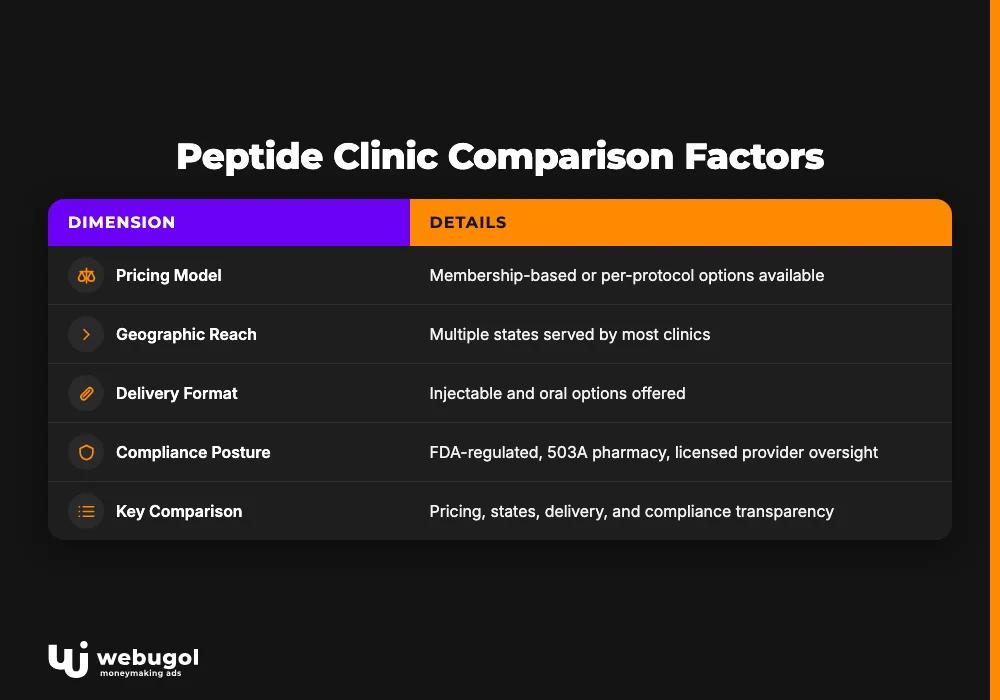
Patients researching a peptide clinic online compare across four dimensions: pricing model, geographic reach, delivery format, and compliance transparency. No top-five competitor offers a side-by-side view. That gap is what this table closes.
| Clinic | Pricing model | States served | Delivery format | Compliance posture |
|---|---|---|---|---|
| Ways2Well | Membership-based | Multiple states | Injectable + oral | FDA-regulated manufacturing, third-party tested |
| Nava Center | Membership-based | 15 states | Injectable + oral | Telehealth + 503A pharmacy fulfillment |
| RegenMD | Membership / per-protocol | Multiple states | Injectable + oral | 503A sourced, documented formulary |
| Bowery Clinic | Per-protocol | Multiple states | Injectable | Named 503A pharmacy partners |
| Relive Health | Protocol-based | Multiple states | Injectable | Licensed provider oversight |
State coverage and formulary availability change as FDA rules evolve. Verify current availability directly with each clinic before patient-facing decisions.
What growing online peptide clinics do differently
The clinics that scale past significant revenue thresholds are not running more ads. They have built a compliant acquisition system with end-to-end visibility from the first ad impression to recognized revenue, treating compliance as the foundation the funnel is built on.
The same fragility that makes this model hard to launch is what stalls a mature clinic at its growth ceiling. A founder launching without a tracking-first intake system repeats a structural mistake that every high-volume operator had to unwind under revenue pressure. The launch problem and the scaling problem are the same problem at different revenue numbers. That is the structural bridge between the operator just starting and the CMO trying to push past a plateau.
What separates growing clinics is not a tactic. It is owning the full revenue path: ad click, intake handoff, consult conversion, follow-up protocol, and renewal, all measured at each stage by a single accountable team rather than four vendors each defending their own scope.
Building patient acquisition systems that survive compliance cycles means designing for the FDA policy update that will come, not just the one that just passed. It means having attribution that shows exactly where the breakdown is when a platform policy hits the ad account.
Webugol owns that full revenue path as one accountable system. What you stop losing is diagnostic uncertainty, coordination overhead between vendors, and the revenue that disappears every time a break falls between vendor scopes.
Book a strategy call with Healthcare Growth System and build the acquisition infrastructure this model needs before scaling spend.
Ready to build an online peptide clinic that scales?
Compliance, funnel architecture, and patient acquisition solved independently keep generating the same problems on a cycle. The FDA policy landscape changes. Ad platforms update health policies. Intake friction compounds at every stage. Each is manageable when one accountable team owns the full revenue path from first impression to enrolled patient.
Healthcare Growth System is Webugol's 90-day Direct-to-Patient Growth Sprint: strategy and funnel foundation in month one, tracking infrastructure and campaign launch in month two, daily optimization and retention systems in month three. Book a strategy call.
FAQ
What is an online peptide clinic?
An online peptide clinic is a telehealth operation where a licensed prescriber evaluates patients remotely, orders lab work, and prescribes peptide protocols that a 503A or 503B compounding pharmacy compounds and ships directly to the patient. The model requires no physical location and can serve patients across multiple states where the prescriber holds valid licensure.
Is it legal to get peptides prescribed online?
Telehealth peptide prescriptions are legal where the prescriber holds valid state licensure, the interaction meets the applicable state's standard of care, and the prescribed compound is currently permissible under FDA compounding rules. The FDA's 2024-2025 bulk-drugs list changes materially affected which peptides can be legally compounded, so operators should audit their formulary against the current list.
How much does online peptide therapy cost in 2026?
Pricing depends on the model: membership-based clinics bundle consults and compound costs into a monthly or quarterly fee, while per-protocol models price by individual peptide stack. Total cost varies with formulary complexity and the compounding pharmacy's cost structure for each compound.
What peptides are available from an online clinic?
Common protocols include CJC-1295, ipamorelin, BPC-157, and thymosin alpha-1, though availability depends on the clinic's formulary and current FDA compounding rules. Compoundable status for several specific peptides changed after 2024-2025 FDA bulk-drugs list revisions, so confirming availability through a licensed 503A or 503B pharmacy is essential before any prescription is written.
How do I know if an online peptide clinic is legitimate?
A legitimate clinic will name its prescribers with verifiable state licensure, disclose its compounding pharmacy partner by name, and describe its follow-up monitoring protocol. If pricing is hidden until after the consult, prescriber credentials are not visible, or the compounding source is unnamed, treat those as disqualifying signals.

