



React JS Web Development Company Built to Grow Your Product
A react js web development company designs, builds, and maintains web applications using the React library, from component architecture to production deployment. The right partner does more than ship code. They align the product with your acquisition and retention goals from day one, then stay accountable after launch. Accountability rarely comes standard. This guide covers how to evaluate vendors, what React projects realistically cost, and what separates a growth-focused development partner from a team that only ships code.
Why React JS for your product?
React has become the default front-end choice for product-driven businesses. Its component architecture lets teams build fast, reusable UI without rewriting the same logic across pages or features. For a founder or marketing director, that translates to shorter release cycles, lower maintenance overhead, and a codebase that scales as your product does.
Here is what React delivers at the business level:
- Faster time to market. Reusable components and a mature ecosystem of libraries compress development timelines compared to building custom UI from scratch.
- Performance that converts. React's virtual DOM minimizes unnecessary re-renders, keeping page-interaction scores high and bounce rates low.
- A large hiring pool. React is the most-used front-end framework among professional developers, according to Stack Overflow's 2024 Developer Survey, so finding qualified engineers or switching partners later is manageable.
- Composable architecture. New features slot in without destabilizing existing ones, which matters when your roadmap is still evolving.
- SEO-ready when paired with Next.js. Server-side rendering and static generation are native to the React ecosystem, closing the SEO gap that older single-page-app approaches left open.
React rewards long-term thinking. Our team handles the full stack from component design to production, working as your react js development company for the entire engagement.
What does a React JS project cost?
Realistic budgets run from $3,000 for an AI-accelerated MVP to $15,000 or more for a full WordPress-to-React migration. What drives that range is scope, the complexity of your existing integrations, and how well the product is defined before the build starts. The subsections below break down what you get at each price point.
MVP and startup projects
For founders who have hit the ceiling of no-code tools, an AI-accelerated React MVP starts from $3–5k and ships in four to six weeks. That entry point is structurally lower than what a classic agency charges because Webugol uses AI tooling in development sprints to handle scaffolding, boilerplate, and documentation, freeing billable hours for decisions that require senior judgment.
A typical MVP engagement includes:
- Core user flows built in React with TypeScript.
- A Node.js or serverless back end wired to your data model.
- Authentication and basic role management.
- A production deployment pipeline with environment separation.
- One round of UI review aligned to your acquisition and onboarding goals.
- Handoff documentation so your team can extend the codebase independently.
Four weeks moves fast. Scope grows when the product requires complex integrations, multi-tenant architecture, or bespoke analytics, and the engagement cost adjusts accordingly.
WordPress to React migration
SMBs with slow, conversion-limiting WordPress sites can migrate to a React front end for $5–15k, with measurable Core Web Vitals gains on delivery. Typical scope covers rebuilding your content and landing pages in React, re-implementing critical third-party integrations, and configuring a headless CMS if ongoing content updates matter to your team.
Replatforming goes beyond performance. Performance gaps cost conversions. It removes a structural ceiling from your marketing, one that slows page load on mobile, blocks A/B testing at scale, and limits how fast your content team can publish. Framing migration as part of a wider technology strategy is the starting point for the conversation; our software development services post covers the full picture.
AI-accelerated React development
Webugol uses AI tooling in development sprints to compress timelines and reduce billable hours. This differentiator is absent from every competitor in this SERP.
Where AI helps: scaffolding component libraries, generating test coverage, drafting API documentation, and surfacing edge cases during code review. Where senior engineers stay in the loop: architecture decisions, security review, integration design, and anything that touches your business logic. The result is a tighter budget without the quality tradeoffs of purely AI-generated output.

How we build React apps
Every engagement runs through three phases, each with explicit client review points so you are never guessing where the project stands.
Discovery. We map your user flows, define the data model, and agree on success metrics before writing a line of code. Teams not yet ready to build can run Discovery as a standalone engagement, which is the scope of product development consulting.
Dev sprints. Two-week cycles with a working demo at the end of each. Demos build real trust. You review and redirect before the next sprint starts, which prevents the classic problem of a three-month build that misses the mark.
Launch and growth. We deploy, monitor Core Web Vitals, and hand off with documentation. For clients in the dev-plus-marketing package, the growth layer activates here. SEO configuration, analytics, and conversion tracking are part of the same delivery, not a separate retainer you negotiate afterward.
Ready to map out your project scope? Book a free discovery call and we will tell you which phase fits your current stage.

React JS projects we've shipped
Valhalla Vitality. The client needed a fast, conversion-ready web presence for their IV therapy brand. The old stack was limiting what the marketing team could test and publish. We rebuilt the front end in React, creating a component system the team controls without filing developer requests for routine updates. Results proved the approach.
Ways2Well. A wellness platform that needed a polished patient-facing UI and a reliable back end to handle appointment scheduling. We delivered a React-based front end integrated with their booking system, giving the marketing team direct control over landing pages without touching the underlying codebase.
Both engagements followed the same pattern: development and marketing infrastructure delivered together, so the client stopped paying for a site and a separate agency to make it work.

React JS vs Next.js: Which is right for your project?
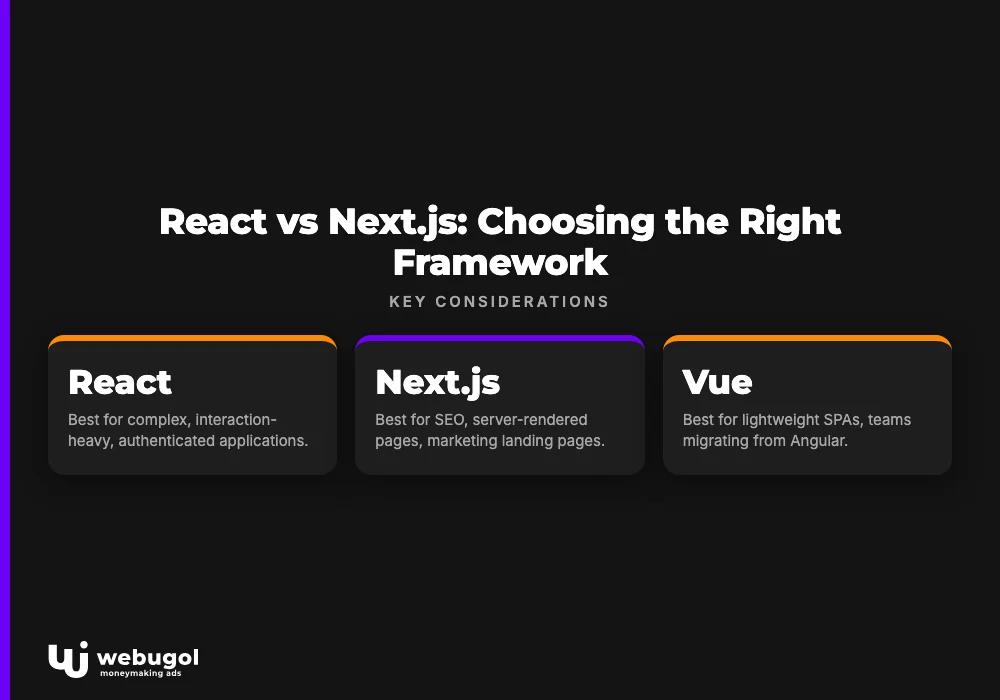
React alone is the right choice when you are building a complex, interaction-heavy application where the user is always authenticated. Next.js is the right choice when SEO, server-rendered pages, or marketing landing pages are part of the same product.
| Framework | Best use case | Rendering model | SEO readiness | Dev complexity | When to choose |
|---|---|---|---|---|---|
| React | SPAs, dashboards, authenticated tools | Client-side (default) | Requires extra setup | Moderate | Your users log in before seeing anything meaningful |
| Next.js | Marketing sites, content platforms, hybrid apps | SSR, SSG, hybrid | Built-in | Moderate to high | You need public pages to rank and load fast |
| Vue | Lightweight SPAs, teams migrating from Angular | Client-side | Requires extra setup | Lower | Smaller team, simpler UI, React ecosystem depth not a priority |
A serious react js web app development company will make this recommendation based on your product's public-versus-authenticated split, not on which framework the team prefers.
How to vet a React JS web development company
Choosing the right react js web development company is the decision every mid-funnel buyer has to make, and no competitor in this SERP provides a structured way to do it. Here is a checklist to apply before signing a contract. Most teams skip this.
- Ask for case studies with measurable outcomes, not portfolio screenshots. Named clients, real problems, and concrete results separate accountable partners from code shops that show static mockups.
- Confirm the tech stack in writing. A capable team builds in React with TypeScript, Next.js where appropriate, Node.js or serverless on the back end, and maintains test coverage from the first sprint.
- Ask how discovery works. Teams that skip discovery build the wrong thing on time. The answer should include user flow mapping and a defined success metric before any code is written.
- Understand the handoff model. You should receive documentation, a working CI/CD pipeline, and an accessible codebase, not an ongoing dependency on the agency for routine changes.
- Clarify what happens after launch. A partner who builds and walks away forces you to hire a second vendor for growth. Ask whether SEO configuration and conversion tracking are part of the engagement.
- Check communication cadence. Two-week sprints with a working demo at the end of each cycle is the standard. Monthly check-ins with no visible deliverable is a red flag.
- Verify that Clutch or G2 reviews are recent. A four-year-old review reflects a team that may no longer exist in the same form. Look for activity from the past twelve months.
A serious React team demonstrates this stack: React, TypeScript, Next.js, Node.js, testing tooling such as Jest and React Testing Library, and a CI/CD pipeline that runs tests before merging.
Ready to build your React app?
Webugol builds React products and the marketing infrastructure to grow them as one accountable engagement. That means your cost per booking is tracked from day one, your funnel is configured at launch, and you stop losing budget to the gap between a dev firm and a growth agency.
If you are evaluating a react js web development company and want a direct conversation about scope and budget, start with a project brief on our contact page. We will tell you in the first call whether React, Next.js, or a hybrid fits your situation, and what a realistic timeline looks like for your specific goals.
FAQ
What does a React JS web development project cost?
A React MVP using AI-accelerated development starts from $3–5k and ships in four to six weeks. A WordPress-to-React migration for an SMB typically falls in the $5–15k range, depending on the number of templates, integrations, and performance targets. Larger custom platforms or multi-tenant applications are scoped individually after a discovery session.
How long does it take to build a React web app?
A focused MVP with a defined scope ships in four to six weeks. A larger migration or custom platform runs eight to sixteen weeks depending on integration complexity and the number of review cycles. Discovery, done upfront, is the most reliable way to narrow that range before the build commitment.
Can you migrate my existing WordPress site to React JS?
Yes. Typical scope covers rebuilding your pages and templates in React, reconnecting third-party integrations, and configuring a headless CMS for ongoing content updates. Core Web Vitals improvements are measurable on delivery, which is the primary business case for the switch.
What is the difference between a React JS development company and a freelancer?
A development company brings a full team covering front-end, back end, QA, and project management under one contract, with structured handoffs and documented processes. A freelancer may suit a narrow, well-defined task but rarely covers the full stack or provides the accountability a growing product needs. The bigger difference with a growth-focused partner is that development and marketing infrastructure ship together, so you stop losing budget to a gap between the two.

