



React.js App Development Services: Fast Delivery, Built to Grow
React JS app development services cover the full front-end lifecycle for businesses commissioning a custom web product: architecture, component design, API integration, and post-launch support. You leave the engagement with a production-ready application, an extensible codebase, and performance baselines configured before launch. That is the difference from a standard dev contract. A React app built as a growth system generates returns, not just a deliverable.
What React JS App Development Services Include
Working with a react js development company covers the following service types, from initial scoping through post-launch iteration.
- Custom React application development builds SaaS dashboards, customer portals, and business tools from the ground up, covering component architecture, state management, and API integration.
- React UI/UX development creates design systems and component-level interfaces measured by LCP, interaction response time, and cross-device layout consistency.
- React migration from WordPress and legacy apps rebuilds or replaces an existing site, using Core Web Vitals as the primary before/after benchmark.
- React MVP development ships a focused first version in four to six weeks, structured so the codebase can be extended without rewrites.
- React maintenance and support covers dependency updates, performance monitoring, and planned feature additions on an ongoing retainer.
- React consulting evaluates an existing architecture, identifies bottlenecks, and recommends a prioritized roadmap before any build begins.
Custom React application development
A custom React build delivers an end-to-end front-end application for SaaS dashboards, internal tools, customer portals, and business-facing workflows. The scope covers component architecture decisions, state management strategy (Zustand, Redux Toolkit, or React Query depending on complexity), REST or GraphQL API integration, and a documented handoff with working tests. What you receive is not a theme or a template. It is a codebase your engineering team can own, with clear boundaries between UI components and business logic.
Custom react js app development services at this tier are priced differently from no-code tools. You are paying for architecture decisions that hold up at scale, not a faster prototype that hits limits in six months. The right state management pattern made during this phase prevents the expensive rewrites that come when a product grows beyond its original scope.
React UI/UX development
Design-system creation and component-level UX work are measured against specific outputs: Largest Contentful Paint under 2.5 seconds, Total Blocking Time under 200 milliseconds, and consistent layout across viewport sizes. This goes beyond visual design. It is the layer where rendering decisions, font loading strategies, and lazy-loading patterns determine whether a user completes a purchase or abandons the flow.
For businesses running conversion-dependent products, the UI layer is a revenue variable. Getting it right from the initial build is cheaper than patching it after launch, when the costs of degraded Core Web Vitals show up in paid acquisition data.
React migration from WordPress and legacy apps
A WordPress-to-React migration typically rebuilds the front-end presentation layer while preserving or porting content and CMS functionality. The scope includes auditing what stays (content, routes, integrations), what gets rebuilt (templates, page structure, performance-critical components), and what can be dropped. Core Web Vitals provide the primary before/after metric: LCP, Cumulative Layout Shift, and Interaction to Next Paint.
Migration is one decision within a broader software development services roadmap. Some businesses replace WordPress incrementally; others do it in a single planned sprint. The right approach depends on how much of the existing site is load-bearing versus legacy weight that now costs more to maintain than it delivers.
The most common blockers are plugin dependencies with no React-native equivalent, inconsistent REST API coverage in the existing CMS, and unclear content ownership across page types. Finding these early prevents scope surprises mid-project.
React MVP for startups
A React MVP is scoped for founders who have outgrown Lovable, Bubble, or Webflow: they have validated a product concept, need a production-grade codebase, but cannot justify a six-month build timeline. The typical phase-one scope covers the core user flow, authentication, one primary integration (payment, booking, or data source), and basic analytics instrumentation. Launch target: four to six weeks from kick-off.
What matters for a founder at this stage is not feature completeness. It is code structure. The MVP codebase should be extendable by a hired engineer in three months without a full rewrite. That is the structural difference between an AI-generated prototype and a production build.
Maintenance and support
Post-launch support covers three categories: dependency updates (React minor and patch versions, third-party library security patches), performance monitoring (catching LCP regressions before they affect rankings or conversion), and planned feature additions under a monthly retainer. This is distinct from a completed project. Handoff-and-disappear engagements cost more to fix than a retainer that catches issues before they compound.
Who Are React JS App Development Services For?
React.js app development services are suited for three buyer profiles: founders moving past no-code tooling limits, businesses whose WordPress site is slowing growth, and teams building AI-powered or real-time products. No top-10 competitor segments the audience clearly, which means most potential buyers have to guess whether a given agency fits their situation.
Founders moving past no-code tools
If you built a working prototype in Lovable, Bubble, or Webflow and it now handles real users, you have discovered the edge of what those tools cover. The limits show up in three places: integrations that require custom backend logic, security requirements that managed platforms cannot satisfy, and performance ceilings that hurt paid acquisition ROI. Moving to custom React is not about starting over. It preserves what you validated in phase one while building on a foundation that scales.
The founder who hits a no-code ceiling is asking the same structural question that every business owner reaches at the growth plateau: what is the cheapest way to stop losing users to slow load times and broken flows?
Businesses outgrowing WordPress
For marketing directors and owners whose WordPress site scores below 70 on PageSpeed Insights, the problem is not aesthetic. It is revenue. A one-second improvement in LCP correlates with measurable conversion lift, according to Google's Web Vitals data. A site at LCP 4.2 seconds is slower than the competition and caps the return on every dollar spent on paid acquisition.
A React migration resets the performance baseline and removes the plugin sprawl that makes WordPress maintenance increasingly expensive over time. That is a revenue decision, not a technology preference. Marketing directors who have watched bounce rates hold steady despite redesigns typically discover the fix lives at the infrastructure level, not the design level.
Teams building AI-powered products
React's concurrent rendering model and component-based state management make it well-suited for interfaces that stream AI responses, update in real time, and manage complex user sessions. If you are adding an LLM assistant, a RAG-powered search interface, or a conversational booking flow to your product, the front-end architecture matters as much as the model selection. React handles partial state updates and streaming responses cleanly, without full-page rerenders that interrupt user context mid-flow.
A well-structured React interface prevents the UI from becoming the bottleneck in an otherwise capable AI-powered product. This is where LLM product work and front-end delivery intersect directly.
Why React.js? And when is it not the right choice?
React is the right choice when the product is an application: interactive, stateful, and not primarily dependent on server-side HTML for organic search performance. When content delivery and SEO are the primary goals from the start, the answer changes.
Should I use React or Next.js for my project?
Use React for client-side SPAs and app-like interfaces where server-side rendering is not a requirement. Choose Next.js when SEO, server rendering, or edge performance are primary requirements from the start.
A customer portal, a SaaS dashboard, or a booking interface that sits behind authentication is a React use case. A marketing site, a content blog, or a product landing page that needs organic ranking is a Next.js use case. The technical difference is where rendering happens. The business difference is whether Google needs to index the page content. For projects that need server-side rendering, nextjs development company work typically clarifies the architecture before the first sprint begins.
Choosing the wrong rendering model at the architecture stage is an expensive fix later. Getting this decision right in the scoping conversation prevents it.
What React won't solve on its own
React covers the UI layer. It does not replace a backend, solve hosting performance problems, or guarantee SEO without the right rendering strategy. A React SPA with no server-side rendering will not rank for content queries regardless of component quality. A React front-end connected to a slow API will still be slow; the bottleneck moves upstream, not away.
The most common scoping misconception is assuming a React rebuild fixes a performance problem that lives in the database query layer or the CDN configuration. React is a UI framework. The systems around it determine whether the full experience performs.

How much does React app development cost?
React app development costs range from $3,000 for a focused MVP to $40,000 or more for a large custom application, depending on scope, design requirements, and third-party integrations. The table below gives ranges by project type, based on what Webugol delivers across segments.
| Project type | Estimated range | Typical timeline |
|---|---|---|
| React MVP (new product) | $3,000–$8,000 | 4–8 weeks |
| WordPress to React migration | $5,000–$15,000 | 6–10 weeks |
| Custom React application | $10,000–$40,000+ | 10–20 weeks |
Three variables move cost within each range. Scope complexity covers the number of distinct user flows and application states. Design requirements determine whether a design system is built from scratch or adapted from an existing one. Third-party integrations each add scoping, testing, and error-handling overhead that compounds with the number of APIs involved.
AI-accelerated development compresses timelines without inflating cost. Code generation and test scaffolding reduce hours required for boilerplate, freeing engineering time for the architecture and integration decisions that actually determine quality. A project that would take fourteen weeks through a traditional development cycle often runs ten weeks with AI tooling in the build phase.
Scoping a React project? Book a free discovery call or review the services page to get a project-specific estimate before committing to scope.
React JS app development services at every price point share one cost driver more consequential than the rest: the number of distinct user flows requiring custom state management. Map those flows in discovery, before the contract is signed.
Our React.js development process
Webugol's delivery model for react js app development services runs in three stages: Discovery, AI-Accelerated Build, and Launch + Growth Setup. Each stage produces defined outputs, not just activities.
Discovery, AI-Accelerated Build, and Launch
Discovery produces a scoped requirements document with acceptance criteria for every deliverable. The team maps user flows, identifies integration points, and surfaces scope risks before a line of code is written. This stage typically runs one to two weeks. It prevents the mid-project scope changes that inflate budgets and push timelines.
The AI-Accelerated Build phase uses code generation for boilerplate components, test scaffolding for coverage baselines, and automated review tooling to maintain code quality at speed. The result is a compressed development cycle that ships production-quality code, not a prototype that needs a cleanup pass before launch. For a React MVP, this stage targets four to six weeks. For larger custom applications, ten to fourteen weeks.
Launch + Growth Setup goes beyond deploying the application. Analytics instrumentation, SEO structure (canonical tags, sitemap, metadata patterns), Core Web Vitals baselines, and performance monitoring are configured before the site goes live. When the product is live, you have visibility into what it is doing from day one, not six months later when a problem shows up in the revenue data.

React technology stack we use
| Layer | Technologies |
|---|---|
| Frontend | React 18+, TypeScript, Next.js (SSR/SSG projects) |
| State management | React Query, Zustand, Redux Toolkit |
| Styling | Tailwind CSS, CSS Modules, Radix UI |
| Testing | Vitest, React Testing Library, Playwright |
| Backend / APIs | Node.js, Express, tRPC, REST and GraphQL |
| Infrastructure | Vercel, AWS (EC2/S3/CloudFront), Docker |
| CI/CD | GitHub Actions, automated test pipelines |
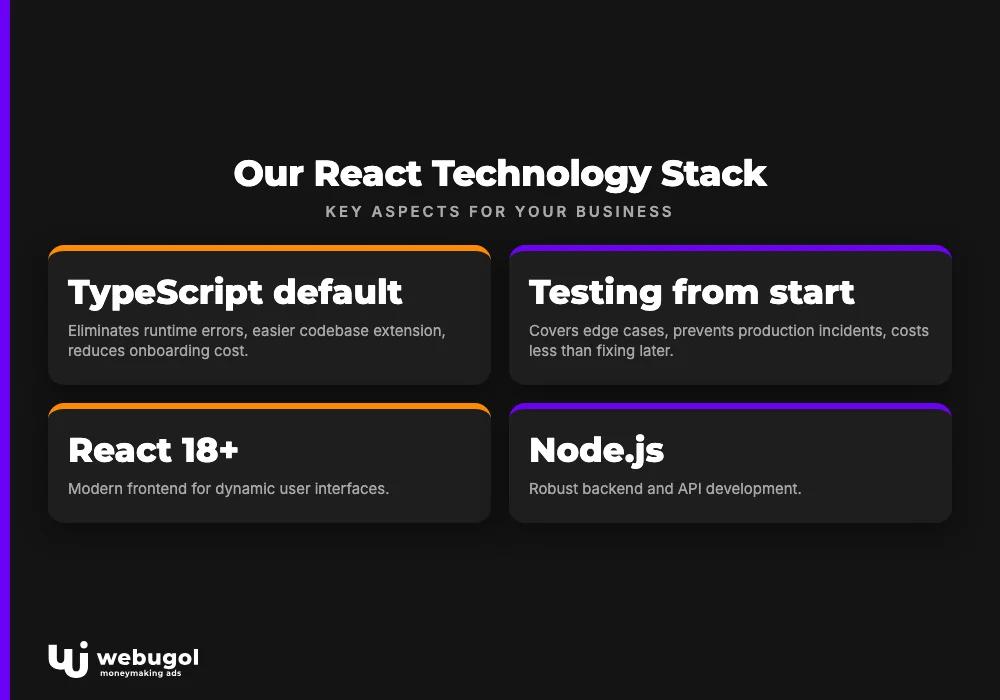
TypeScript is the default on all new projects. It eliminates an entire category of runtime errors that otherwise surface in production and makes the codebase substantially easier to extend as the team grows. For a business owner, this matters because TypeScript-enforced contracts between components reduce the cost of adding engineers to a project later. There is less tribal knowledge required to onboard and fewer regressions introduced during feature additions.
Testing frameworks are configured from project start, not added retroactively. Test coverage added after the fact typically covers only happy paths, not the edge cases that cause production incidents. Getting this right at the beginning costs less than fixing it later.
React app development results
Webugol's portfolio includes front-end builds for Valhalla Vitality, Ways2Well, and Humanaut Health, three healthcare brands that needed production-grade web applications matching clinical-brand positioning and performance requirements.
What these engagements share is a delivery model that includes growth setup at launch: analytics configured, performance baselines set, SEO structure in place. The business impact is that owners stop losing bookings to slow load times and broken flows from day one, rather than discovering the problem months later in a revenue report. That is the operational difference between a site built as a deliverable and one built as a growth system.

Ready to build your React app?
A React application built as a standalone deliverable becomes a sunk cost the moment a team inherits it without documentation, analytics, or a performance baseline. Webugol delivers React projects as full growth systems: from first commit through post-launch SEO, analytics, and iteration support.
The difference shows up in what you stop losing: untracked conversions, slow pages eroding paid acquisition ROI, and handoff gaps that add months to every future change. React.js app development services built on this model include the growth setup as a standard deliverable, not an add-on.
If you are scoping a custom build, an MVP, or a WordPress migration, the discovery call is the right starting point. It surfaces scope risks before the contract, not after. Book a free discovery call to scope your project, or review the services page to see what the full engagement covers.
FAQ: React.js app development
What does a React.js development company do?
A React.js development company builds custom web applications using the React library, covering new products, platform migrations, and UI overhauls for existing applications. Services typically include frontend architecture, component design, API integration, and post-launch support. The scope can range from a focused MVP delivered in weeks to a multi-stage migration of an existing platform.
How long does it take to build a React app?
A React MVP typically takes four to eight weeks from kick-off to launch. A full custom application or WordPress-to-React migration runs ten to twenty weeks depending on scope and third-party integrations. AI-accelerated development can compress the build phase without changing the architecture or quality of the output.
How much does React app development cost?
React MVP projects start at $3,000 to $5,000; migrations from WordPress or legacy apps typically run $5,000 to $15,000. Larger custom builds vary based on feature complexity and the number of integrations required. The main cost drivers are the number of distinct user flows, design scope, and how many third-party APIs need to be connected.
Should I use React or Next.js for my project?
Use React for client-side SPAs and app interfaces where server-side rendering is not a requirement. Choose Next.js when the project needs strong SEO, server rendering, or edge performance out of the box. The key question is whether Google needs to crawl and index the page content directly.
How do I choose the right React development agency?
Look for agencies that share real case studies with before/after metrics, explain their delivery process in concrete stages, and include post-launch growth support rather than a straight handoff. Pricing transparency is a signal: agencies that publish cost ranges have already thought through how scope drives budget, which reduces surprises mid-project. When evaluating react js app development services, ask specifically how the agency handles scope changes after the discovery phase ends.

