



Medical spa marketing agency: how to choose a partner that delivers
A medical spa marketing agency bridges the gap between your clinical expertise and the clients who are actively searching for your services. The right partner integrates medical spa SEO, paid advertising, social media, and reputation management into one coordinated strategy. This guide covers what to look for in an agency, which channels produce results, how to structure the budget conversation, and what to verify in a contract before signing.
What makes med spa marketing different from general healthcare promotion
Medical spas occupy a distinct position. They combine clinical procedures under physician oversight with the service environment of a wellness practice. That puts them in simultaneous competition with aesthetic surgery centers, dermatology clinics, and day spas, often targeting the same prospective client.
General healthcare marketing templates do not fit this model well. Tactics built for primary care emphasize access, safety, and insurance. Med spa advertising needs those qualities too, but it also needs to convey precision, outcomes, and transformation. The messaging requirements differ fundamentally.
Regulatory constraints add real complexity. Advertising rules for clinical cosmetic procedures vary by jurisdiction and by platform. Treatment outcome claims require careful language. Before/after imagery is restricted on certain ad networks. An agency unfamiliar with these constraints will spend your budget learning them.
The treatment menu also moves quickly. Laser technologies, injectables, and body-contouring devices iterate fast. Medical spa digital marketing must promote new offerings without creating compliance problems and without confusing existing clients who already know your current services.
Key performance indicators a medical spa marketing agency should track
Understanding these KPIs helps you evaluate whether an agency truly knows your business, not just your category.
| KPI | What it measures | Why it matters for med spas |
|---|---|---|
| Customer Acquisition Cost (CAC) | Total marketing spend divided by new clients acquired | High-ticket treatments allow a higher CAC, but only when modeled against lifetime value |
| Customer Lifetime Value (CLV) | Net revenue from one client across all visits | CLV in aesthetic practices typically far exceeds first-visit cost, justifying larger acquisition budgets |
| Online booking rate | Percentage of website visitors who schedule an appointment | Direct signal of how well your digital presence converts intent into actual bookings |
| Client retention rate | Percentage of clients returning for additional services | Repeat visits drive the majority of revenue in most established med spas |
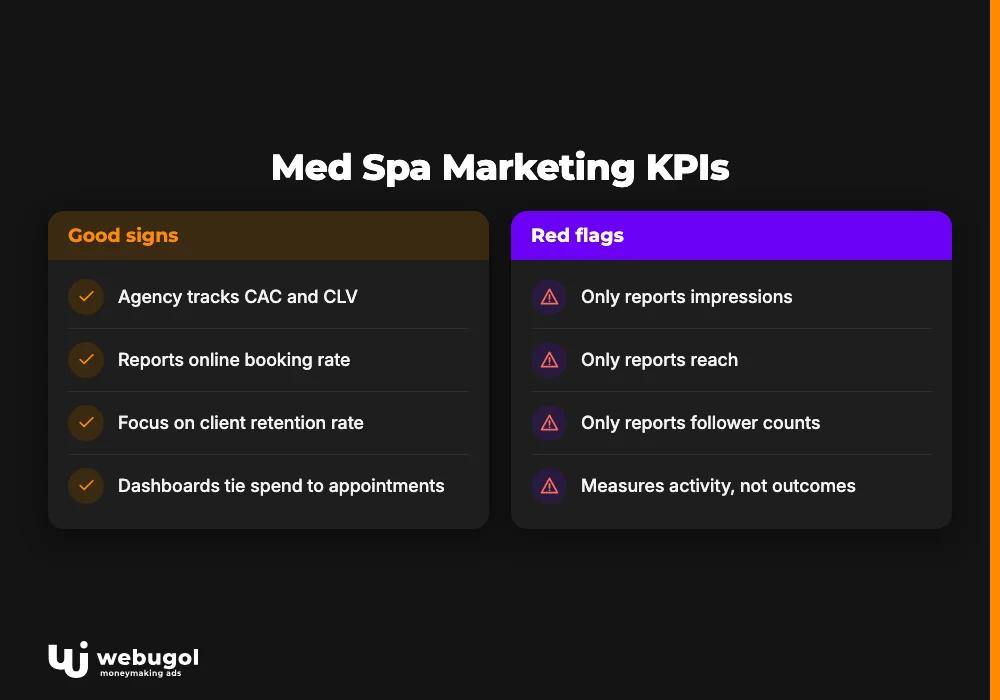
Agencies that report only on impressions, reach, or follower counts without connecting those numbers to CAC and booking rate are measuring activity rather than business outcomes. Require dashboards that tie channel spend to appointments booked.
How to market a medical spa online?
Effective medical spa online marketing combines organic search, paid channels, social media, and email into a system where each channel reinforces the others. Organic SEO builds the long-term traffic floor. Paid search captures high-intent queries immediately. Social platforms create awareness and treatment familiarity before a prospect is ready to book. Email re-engages existing clients at very low cost.
Local search is the highest-priority channel for most practices. The majority of med spa clients book within a defined geographic radius, which means appearing in Google's local map pack matters more than broad national organic rankings. Medical spa SEO that skips local optimization misses the most commercially valuable search traffic. For how organic search builds compounding visibility over time for practices in this space, see why consistent SEO creates sustainable growth for health businesses.
The channels reinforce each other when run in coordination. A prospect who sees your before/after content on Instagram and then searches for your brand converts at a meaningfully higher rate than a cold organic visitor. Medical spa social media marketing extends and warms the audience that SEO eventually captures.
Treatment-specific landing pages strengthen the entire system. Each major service category, injectables, laser treatments, body contouring, benefits from a dedicated page that ranks for relevant searches and converts visitors arriving from any channel. A skilled medical spa marketing agency will prioritize this architecture early.
What should a medical spa look for in a marketing agency?
Three criteria matter most: vertical experience, reporting transparency, and regulatory competence.
Vertical experience means the agency has run campaigns specifically for aesthetic medicine practices, not just general health or wellness. Ask to see examples of campaigns promoting injectables, laser treatments, or recurring service memberships. The creative approach and compliance constraints for these services differ substantially from general wellness marketing.
Reporting transparency means receiving dashboards that show exactly how budget was allocated, which channels drove bookings, and how KPIs moved month over month. Vague reports describing activity without outcome data are a consistent warning sign.
Regulatory competence means the team understands which claims are permitted in cosmetic procedure advertising, how before/after content can be used legally on different platforms, and how to write effective copy that does not create liability for your practice.
Beyond those three core criteria, review the agency's completed campaign portfolio for businesses at a comparable size and growth stage. A strategy built for a flagship multi-location clinic does not translate directly to a single-location practice growing its first consistent patient base.
Data handling is a practical concern worth raising early. Client contact records and booking history are sensitive. Confirm the agency uses appropriate data protection practices, and that all ad accounts, analytics properties, and CRM integrations remain owned by your practice throughout the engagement.
Which digital channels work best for med spas?
The highest-performing combination for most med spa practices is local SEO, Google Ads targeting treatment-intent searches, and Meta platforms for visual content.
Local SEO places your practice in front of clients searching by treatment type and location. Google Ads capture demand immediately when organic rankings are not yet established, or when launching a new treatment that needs fast exposure. Instagram and Facebook work well for before/after content, promotional offers, and building familiarity with audiences who have not yet begun searching for a specific treatment.
How patients use social content to research aesthetic procedures shapes channel strategy. Research on how social platforms influence patient research and treatment consideration confirms that visual treatment content drives significant pre-booking behavior, making social an important awareness channel even when direct attribution to bookings is difficult to measure precisely.
Email handles a distinct function within spa digital marketing. It reactivates clients who have not visited recently, communicates with package holders and members, and promotes seasonal offers at very low cost per contact. Building this channel early compounds its value. A warm list of past clients is one of the most efficient conversion assets a med spa can hold.
The right mix depends on growth stage. A newly opened practice needs immediate awareness and bookings, so paid search and social advertising carry more of the initial budget. An established practice with steady organic traffic should shift additional resources toward retention programs and structured referral incentives that convert existing clients into an acquisition channel.
How much does medical spa marketing cost?
No published rate card exists for medical spa digital marketing, and specific figures vary too widely by market, agency tier, and scope to cite accurately. What you can evaluate is cost structure and expected return on investment.
Most agencies price ongoing med spa advertising management as a monthly retainer covering a defined scope, a percentage of ad spend managed, or a combination of both. One-time work such as a website build or brand identity development is priced separately. Performance-based arrangements exist but are less common for full-service, multi-channel engagements.
The right question is not "what is the lowest monthly fee" but "what CAC can this agency deliver for my practice, and does that CAC fit my profitability model." An agency that costs more per month but drives a CAC within your unit economics delivers more actual profit than a cheaper option producing high volumes of low-quality inquiries.
When reviewing proposals, ask for itemized cost breakdowns showing what each budget line buys, which reporting is included, and which additional services are negotiable. Strategy sessions, higher reporting frequency, and supplemental campaign builds are often available without changing the base fee, particularly at the start of a new engagement.
How to get more clients for a medical spa?
The fastest route to new clients is Google Ads targeting high-intent treatment searches, combined with a fully optimized Google Business Profile. These two surface your practice to prospects who are already motivated to book. Paid search results can appear within days of a campaign going live.
For sustainable growth, medical spa SEO builds a traffic base that does not require ongoing ad spend to sustain. Reviews are critical in this category. Clients evaluating aesthetic treatments read multiple reviews before deciding. A systematic process for requesting reviews from satisfied clients, timed to the right moment after a visit, reliably increases both volume and average star rating over time.
Referral programs are underused by most practices. Satisfied clients who have seen strong results are the highest-converting acquisition source available. A structured incentive program integrated into your booking and CRM system typically delivers a lower CAC than any paid channel and produces clients with higher lifetime value.
Membership and package programs improve retention and generate predictable recurring revenue. Clients on packages return more frequently and refer more actively than single-visit clients. Incorporating these programs into your med spa marketing strategy, not just your operations workflow, amplifies the revenue contribution of each active member.
What to check before signing with a medical spa marketing agency
Three contract areas carry the most practical risk.
Deliverables and scope. The contract should name specific outputs: which campaigns are managed, how many reports are delivered per period, and who retains ownership of ad accounts, website assets, and analytics data if the engagement ends. Vague scope language protects the agency. Specific, named deliverables protect your practice.
Reporting cadence and KPIs. Define upfront which metrics the agency will report on and how often. Monthly reporting is the standard. Quarterly intervals allow underperforming channels to drain budget before anyone is positioned to act.
Data ownership. Confirm in writing that all ad accounts, analytics platforms, and CRM integrations belong to your business. Moving to a different agency becomes significantly harder when you cannot export your own historical campaign data and performance records.
A note on headline claims: several agencies currently ranking for "medical spa marketing agency" report individual client growth figures in the range of +190% to +500%. These are specific case outcomes, not typical results. Ask any agency you evaluate for case studies from practices at a comparable size and market, and request direct references you can contact. Specific contacts from past clients carry more weight than aggregate percentage claims.
Start building a scalable marketing system for your med spa
Choosing the right medical spa marketing agency is what separates a practice with unpredictable client flow from one with a consistent, scalable acquisition system. Your agency should bring verified aesthetics marketing experience, performance reporting tied to real KPIs, and the compliance knowledge to operate across channels without exposing your practice to risk. The Webugol Healthcare Growth System is designed for health and wellness practices that need a structured path from inconsistent growth to predictable, scalable results. Get in touch to discuss a strategy built around your specific goals and market.
FAQ
What does a medical spa marketing agency do?
A medical spa marketing agency manages the digital channels that bring new clients to your practice, including SEO, paid search, social media advertising, and email. The agency handles strategy, execution, and performance reporting so your internal team can focus on delivering treatments.
How long does it take to see results from med spa marketing?
Paid search campaigns can generate qualified leads within days of launch. Medical spa SEO typically takes three to six months to produce meaningful organic traffic growth. Building local search authority and a strong review profile is generally a six-to-twelve-month process.
Is a specialist medical spa marketing agency worth more than a general digital marketing firm?
For most practices, yes. Regulatory compliance in aesthetic advertising, before/after content policies on social platforms, and the specific economics of med spa CAC and CLV all require prior experience to handle without costly errors. A general firm can learn these requirements, but that learning runs on your budget.
What KPIs should my marketing agency report on?
Require reporting on customer acquisition cost, customer lifetime value, online booking rate, and client retention rate. These four connect marketing activity directly to business outcomes. Traffic and engagement metrics are secondary indicators, not primary measures of success.
Who should own the ad accounts and website assets?
Your practice should hold ownership of all accounts: Google Ads, Meta advertising, analytics platforms, and website hosting. If the agency retains ownership and the relationship ends, you lose access to your campaigns, historical data, and accumulated performance records. Confirm ownership terms in the contract before signing.