



Med spa content marketing: a complete guide to growing your practice
Med spa content marketing is the practice of creating and distributing relevant content across digital channels to attract prospective clients, build trust, and convert interest into booked appointments. It covers blog posts, social media, email campaigns, SEO, and video. For medical spas competing in a crowded market, a well-executed content strategy is one of the most cost-effective ways to differentiate and grow.
What types of content work best for medical spas?
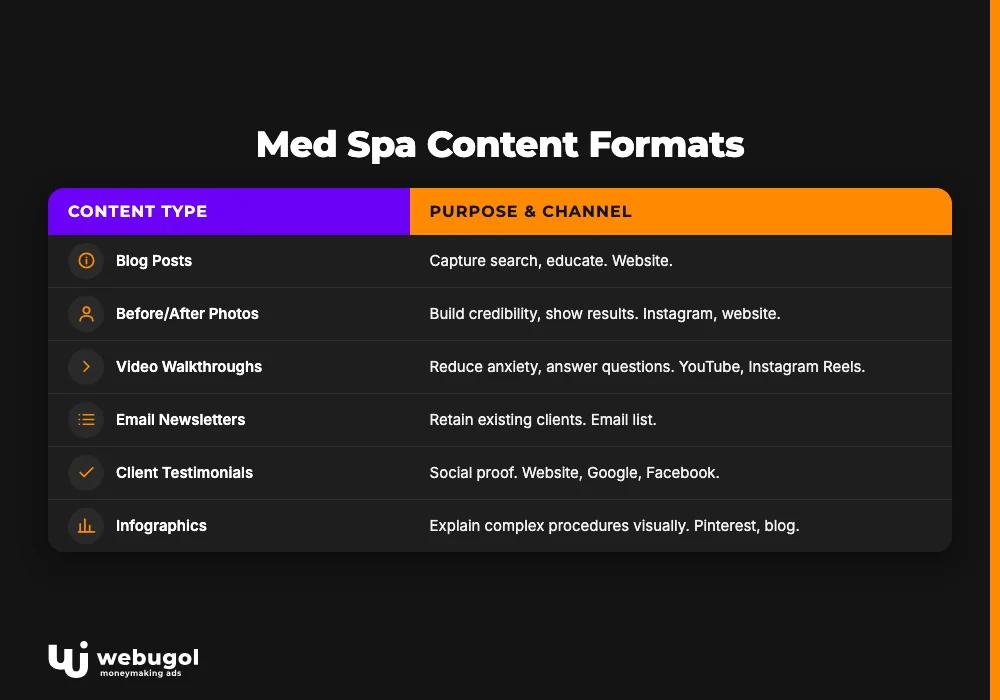
The most effective content formats combine education with proof. Each format addresses a different stage of the client decision process.
| Content type | Primary purpose | Best channel |
|---|---|---|
| Blog posts | Capture organic search, educate | Website |
| Before/after photos | Build credibility, show results | Instagram, website |
| Video walkthroughs | Reduce anxiety, answer treatment questions | YouTube, Instagram Reels |
| Email newsletters | Retain existing clients | Email list |
| Client testimonials | Social proof | Website, Google, Facebook |
| Infographics | Explain complex procedures visually | Pinterest, blog |
Blog topics can range from skincare tips to treatment explainers and wellness trends. Social media works well for live Q&A sessions, behind-the-scenes content, and client reviews. Video is particularly effective: prospective clients can watch a virtual tour of the facility or a treatment demonstration before they ever visit.
Infographics make complex procedures easier to understand and perform well on Pinterest and in long-form blog posts.
Relying on a single format limits your reach. A mix across the formats above gives your content strategy the coverage it needs.
Building your healthcare spa brand strategy
A strong brand starts with a clear picture of who your clients are. Most medical spa clients seek both wellness and cosmetic results. Your content should reflect that balance.
Identifying your Unique Selling Proposition early, whether that is a specific treatment portfolio, a clinical philosophy, or a distinct client experience, gives every piece of content a clear angle.
Your messaging needs a consistent voice across every channel. That voice should convey clinical credibility while staying warm and accessible. Inconsistent messaging across email, social, and your website confuses prospective clients. Consistency compounds over time: clients who recognize your voice across platforms develop stronger recall, and recall drives referrals.
What social media platforms are best for medical spa marketing?
In medical spa digital marketing, platform choice matters as much as the content itself.
Instagram is the primary channel for most med spas. High-quality treatment images, short Reels, and Stories perform well here. The format is built around visual results.
Facebook supports community-building and targeted paid advertising. It performs well for promotions, event announcements, and reaching demographics that typically carry higher spending power.
Pinterest is underused but effective in a medspa social media strategy focused on sustained referral traffic. Wellness tips, skincare advice, and treatment inspiration boards generate consistent clicks over time.
YouTube suits longer-form video content. Treatment walkthroughs, provider Q&As, and client testimonial videos all find an engaged audience there.
Consistent interaction with followers, responding to comments and hosting live events, builds a sense of community that keeps your brand visible between appointments. For a deeper look at platform-specific execution, this med spa social media engagement guide covers engagement tactics in detail.
Med spa SEO optimization: ranking when clients search
Med spa SEO optimization makes your content findable at the exact moment a prospective client is searching for a treatment. That requires three things: relevant keywords matched to client intent, a mobile-optimized website, and quality backlinks.
Keyword research starts with what clients actually type: treatment names, conditions they want to address, and location-based phrases. Work those terms into blog posts, service pages, and image alt text. Forced insertion reads poorly and signals manipulation to search engines. The goal is natural placement that answers real questions.
Mobile matters. A large share of medical spa searches happen on smartphones, and a site that loads slowly or breaks on mobile loses that visitor immediately.
Backlinks from local health directories and wellness publications signal authority to search engines. Your Google Business Profile and consistent location data across directories are critical for local visibility. For a structured approach to local ranking, see this guide to local search visibility for healthcare practices.
Medical spa email campaigns and client retention
Email remains one of the highest-return channels in med spa marketing. You own the list. Clients who opted in have already expressed interest, which makes this audience inherently warmer than a cold social media audience.
Medical spa email campaigns perform best when segmented. A client who came in for Botox receives different content than one exploring body contouring for the first time. Segmenting by treatment history, visit frequency, and stated interests makes each message more relevant. Relevant messages get opened. Generic ones do not.
Effective newsletters share practical wellness content, announce new treatments, and offer promotions tied to clear value. Personalized follow-up offers tied to a client's treatment history drive repeat bookings more reliably than broad discounts. Seasonal campaigns linked to holidays or cosmetic event windows, combined with loyalty programs and bundled service discounts, complete a retention-focused email plan.
How to build a med spa content marketing plan from scratch?
A content plan built from scratch follows a clear sequence. Running tactics in parallel without a foundation wastes time and budget.
Step 1: Define your audience. Who are your ideal clients? What questions do they ask before booking? Those questions become your content topics.
Step 2: Audit existing assets. If your practice already has a website and some social presence, assess what is working before creating anything new.
Step 3: Choose core channels. Start with a blog for SEO, Instagram for visual proof, and email for retention. Add channels only after the core three run consistently.
Step 4: Build a content calendar. Map out topics, formats, and publishing dates at least one month ahead. This removes daily guesswork from execution.
Step 5: Measure and adjust. Review traffic, engagement, and booking inquiries monthly. The data tells you what to scale and what to stop.
For practices that want a structured system covering content, SEO, and paid channels together, the Webugol healthcare growth program is built for exactly this.
How often should a med spa publish blog posts?
Publishing frequency matters less than publishing consistently. A med spa that releases two well-researched posts per month, on a reliable schedule, will outperform one that publishes ten posts in a burst and then goes quiet.
One to two blog posts per month is a sustainable starting point. Each post should answer a real question, incorporate relevant keywords naturally, and link to related service pages. Review and refresh your content plan at minimum once per quarter: treatment offerings change, client questions evolve, and your content should stay aligned with both.
How do you measure content marketing ROI for a med spa?
Measuring returns from med spa content marketing means tracking metrics at each stage of the client funnel.
At the top: organic search traffic, blog page views, and social media reach. These confirm whether content is getting found.
In the middle: time on page, email open rates, and newsletter click-through rates. These show whether the content engages the right people once they arrive.
At the bottom: contact form submissions, booking requests, and phone inquiries attributed to content-driven sessions. This is where marketing effort connects to real revenue. Connect your analytics platform to your booking or CRM system. Without that connection, you are counting views rather than clients.
Monthly reporting across these three layers tells you where to invest more effort and where to stop.
Start building your med spa content marketing strategy
It compounds over time. Every well-optimized blog post, every email campaign that re-engages a lapsed client, and every social post that drives a booking inquiry adds to a durable asset base. Start with the content formats your audience already responds to, anchor them in solid SEO, and build from there. If you want a partner to plan and execute a full medical spa digital marketing strategy, explore how Webugol works with med spas.
FAQ
What is med spa content marketing?
Med spa content marketing is a structured approach to creating and distributing blog posts, social content, email campaigns, and video to attract and retain clients. It differs from paid advertising in that it builds lasting organic visibility over time. Most successful med spas use both content and paid channels together.
How often should a med spa publish blog posts?
One to two posts per month is a sustainable and effective starting point for most practices. Consistency matters more than volume. Review and refresh older posts quarterly to keep them accurate and aligned with current services.
What social media platforms work best for medical spas?
Instagram is the strongest platform for most med spas because of its visual format and large audience for beauty and wellness content. Facebook supports paid targeting and community engagement. Pinterest drives steady referral traffic for skincare and treatment-related content.
How do you measure content marketing ROI for a med spa?
Track organic traffic, email open rates, and booking inquiries attributed to content sessions. Connect your analytics platform to your booking system to see which content pieces drive actual appointments. Review these numbers monthly to identify what is working.
Do client testimonials improve med spa marketing results?
Yes. Client testimonials provide social proof that influences booking decisions at the consideration stage. Placing them on your website, Google Business Profile, and social channels gives prospective clients direct evidence of your results and service quality.