



Chiropractic digital marketing: a complete strategy guide
Chiropractic digital marketing is the use of online channels, including SEO, paid ads, content, and social media, to attract new patients and retain existing ones. A well-structured approach makes your clinic visible when someone searches "chiropractor near me," builds authority through educational content, and converts site visitors into booked appointments. Surveys of healthcare patient behavior confirm that patients now assess providers through online reviews and social media before ever calling a clinic. Coordinating channels consistently outperforms any single tactic.
What does digital marketing for chiropractors include?
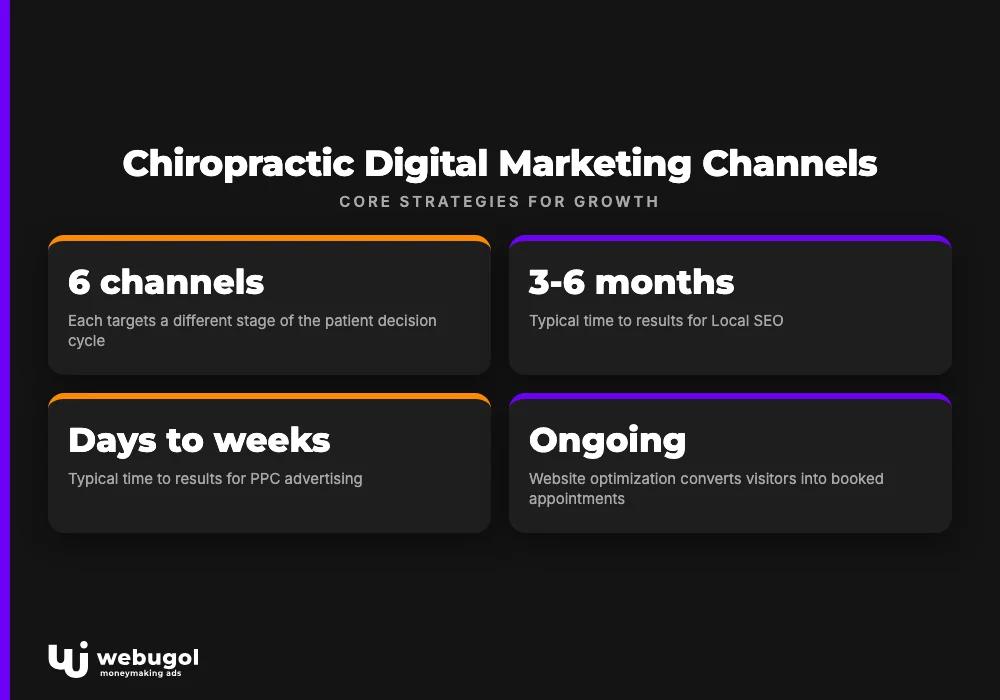
Chiropractic digital marketing covers six core channels, each targeting a different stage of the patient decision cycle.
| Channel | Primary goal | Typical time to results |
|---|---|---|
| Local SEO | Rank in Google Maps and local organic results | 3-6 months |
| Website optimization | Convert visitors into booked appointments | Ongoing |
| Chiropractic content marketing | Build authority and answer patient questions | 6-12 months |
| PPC / chiropractic advertising | Immediate reach for high-intent searchers | Days to weeks |
| Social media | Awareness and patient engagement | 1-3 months |
| Retain and reactivate existing patients | 1-2 months |
No single channel works in isolation. A patient may find you through a Google search, read a blog post, check your reviews, and then book through your website. Coordinating these touchpoints is what separates growing practices from stagnant ones.
How to get more chiropractic patients online?
The fastest path to more online patients combines three immediate actions: optimizing your Google Business Profile, building a conversion-ready website, and targeting local search keywords.
Start with your Google Business Profile. It is the most visible real estate in local search. Complete every field: hours, services, photos, and a booking link. Collect reviews consistently; surveys of healthcare patient behavior show that patients evaluate providers heavily through online feedback and social media. One negative review rarely sinks a practice, but an empty review profile does.
Next, examine your website from a patient's perspective. Can someone find your address in under ten seconds? Is there a clear button to book an appointment? Does the page load in under three seconds on a phone? These basics determine whether traffic converts or bounces.
Chiropractor marketing strategies built around local search also depend on citation consistency. List your practice on Google, Yelp, Healthgrades, and relevant specialty directories. Name, address, and phone number must match exactly across every listing. Our guide covers how chiropractic and healthcare clinics build local search visibility step by step for competitive markets.
How to improve a chiropractor website Google ranking?
Your website's Google ranking depends on three layers: technical health, on-page relevance, and off-page authority.
Technical health means the site loads fast, works on mobile, uses HTTPS, and has an XML sitemap. Google treats a slow or broken site as a low-quality signal regardless of how good the content is. Mobile performance is non-negotiable. Most patients searching for a chiropractor do so on a phone.
On-page relevance starts with keyword research. Use Google Keyword Planner to find what your local audience actually searches: "back pain chiropractor [city]," "neck pain treatment near me," and condition-specific phrases. Place these naturally in page titles, H1 headings, meta descriptions, and the first paragraph of each service page. Healthcare SEO for chiropractors also means writing substantively about the specific conditions you treat, not just listing service names.
Off-page authority comes from backlinks. Collaborate with local health blogs, chiropractic associations, and community organizations. A mention on a credible local site carries more weight than dozens of low-quality directory links. Quality beats volume.
Consistent content sustains rankings month over month. Content-driven SEO for health practices compounds long-term authority in ways paid ads cannot replicate, which is why chiropractic web marketing plans that skip content always plateau.
Chiropractic content marketing that builds patient trust
Chiropractic content marketing turns search traffic into trust before a patient ever contacts you. A blog post explaining sciatica options earns a reader weeks before they book. An FAQ page answering "how many sessions will I need?" removes a barrier before it forms.
Strong content follows one rule: answer the question the patient already has. Common topics include explanations of chiropractic conditions, what to expect on a first visit, differences between treatment approaches, and preventive care guidance. These are not optional extras. They are the exact queries patients type into Google.
Beyond blogs, chiropractic internet marketing extends through short videos demonstrating exercises, infographics explaining anatomy concepts, and social posts sharing clinic updates. Each format reaches a different learning style. Mixing them expands your reach without requiring proportional effort.
Content also has a compounding advantage that chiropractic advertising does not. A blog post published today may generate patient inquiries two years from now. Paid ads stop the moment you stop paying. Content does not.
Publish consistently and prioritize accuracy. Patients make health decisions based on what you write. Thin or vague content harms trust faster than publishing nothing at all.

Chiropractic advertising: PPC for high-intent patients
Pay-per-click advertising places your clinic at the top of Google search results immediately, and you pay only when someone clicks. That makes chiro website marketing through Google Ads one of the most efficient forms of chiropractic advertising for practices that need fast results alongside longer-term SEO efforts.
The core strength of PPC is intent. When someone searches "emergency chiropractor [city]" or "sports injury chiropractor near me," they are ready to book. A focused Google Ads campaign captures that moment before competitors do.
Effective PPC ads are specific, not generic. "Back pain specialist accepting new patients" outperforms "chiropractor in [city]" because it speaks directly to the searcher's problem. Always include a clear call to action and a link that lands on a booking page rather than the homepage. Direct landing pages reduce friction and lift conversion rates.
PPC and SEO work best together. SEO builds visibility over months. PPC covers you while SEO matures and targets high-competition terms where organic ranking takes longer. Together, they give your chiropractic digital marketing plan both short-term reach and long-term momentum.
What are the best marketing strategies for a chiropractic practice?
The most effective chiropractor marketing strategies match channel to patient intent.
High-intent patients, those actively searching for a chiropractor, respond best to local SEO and Google Ads. Patients in the awareness stage, learning about back pain or posture issues, engage with content and social media. Existing patients stay connected through email. Knowing which stage a patient occupies determines where to invest first.
For most practices, a rational priority order looks like this:
- Fix your website and Google Business Profile. Every other channel depends on them.
- Build local SEO. It compounds over time with no per-click cost.
- Add PPC to capture immediate demand while SEO matures.
- Layer in chiropractic content marketing to establish authority and reduce paid-traffic dependency.
- Use email to retain the patients you have already acquired.
How social media shapes patient engagement and supports brand authority in healthcare is well-documented, but social media rarely drives the first appointment for most practices. It reinforces a decision a patient is already leaning toward.
No single framework fits every market. A solo practitioner in a rural area has different priorities than a multi-location clinic in a competitive city. The sequence above is a starting point, not a fixed prescription.

How much does chiropractic digital marketing cost?
Cost varies by market competition, which channels you activate, and whether you work with an agency or manage marketing in-house.
The two cost structures are time and money. DIY chiropractic internet marketing costs primarily in time: learning platforms, writing content, managing ad accounts yourself. An agency costs money up front but typically delivers faster results and lets the practitioner focus on patient care.
Every practice should define a budget using two numbers: patient lifetime value and the cost to acquire a new patient. These figures reveal whether a given marketing spend is justified before you commit. Avoid setting budgets based solely on what competitors claim to spend; your market and margins determine the floor and ceiling.
Build your chiropractic digital marketing plan
Chiropractic digital marketing works best as a coordinated system, not a set of isolated campaigns. If you want help building a strategy across SEO, advertising, and content for your clinic, Webugol's healthcare growth program is built specifically for health and wellness practices. Our team covers every channel, from technical SEO to paid search, under one plan. Reach out to start the conversation.
FAQ
What is chiropractic digital marketing?
Chiropractic digital marketing is the use of online channels, including SEO, paid search, content, and social media, to attract and retain patients. It covers everything from your Google Business Profile to the educational posts on your website. The goal is to make your clinic visible and credible at every stage of the patient's decision process.
How long does it take to see results from chiropractic digital marketing?
PPC campaigns can generate patient inquiries within days of launch. SEO and chiropractic content marketing typically take three to six months to produce meaningful organic growth. Email and social media deliver results on a rolling basis, depending on list size and posting consistency.
Do chiropractors need a dedicated marketing agency?
Not necessarily, but the practice needs someone who owns strategy and execution consistently. A solo chiropractor managing marketing alongside full patient care often sees slower results due to limited time. An agency accelerates progress, especially in competitive local markets where ranking and ad competition are high.
What is the most important digital marketing channel for chiropractors?
Local SEO consistently delivers the highest return for most chiropractic practices because it captures patients actively searching for care in their area. A complete Google Business Profile and consistent local citations are the minimum starting point. PPC adds speed; chiropractic content marketing adds long-term compounding authority.
How does content marketing help a chiropractic practice grow?
Content marketing builds trust before a patient ever calls your clinic by answering the questions patients already search for online. Quality blog posts and educational pages improve your Google ranking and position the practice as a credible authority in your area. Over time, that organic visibility reduces dependence on paid advertising for new patient acquisition.