



The Institutional Knowledge That Disappears When You Switch Marketing Agencies
Switching marketing agencies resets 6–8 weeks of onboarding, but the larger cost is institutional memory: the tracking configuration your previous team built, the offline conversion mapping they validated, and the documented reasoning behind your ad account structure. None of that transfers automatically when a relationship ends. For a clinic or telehealth practice spending $20k or more per month on patient acquisition, that gap is a revenue event. The diagnostic framework here draws on onboarding patterns a digital marketing agency runs when taking over accounts where the previous team's knowledge was never documented.
Is the problem your agency, or your marketing system?
If CPA has risen across more than one agency relationship without changes to your offer or intake process, the problem is likely structural, not a vendor problem. Switching again before diagnosing that costs another 6–8 weeks without improving anything beneath the surface.
Signs the problem is the agency
These operational symptoms point to the vendor relationship, not the funnel:
- Reporting is consistently disconnected from revenue metrics. You see impressions and CTR, not appointments booked.
- There is no documented rationale for strategy changes. Decisions happen; written reasoning does not follow.
- Deliverable SLAs are missed repeatedly with no accountability escalation.
- The agency claims ownership of campaign performance but zero ownership of funnel metrics beyond the ad click.
Signs the problem is your funnel, tracking, or offer
These symptoms recur across agency tenures and point to something structural:
- CPA has risen across multiple consecutive agency relationships. Same problem, different vendor.
- Leads arrive and stall at the same funnel stage regardless of who is buying the media.
- Tracking gaps predate the current agency relationship and appear in every new audit.
- Offer economics are the constraint. No media buyer can fix a margin problem with targeting adjustments.
This diagnostic split is absent from most content on switching marketing agencies. Making it before you sign a new contract can prevent a costly change that solves nothing.
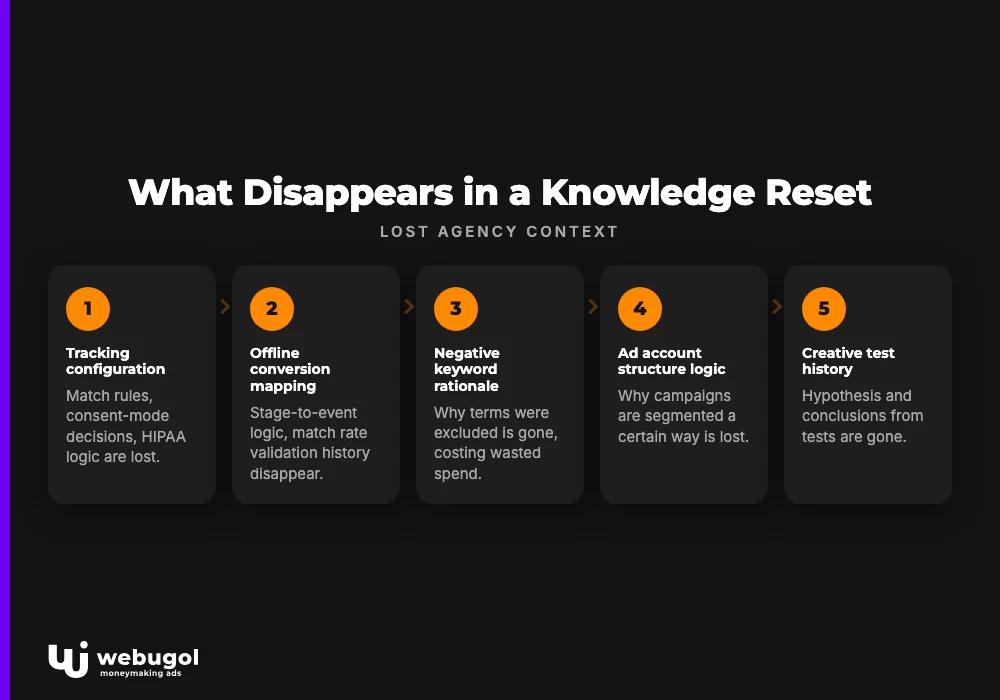
What actually disappears in a knowledge reset
The core loss when an agency relationship ends is not access to campaign files. It is the institutional context behind them. The creative test history sits in a folder; the interpretation of what it proved lives in the account manager's memory. The negative keyword list exists in exports; the reasoning behind each term is gone.
Here is a practical inventory of what evaporates without documented transfer:
| Knowledge asset | Where it lives | What is lost without documented transfer | Rebuild time |
|---|---|---|---|
| Tracking configuration | Tag manager, pixel settings | Match rules, consent-mode decisions, HIPAA-compatible handling logic | 2–3 weeks |
| Offline conversion mapping | CRM integration layer | Stage-to-event logic, match rate validation history | 1–2 weeks |
| Negative keyword rationale | Campaign exports | Why each term was excluded; re-adding it costs wasted spend | Ongoing |
| Ad account structure logic | Account architecture | Why campaigns are segmented the way they are | 1–2 weeks |
| Audience exclusion reasoning | Saved audience files | Which audiences were excluded and why, especially compliance-driven ones | 1 week |
| Creative test history | Asset libraries | What was tested, what the hypothesis was, what conclusion was reached | Ongoing |
The 6–8 week onboarding period that follows a switch is not calendar friction. It is a knowledge reconstruction project. The incoming team rebuilds from raw assets without the context that made those assets work. Across healthcare practice onboarding, including telehealth operators like Valhalla Vitality, tracking rebuild is consistently the highest-priority Month 1 work when documentation from the previous agency is absent. Not optional pre-work. The actual foundation.
What does switching marketing agencies really cost?
Beyond the new agency's onboarding fee, the real cost is performance degradation during weeks 2–6 while the incoming team reconstructs data context and makes optimization decisions on an incomplete baseline. The new team's first weeks of bidding train the algorithm on whatever conversion events fire, which may not reflect actual booked appointments or revenue.
The compounding effect matters here. By the time misaligned tracking is caught and corrected, the campaign history built while it was broken becomes the baseline for future optimization. Every dollar spent during that window trains the algorithm on the wrong signal. Protecting against this requires exit documentation obligations that most conversations about switching marketing agencies never address.
Before you switch: the diagnostic checklist
Before engaging any new agency, run through this checklist to preserve institutional knowledge and prevent a clean-slate Day 1. Two work streams matter: what you pull from the outgoing agency, and what you audit in your own stack before any new access is granted.
What data to extract from your current agency
Request all of the following in writing before the relationship officially ends:
- Campaign structure exports with documented rationale for each structural decision, not just file exports.
- Conversion event definitions with match rules and any known discrepancies between platforms.
- Audience lists with the exclusion logic written out, especially any compliance-driven exclusions.
- Negative keyword files with the reason each term was added, not just the term itself.
- Creative test history: what ran, what the hypothesis was, what the conclusion was.
- A 12-month performance baseline with context notes on anomalies.
For healthcare practices, add one step: confirm that all transferred data assets comply with HIPAA-compatible handling protocols before the handoff is finalized.
What to audit in tracking and CRM before Day 1
A tracking audit before the new agency has any access prevents the most common knowledge-reset failure mode. Work through each of these before granting permissions:
- Consent-mode configuration: verify it is active and correctly structured for your ad platform signals.
- Pixel and tag review: confirm no tags are firing on protected health information fields.
- Offline conversion mapping: validate the CRM stage-to-ad-event connection and the match rate in each platform. Broken mapping is often what tanks new agency performance in the first month, not media buying skill.
- Lead routing rules and speed-to-lead baseline: document current performance before any new team touches the stack.
If this audit surfaces broken or unvalidated tracking, the Direct-to-Patient Growth Sprint rebuilds the full tracking foundation before any media spend is scaled. Optimization decisions start from real data, not reconstructed estimates.
What to demand in your new agency contract
Most agency contracts name deliverables but leave the revenue path unowned. Five clauses close the accountability gap that causes knowledge loss in the first place:
- Explicit data and ad account ownership language. Every asset built during the engagement belongs to the client. Named, not implied.
- Tracking setup SLA with documentation obligation. The incoming agency delivers a written tracking spec, not just confirmation that tags are firing.
- Offline conversion responsibility assignment. Name who owns CRM-to-platform mapping and what happens if match rates fall below a defined threshold.
- Revenue-tied reporting cadence. Reporting covers appointments booked or revenue attributed to campaign activity, not ad platform metrics alone.
- Knowledge transfer and documentation obligation on exit. The outgoing agency must deliver a documented handoff package before the final invoice is processed.
The fifth clause is the one most often absent. It is also the cheapest to negotiate before signing and the most expensive to chase after the relationship has ended. For a full breakdown of agency contract terms that hold vendors accountable through a transition, the dedicated contract guide covers what to put in writing and how to enforce it.
How do I switch marketing agencies without losing performance?
Stage the transition with a minimum two-week parallel-run period before full cutover, and complete the knowledge transfer checklist before the previous agency's access is revoked. The timeline below maps the mechanics week by week.
Week-by-week transition timeline
| Week | Action | Owner | Healthcare compliance checkpoint |
|---|---|---|---|
| 1 | Knowledge extraction and documentation from outgoing agency | Client + outgoing agency | Confirm HIPAA-compatible data handling for all transferred assets |
| 1–2 | Tracking audit and consent-mode verification | Client or trusted third party | Verify no PHI fields in pixel or tag firing rules |
| 2–3 | New agency onboarding on cloned assets with documented rationale | Incoming agency | Review audience exclusion lists for compliance-driven terms |
| 3–4 | Parallel campaign run with performance comparison | Incoming agency | Monitor conversion event integrity daily |
| 5 | Full cutover after baseline match confirmed | Client | Final compliance review of new creative and claims |
| 5–6 | Creative compliance review before new ads launch | Compliance approver | Medical and legal review of all new ad copy and landing page claims |
Running this sequence cuts the average degradation window. It does not eliminate the reset cost, but it prevents the compounding version where a new agency optimizes on incomplete data for months before anyone catches it.
Stop rebuilding from zero after every agency change
For healthcare practices spending $20k or more per month on patient acquisition, each agency transition is a structural risk. Six weeks of degraded tracking, reset optimization baselines, and rebuilt audience logic is not a one-time inconvenience. It compounds because every dollar spent while tracking is broken trains the algorithm on the wrong signal, and that campaign history cannot be undone. The disruption reaches beyond acquisition: the same broken conversion data that misfires your bidding also undermines patient retention campaigns, since lifecycle sequences feed from the same event stream.
The answer is not a better agency. It is a system where tracking, funnel logic, and reporting belong to the system itself, not the agency relationship. When the system owns the institutional knowledge, a vendor change becomes a personnel event, not a knowledge-loss event. You stop losing 6–8 weeks of optimization context every time a contract ends. That is what reduces the real cost of switching marketing agencies from structural fragility to a managed operational transition.
To audit your current setup and see what a transition-proof acquisition system looks like for your clinic, book a Strategy Call through the Healthcare Growth System program page.
FAQ
How do I switch marketing agencies without losing my ad data?
Before the transition, export all campaign structures, conversion event definitions, audience lists, and negative keyword files with documented rationale from your current agency. Request written documentation of all major account decisions, not just the raw asset exports.
What should I ask a new marketing agency before signing?
Ask who owns the tracking setup and what happens to that configuration if the relationship ends. Get data ownership, exit knowledge-transfer obligations, and offline conversion responsibility written into the contract before you sign.
How long does it take to see results after switching marketing agencies?
Most practices see 6–8 weeks before the new agency has enough data context to optimize effectively. Performance often dips in weeks 2–4 as the incoming team rebuilds tracking baselines and learns your conversion patterns.
What is the real cost of switching marketing agencies?
Beyond agency fees, the real cost is institutional memory: tracking configurations, offline conversion mapping, negative keyword rationale, and ad history built over months. For a practice spending $50k per month, a six-week performance degradation period carries significant unrealized acquisition value.
How do I know if my agency is the problem or my marketing system?
If CPA has risen across more than one agency relationship without changes to your offer or intake process, the problem is likely structural. Check your tracking accuracy, funnel conversion rates by stage, and offer economics before triggering another switch.

