



Proven SEO strategies that drive organic traffic growth
Proven SEO strategies help websites earn higher rankings by improving content quality, technical infrastructure, and external authority in parallel. Unlike paid ads, organic traffic growth from SEO compounds: well-ranked pages keep delivering visitors without ongoing spend. For SEO for beginners and growing sites alike, three foundations anchor every effective approach: keyword research basics, on-page optimization, and building credible backlinks.
What are the most effective proven SEO strategies for a new website?
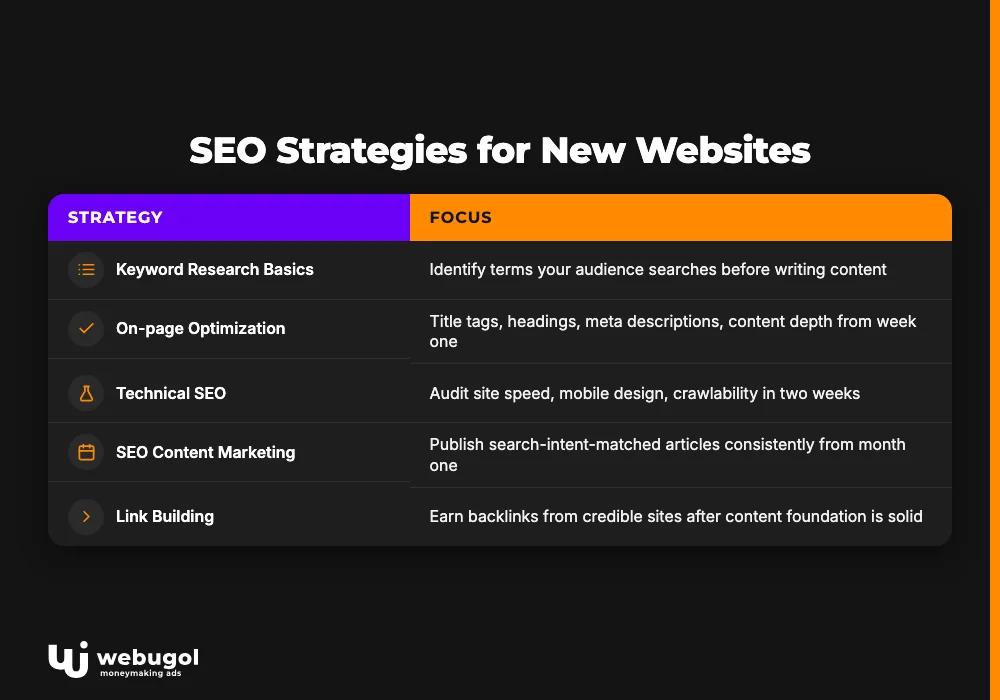
Applying tactics in the right order matters as much as applying them at all. New sites gain the most traction from this sequence:
| Strategy | What it covers | When to start |
|---|---|---|
| Keyword research basics | Identifying terms your audience actually searches | Before any content is written |
| On-page optimization | Title tags, headings, meta descriptions, content depth | From week one |
| Technical SEO | Site speed, mobile design, crawlability | Audit in the first two weeks |
| SEO content marketing | Publishing search-intent-matched articles consistently | Month one onward |
| Link building | Earning backlinks from credible external sites | After content foundation is solid |
Start with keyword research and on-page optimization. These two produce measurable results before you have the domain authority to attract quality backlinks.
What is the difference between on-page and off-page SEO?
On-page SEO covers every element you control directly within your website: content, headings, URL structure, page speed, and internal links. Off-page SEO refers to signals from outside your site, primarily backlinks from credible websites, that tell search engines your content is trustworthy. Both are core search engine ranking factors, and neither substitutes for the other.
On-page optimization tips
Keyword placement. Use your target phrase in the title tag, H1, the opening paragraph, one or two subheadings, and naturally throughout the body. Spread it consistently. Forcing it into every sentence reduces readability and can trigger spam filters.
Content depth. A page that fully answers a query will outrank a page with superficial coverage, even if both target identical keywords. Each section should add a distinct piece of information the searcher cannot get elsewhere.
Meta titles and descriptions. The title tag directly influences ranking and is the headline every searcher reads in the results. The meta description does not affect ranking directly, but a clear, specific description raises click-through rate, which sends positive quality signals back to Google.
Internal linking. Links to related pages on your site distribute ranking authority and help search engines map your content structure. They also keep visitors navigating deeper, which improves engagement signals.
URL structure. Keep URLs short, descriptive, and keyword-inclusive. Use hyphens between words. Avoid trailing numbers, session IDs, and long parameter strings.
Off-page SEO: building authority beyond your site
Backlinks are the strongest off-page signal. Quality is what matters. One editorial link from a respected industry publication outweighs dozens of directory submissions.
The most durable link-building tactics are guest contributions on relevant publications, original research that other writers cite, and genuinely useful tools that earn links organically. Paid links and link exchanges violate Google's guidelines and can trigger algorithmic penalties.
Social activity does not affect rankings directly, but content that spreads widely earns more exposure and increases the chance of attracting natural backlinks. Organic traffic growth and social reach reinforce each other over time.
How do you choose the right keywords for SEO?
Keyword research basics start with search intent. A keyword is only valuable if the searcher's goal matches what your page delivers. Targeting "what is SEO" while selling SEO services attracts informational visitors who leave quickly, which raises bounce rate and weakens ranking.
Evaluate each keyword on three factors:
- Search volume shows how many people search for the term monthly, giving you a sense of traffic potential.
- Keyword difficulty measures how competitive the term is, based on the authority of pages currently ranking for it.
- Search intent classifies the query as informational, navigational, or transactional, determining what type of content to build.
New sites should prioritize long-tail keywords: specific, lower-competition phrases where ranking is achievable without high domain authority. As the site grows, broader and more competitive terms become reachable.
Technical SEO: core search engine ranking factors
Technical SEO covers the infrastructure search engines use to find, crawl, and evaluate your pages. These factors directly affect whether pages can rank at all:
- Page speed influences both user experience and ranking. Compress images, minimize JavaScript, and use a content delivery network.
- Mobile-friendliness is mandatory under Google's mobile-first indexing. Your mobile version is what Google primarily crawls.
- HTTPS is a confirmed direct ranking signal. An SSL certificate also builds visitor trust.
- Crawlability depends on a clear XML sitemap, a correctly configured robots.txt file, and logical site architecture.
- Structured data markup helps search engines understand your content type and can activate rich results like FAQ snippets and review stars in the SERP.
- Broken links create dead ends for both users and crawlers. Audit and fix them on a regular schedule.
For a detailed comparison of how technical choices interact with content decisions, the technical vs. content SEO breakdown covers each trade-off across both disciplines.
How long does it take to see SEO results?
Most sites begin seeing measurable organic traffic growth within three to six months of consistent effort. Significant keyword ranking gains typically take six to twelve months. New domains and competitive niches tend toward the longer end.
Months 1-3: Audit the site for technical issues, complete keyword research, publish the first optimized content pieces, and configure Google Analytics and Search Console.
Months 4-6: Expand content to cover keyword gaps identified in Search Console, optimize existing pages using performance data, and begin building backlinks through outreach and guest contributions.
Months 7-9: Repurpose high-performing content, diversify link-building sources, and add interactive elements to improve time-on-page.
Months 10-12: Run a full SEO audit to assess cumulative progress, refine the strategy based on long-term data, and pursue higher-authority link opportunities.
Consistency through algorithm updates separates sites that stagnate from those that compound ranking gains year over year.
How much does professional SEO cost for a small business?
Professional SEO costs vary based on scope, market competition, and the type of provider. Freelancers, boutique agencies, and large firms price the same work differently.
The most cost-effective approach starts with a technical audit to identify the highest-priority gaps. Investing in content and link building before fixing technical issues produces weaker returns. A scoped engagement focused on specific ranking goals typically delivers clearer ROI than an open-ended monthly retainer.
Any provider promising guaranteed rankings should be treated with caution. Competitive dynamics and ongoing algorithm changes mean no legitimate agency can guarantee specific search positions.
Key metrics to track your organic traffic growth
Proven SEO strategies only improve over time if you measure their impact consistently. The metrics that matter most:
- Organic sessions confirm whether your keyword and content approach is working. Track the trend over 90-day windows to filter out weekly volatility.
- Keyword rankings should be reviewed weekly for target terms. Sudden drops often point to technical issues or algorithm updates worth investigating.
- Click-through rate on ranked pages reveals whether your title tags and meta descriptions are compelling enough to earn the click.
- Bounce rate indicates whether searchers find what they expected. A high rate on a well-ranked page typically signals a search-intent mismatch.
- Backlink growth is a leading indicator of long-term authority. Track new and lost links monthly.
- Conversion rate from organic sessions measures whether traffic delivers business value, not just visitor counts.
SEO and paid search data work best read together. If you are weighing how paid campaigns fit into a broader search strategy, the guide on how paid search complements organic ranking is a practical starting point.
Apply proven SEO strategies with expert support
The proven SEO strategies in this guide, keyword research, on-page optimization, technical health, link building, and performance tracking, produce results when applied as a connected system. Each area reinforces the others. Start with a technical foundation, build keyword-targeted content, and grow authority through quality links.
Search engine ranking factors shift, but the fundamentals remain stable. Sites that measure consistently, update content when it ages, and maintain clean technical infrastructure are the ones that sustain rankings through algorithm changes.
A digital marketing agency can audit your current state, identify the gaps holding back your rankings, and build a prioritized roadmap to reach your growth targets.
FAQ
How long does it take to see SEO results?
Most websites see measurable organic traffic increases within three to six months of consistent work. Competitive keywords and newer domains typically require six to twelve months before significant ranking gains appear.
What are the most important on-page optimization tips for beginners?
Start by placing your primary keyword in the title tag, H1, and first paragraph, then review your internal link structure and meta descriptions. Content that directly and thoroughly answers the search query consistently outperforms content that targets keywords without matching the searcher's intent.
What is keyword research and why does it matter?
Keyword research identifies the exact phrases your audience types into search engines and reveals the intent behind each query. Choosing terms that align with your page's purpose ensures you attract visitors likely to engage or convert, not ones who leave immediately.
What is the difference between on-page and off-page SEO?
On-page SEO includes everything you control within your site: content, title tags, headings, internal links, and technical performance. Off-page SEO refers to external signals, primarily backlinks from credible websites, that signal authority to search engines.
Do I need technical SEO if my site is small?
Yes. Slow load times, broken links, and missing sitemaps affect rankings at every site size. Fixing these issues early prevents ranking ceilings that become significantly harder to resolve as the site grows.