



SEO website audit: find and fix what holds your site back
An SEO website audit is a structured analysis of your site that surfaces technical errors, on-page issues, and off-page weaknesses blocking search visibility. It examines everything from sitemap configuration and HTTP status codes to title tags, heading structure, and backlink quality. Running it before any promotion campaign, and repeating the process at least twice a year, gives you a prioritized seo audit report your team can act on immediately.
What does an SEO website audit include?
A complete SEO website audit covers three layers, each targeting a different dimension of search performance:
| Audit layer | What gets checked |
|---|---|
| Technical SEO audit | Sitemap.xml, robots.txt, HTTP status codes, SSL certificate, page load speed |
| On-page SEO audit | Title tags, meta descriptions, H1/H2/H3 headings, image alt attributes, URL structure |
| Off-page SEO audit | Backlink quality, anchor text distribution, social profiles, Google Business Profile |
A well-structured report groups findings by severity so your team addresses what matters most first, not just what is easiest to fix.
What is the difference between on-page and off-page SEO audit?
The on-page SEO audit examines everything inside your site that search engines read: code, metadata, headings, and content. The off-page SEO audit reviews signals from outside your site, primarily the backlinks pointing to your domain. Both layers affect rankings, and both belong in any serious website audit checklist.
On-page SEO audit components
Title tags must be unique across every page and stay within 65 characters. Duplicate or missing titles are among the most common findings in an on-page SEO audit, and each one creates a situation where two pages compete for the same query in search results.
Meta descriptions run 120-145 characters and shape click-through rate. They should describe the page content accurately; keyword-stuffed descriptions lower trust and signal spam patterns to crawlers.
H1 headings must appear once per page, sit above any H2-H6 tags, and not duplicate the title tag. Supporting headings (H2-H3) typically appear 3-8 times per page depending on content volume. Reviewing how headings are structured across the full site often exposes dozens of structural errors that a page-by-page check misses entirely.
Image alt attributes need descriptive text that includes relevant key phrases. The audit flags every image missing an alt tag. URL structure should be human-readable, match the page topic, and maintain consistent nesting depth across the site.
Off-page SEO audit components
The link audit examines every domain pointing to your site, with quality taking priority over volume. A high count of low-quality links from unrelated domains can pull rankings down rather than raise them. Google's Penguin algorithm targets over-anchored or spammy backlink patterns specifically, so natural anchor text distribution is a signal the off-page SEO audit measures carefully.
Active, linked social media profiles add a credibility layer that both search engines and first-time visitors recognize. Google Business Profile is essential for any business with a physical location: a complete, regularly updated profile with genuine reviews raises local trust signals and affects map rankings directly.

Technical SEO audit: the checks that underpin everything else
The technical SEO audit is the foundation all other layers rest on. If crawlers cannot reliably access and read your pages, quality content and strong backlinks both underperform.
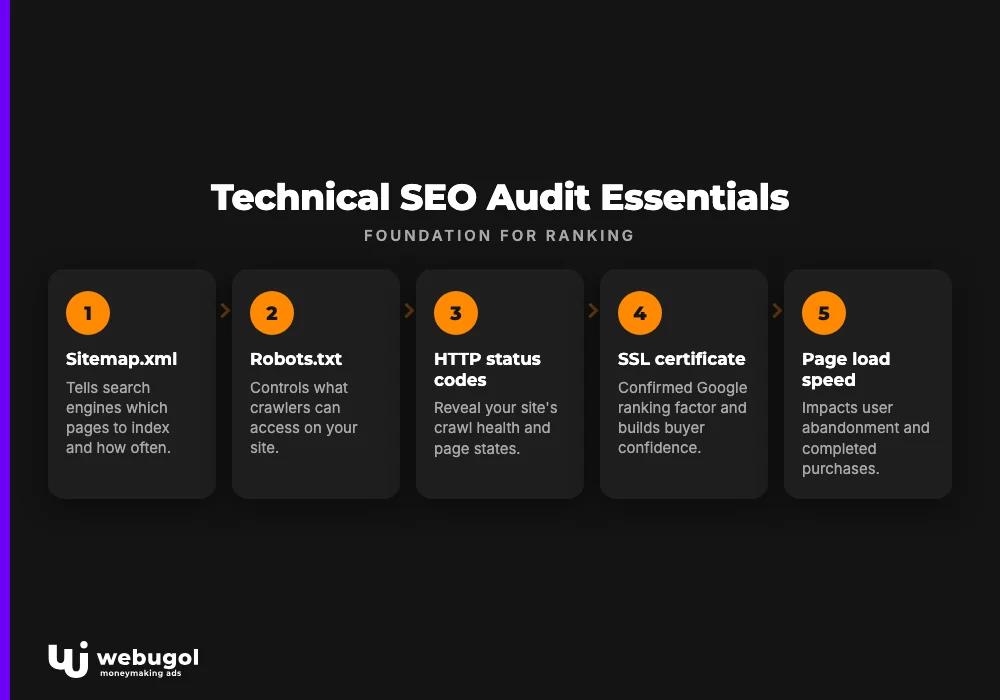
Sitemap.xml tells search engines which pages to index and how often to re-check them. A valid sitemap must contain no more than 50,000 URLs and weigh no more than 10 MB. Larger sites split the sitemap across multiple files with a single master index referencing all of them. Verify the sitemap in Google Search Console and add its path to robots.txt.
Robots.txt controls what crawlers can access. Misconfigured rules frequently block pages that should rank, or leave admin and staging pages open to indexing.
HTTP status codes reveal the actual state of your site's crawl health. Pages that exist should return 200 OK. Permanent redirects must use 301, not 302. Using 302 for a permanent move is a common technical mistake that leaks link equity. Duplicate pages need 301 redirects to their canonical version. Missing pages should return 404; a server returning 200 for a non-existent URL creates a "soft 404" that can enter Google's index and dilute ranking signals. Server-side 500 errors typically trace back to .htaccess directives, plugin conflicts, or script timeout limits. Check server logs, correct syntax errors, disable recently added plugins, and restore from a backup if needed.
SSL certificate is a confirmed Google ranking factor. For e-commerce sites, the absence of HTTPS also removes buyer confidence at the point of purchase.
Page load speed carries documented business consequences. Google's research shows approximately 53% of mobile users abandon a site that takes longer than 3 seconds to load, and one extra second on an e-commerce site cuts completed purchases by about 20% (Think With Google). The most common causes found during audits are underpowered hosting, oversized or poorly formatted images, and bloated CMS themes. Running PageSpeed Insights to identify specific load bottlenecks is the standard starting point for any speed-related finding.
How to act on your seo audit report
A list of 150 issues is not an action plan. It becomes useful only when findings are sorted by three criteria: severity (does the issue block crawling or just reduce efficiency?), volume (how many pages does it affect?), and effort (how long does the fix take?).
Crawl blockers and 500 errors go first because they stop Google from reading content beyond them. Redirect chains and soft 404s come next, as they quietly transfer link authority away from the pages you want to rank. On-page issues such as missing titles, empty alt tags, and duplicate headings come after, since they affect one page at a time. Off-page cleanup, including disavowing low-quality links and completing the Google Business Profile, follows once the technical foundation is stable.
This ordering converts a findings list into a sprint backlog a development team can execute without constant guidance.
What tools are used for an SEO website audit?
The choice of site audit tools depends on crawl volume and how frequently you need automated sweeps. Google's free tools cover most of what a standard website audit checklist requires for smaller sites.
Google Search Console is the primary resource for indexation data, crawl errors, and manual action alerts. If Google has issued a penalty, it appears here. An "Action Against Site" penalty removes the domain from search results entirely. An "Action Against Links" penalty requires cleaning the backlink profile and waiting for Google to re-crawl the site, a process that can take considerable time.
PageSpeed Insights generates a load-speed report with specific fix recommendations. It is the standard tool for any speed-related finding in the technical SEO audit.
The `site:` command in Google search (for example, site:yourdomain.com) gives a fast index check. Pages missing from results point to a crawl configuration issue worth investigating.
Paid crawling platforms extend these capabilities by automating full-site sweeps and grouping findings by category and severity. They are most useful for larger sites or teams running audits on a regular schedule.
How often should you run an SEO audit?
Run a full SEO website audit at least twice a year, and always before starting a new promotion campaign. Sites with frequent content updates, recent CMS migrations, or redesigns benefit from quarterly audits. Technical issues left unchecked can suppress traffic within weeks.
It also works as a content planning tool: reviewing which pages rank, which have dropped, and where topic gaps exist helps you decide what to update or create next, not just what to fix technically.

How long does a full SEO audit take?
Scope determines duration. A technical crawl for a small site under 500 pages takes a few hours. Covering all three layers for a mid-size site takes several days, including time to turn raw findings into an actionable deliverable.
Raw issue counts are not the deliverable. Sorting findings by impact, assigning severity ratings, and drafting fix recommendations is what converts audit data into work a team can execute. Understanding where SEO fits within your overall acquisition strategy helps set realistic expectations for when audit fixes show up as traffic gains.
Get your SEO website audit done right
A regular SEO website audit is the most direct path to finding what is costing you rankings and addressing it before the damage compounds. The Webugol team runs full technical, on-page, and off-page audits with a detailed seo audit report and a prioritized website audit checklist your developers can act on immediately. Contact us to schedule your audit.
Frequently asked questions
What does a complete SEO website audit cover?
The analysis covers a technical SEO audit (crawl health, status codes, SSL, page speed), an on-page SEO audit (titles, headings, meta descriptions, image alt tags, URL structure), and an off-page SEO audit (backlink quality, anchor distribution, Google Business Profile). Each layer produces prioritized findings across all three dimensions.
How often should you run an SEO audit?
Run a full audit at least twice a year. Sites going through redesigns, hosting migrations, or active link-building should audit quarterly, because technical problems and algorithm changes can suppress rankings within weeks of going undetected.
What tools are used for an SEO website audit?
Google Search Console and PageSpeed Insights cover most of a standard website audit checklist at no cost. Larger sites typically add a dedicated site audit tool that automates full-site crawls and groups findings by category and severity.
How long does a full SEO audit take?
A basic technical crawl for a small site takes a few hours. A comprehensive SEO website audit covering all three layers typically takes several days for a mid-size site, including time to organize findings into a prioritized audit report.
What is an SEO audit report?
An SEO audit report is the structured output of an audit: a categorized list of issues across technical, on-page, and off-page layers, each with a severity rating and a recommended fix. A well-organized report tells your team which problems to address first for the fastest improvement in search rankings.