



Bespoke MVP development company: why custom beats cookie-cutter
A bespoke MVP development company builds your minimum viable product from your exact data model, user flows, and integration requirements rather than adapting a recycled boilerplate. Template agencies ship products they have built ten times before; a bespoke shop delivers architecture that belongs to you and scales on your terms. For founders and marketing leads who want tailored delivery over templated work, the right partner builds both the product and the growth infrastructure that makes it scale from day one.
What does "bespoke" actually mean in MVP development?
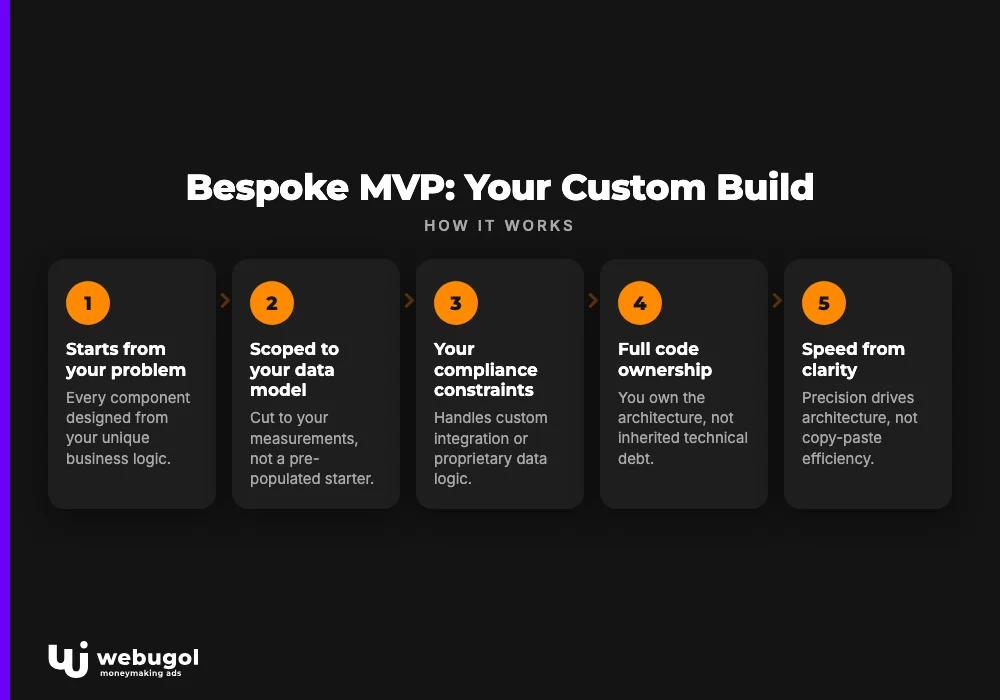
Bespoke MVP development means every component of the product is designed from your unique business logic rather than from a pre-populated starter repository. No shared UI kit. No copy-pasted auth flow carried over from last quarter's client project.
The word "bespoke" comes from tailoring. A bespoke suit is cut to your measurements; a bespoke build is scoped to your data model, your compliance constraints, and your growth trajectory. Template agencies optimize for delivery speed by reusing components across clients. That tradeoff works for a standard application with no unique constraints and stops working the moment your product requires a custom integration, proprietary data logic, or a compliance requirement the template was never designed to handle.
Bespoke vs template: the real difference
Template-based agencies start every project from the same repository. The UI components, authentication module, and database schema are reused with surface-level modifications for each client. That cuts their cost of delivery, not yours. You pay the same rate but inherit their design decisions, their technical debt, and the architectural constraints of a system built for someone else's problem.
A bespoke approach starts from your problem. What data does your product capture? Who are the users, and how do they move through it? What third-party systems must connect on day one? The answers drive the architecture. Speed comes from clarity and precision, not from copy-paste efficiency.
| Bespoke | Template agency | No-code (e.g. Lovable) | |
|---|---|---|---|
| Starting point | Your data model and user flows | Reused boilerplate repository | Platform's visual builder |
| Code ownership | Full, yours entirely | Partial (shared architecture patterns) | None (platform-dependent) |
| Timeline | 4–16 weeks | 3–8 weeks | 1–4 weeks |
| Entry cost | From $3–5k (AI-assisted) | Comparable but ceiling is lower | Low upfront, platform subscription ongoing |
| Best for | Regulated products, proprietary logic, scale | Standard apps with no unique constraints | Prototyping and pre-seed validation |
| Core risk | Requires a skilled partner | Technical debt, missed requirements | Platform lock-in, integration ceiling |
When should you choose bespoke MVP over no-code tools like Lovable?
Choose a bespoke MVP development company over Lovable or Bubble when your product requires custom integrations, proprietary logic, compliance controls, or IP protection that the platform cannot support at the architecture level. Lovable is an excellent tool for validating a concept quickly. It is not built for a HIPAA-compliant data flow, a custom ML inference layer, or a multi-tenant SaaS with granular role-based permissions.
The platform ceiling is structural, not a pricing tier. You cannot buy your way past Lovable's auth architecture or Bubble's performance limits under sustained load. If your product's moat is a proprietary algorithm, a unique data model, or a workflow you plan to protect as IP, that IP sits on a platform you do not own. That is a liability before the first user ever signs up.
When do you actually need a bespoke MVP?
You need a bespoke MVP development company when off-the-shelf tooling creates a technical, legal, or competitive ceiling you cannot build past. Three triggers come up consistently across the founders and marketing leads who reach this decision: a compliance requirement the platform cannot satisfy, proprietary logic that is the product, and a no-code tool that has already stopped scaling. Each of these is a structural problem, not a configuration problem.
You are ready for bespoke if any of the following apply:
- Your product must meet HIPAA, SOC 2, or GDPR right-to-erasure requirements, and your no-code tool's compliance documentation does not satisfy your legal team.
- You need a third-party integration that requires a custom API adapter, not a native connector the platform already ships.
- The core of your product is a proprietary algorithm, scoring model, or data transformation that must stay private and fully owned by you.
- You have already shipped a no-code prototype and hit a wall: missing webhook support, degraded performance under load, or no way to customize the authentication flow.
- An investor, partner, or enterprise customer has asked for a code review, a security audit, or IP assignment, none of which are possible on a platform you do not control.
You have compliance or integration requirements
Regulated industries like healthcare and fintech are the clearest case. HIPAA requires a business associate agreement, specific encryption standards, and audit logs. Most no-code platforms do not expose the control depth these requirements demand, and even when a platform claims compliance, your ability to manage data handling is limited by what that platform chooses to surface to operators.
Deep third-party integrations follow the same logic. A custom EHR connector, real-time insurance eligibility checks, or multi-vendor payment routing all require an API layer you own and can audit independently. This is an architectural constraint, not a plan tier. If compliance or a critical integration sits anywhere on your roadmap, retrofitting a no-code prototype into a compliant architecture costs more and takes longer than building it correctly at the start. A bespoke MVP service built for your data model from the first sprint eliminates that rework cost entirely.
Your IP is the core product
When a proprietary algorithm, a unique data model, or a novel workflow is your competitive moat, the code that embodies it must be yours outright. Templated repositories come with shared architecture patterns that can be identified, reversed, and replicated. Code that lives on a third-party platform can be governed by that platform's terms of service, limiting your ability to assign, license, or protect it.
The IP risk is not theoretical. It surfaces when you raise your Series A and investors conduct a code audit. It surfaces again when you negotiate an acquisition and the buyer asks for clean ownership documentation. Build the moat on foundations you own from the first sprint.
You have hit the ceiling of no-code
The no-code ceiling is specific. It looks like page load times that degrade past a certain user count, webhooks that fire inconsistently, an authentication flow you cannot extend beyond the platform's defaults, and a support ticket that closes with "that feature is not on our roadmap." These are not bugs to fix. They are the product of a platform optimized for the median use case.
The transition from a no-code prototype to a custom build is not a failure of the prototype. The prototype validated the idea quickly, which is exactly what it was built to do. A bespoke MVP development company takes that validated concept and rebuilds it on an architecture that scales with your users and product requirements, carrying forward what you learned while discarding the ceiling that blocked you.
How we build bespoke MVPs, and why AI changes the price
Traditional custom development quoted projects at $50,000 and up, with timelines measured in quarters. That ceiling kept bespoke MVP development out of reach for most early-stage founders. AI-assisted development changes the math. Working with a bespoke MVP development company that uses AI tooling compresses development time enough to bring the entry point to $3–5k without compromising the architectural quality that makes bespoke work worth pursuing.
Discovery and custom scoping for non-technical founders
For a founder without an in-house engineering team, translating a business problem into a development brief is the first place projects go wrong. Teams skip discovery, write a rough spec, and hand it to developers who build the wrong thing precisely. Discovery is the checkpoint that prevents this. It surfaces the requirements, the risks, and the full scope before a single line of code is committed.
At Webugol, the discovery process starts with a structured session that captures your business goals, your users, the jobs they need to do, and the integrations your product must support on day one. The output is a written scope document your developer, your investor, and your legal counsel can read without a translator. No jargon.
Here is what the full process looks like from first contact to shipped product:
- Intro call (30 minutes): goals, timeline constraints, and rough budget alignment.
- Discovery session (60 to 90 minutes): user flows, integration map, compliance requirements, and feature prioritization.
- Scope document: written brief with tech stack recommendation, component list, and risk callouts.
- Cost and timeline estimate: tiered by complexity, with AI-assisted and full-custom options clearly separated.
- Design sprint: wireframes and user flow diagrams reviewed and approved before development starts.
- Development sprints: two-week cycles with working product demos at the end of each cycle.
- QA and launch: structured testing against your acceptance criteria, then deployment to your infrastructure.
- Handoff: complete code ownership, full documentation, and an optional post-launch growth kickoff session.
AI-accelerated build from $3–5k
AI code generation tools compress repetitive development work: boilerplate scaffolding, standard API connectors, test generation, and documentation. A project that required six weeks of full-time engineering two years ago can ship in three to four weeks today. The compression is real and shows up directly in the scope estimates that come out of discovery.
The critical boundary is where AI tooling ends and human judgment begins. AI generates code; it does not make architectural decisions. It does not know that your healthcare product needs a full audit log or that your SaaS pricing model requires a specific subscription logic layer. Those decisions require a senior engineer who understands your problem domain. The result is a bespoke MVP development company workflow where AI handles velocity and the human team handles architecture, compliance logic, and the domain-specific decisions that determine whether the product actually works for your users.
Before your first call, run through our MVP planning checklist to understand what discovery covers, or review MVP service details to see how the full engagement is structured.

Bespoke MVP cost and timeline: honest numbers
The cost of working with a bespoke MVP development company depends on three variables: the complexity of your data model, the number and depth of integrations, and how much of the work AI tooling can accelerate. No single number covers all projects. The tiers below reflect how scope typically breaks out.
- AI-assisted MVP ($3–5k, 4–6 weeks): A single-flow product with minimal third-party integrations and no regulated data handling. AI tooling handles the scaffolding; engineering hours focus on architecture review, testing, and launch.
- Hybrid build ($8–15k, 6–10 weeks): Multiple user roles, two to four integrations, and some custom business logic. AI handles boilerplate; engineers own the domain-specific components and integration work.
- Full custom ($15–30k+, 10–16 weeks): Regulated data requirements, complex multi-tenant architecture, or significant AI feature work including RAG pipelines, custom agents, or fine-tuned model integrations. AI tooling reduces time-to-ship but cannot replace the depth of engineering these builds require.
These ranges assume a focused scope coming out of a completed discovery session. Each new integration, each compliance requirement, and each scope change mid-sprint adds to the timeline and to the cost. A well-run discovery phase is what keeps the final number close to the original estimate, which is why no serious bespoke agency skips it. If an agency gives you a fixed price without a discovery session, that price was not built for your product.
What happens after your MVP launches? Growth, not silence
Most agencies hand you a repository and disappear. The founder is left with a shipped product, no roadmap for getting users, and no system for improving conversion based on what the usage data shows. This gap is not an oversight. It is a structural feature of the pure dev-agency model: the engagement ends at launch and the problem of growth begins.
Working with a bespoke MVP development company that bundles development with post-launch growth infrastructure changes what you stop losing after day one. Instead of a handoff, you get a system: SEO-optimized product pages, a conversion funnel from first visit to sign-up, analytics wired into the decisions that matter, and an iteration roadmap tied to actual user behavior rather than the assumptions you made at discovery.
The first 90 days after launch are where most MVPs either compound or stall. Here is what a growth-focused post-launch plan covers:
- SEO foundation: title structure, meta tags, and site architecture set for indexing from day one of launch.
- Conversion audit: identify where users drop off between landing and activation, then ship prioritized fixes against real data.
- Funnel instrumentation: events tracked and dashboards built so every product change has a measurable effect you can read.
- Content entry points: initial blog posts or landing pages targeting the highest-intent search queries for your specific product category.
- Retention baseline: email sequences or in-app nudges for the first activation and the return visit.
- Iteration sprint: a two-week post-launch review of real user behavior with a prioritized fix list.
The dev-plus-growth bundle is what turns a validated MVP into a product that acquires users on its own instead of waiting for you to push it.
The practical difference for a business owner is in cost per booking or cost per activation. When the product ships without SEO structure, without tracked funnels, and without an iteration process, the cost of acquiring each early user is entirely manual: paid ads, founder-driven outreach, or waiting. When the growth infrastructure ships alongside the product, organic acquisition starts compounding from week one. The gap between those two trajectories widens every month. This is why Webugol positions the build and the growth system as a single engagement rather than two separate contracts.

How to spot a "bespoke" agency that is really a template shop
Many agencies describe their work as bespoke. Few mean it structurally. The word has become a marketing term, which means you need a framework for evaluating claims before signing anything.
The tell is in the process, not the portfolio. A genuine bespoke MVP development company cannot give you a fixed price before discovery because they do not know your data model yet. A template shop can quote in 24 hours because they already know what they are building. It is the same build they always do, with your brand name in the title.
5 red flags before you sign
Inspect these five signals before committing to any agency:
- Identical visual patterns across different client portfolios. If the layout structures, UI components, and interaction patterns look like variations of one theme, the work is templated regardless of what the brief said.
- A fixed price delivered within 24 hours of first contact. Real scoping takes a discovery session. A quote that arrives the same day as your introductory email was not built for your problem.
- No discovery phase in the proposed process. If the agency goes straight from "tell us your idea" to "here is the statement of work," they are skipping the step that determines whether the build will actually fit your requirements.
- NDA or contract language that restricts code ownership. Some agreements include IP clauses that give the agency rights to reuse your architecture across other projects. Read the ownership section before signing.
- A development team simultaneously active on more than five projects. This is a capacity signal. It tells you how much attention your sprint will get when competing priorities arrive.
Bespoke MVPs we have built
Three product builds from the Webugol portfolio show how the development-plus-growth model works in practice. Each started with a discovery session, was built to the client's specific architecture requirements, and launched into an active growth system rather than a handoff.
Valhalla Vitality is a direct-to-consumer wellness brand that needed a product experience built around its specific supplement protocol and subscription model. The build centered on a custom data model for recurring commerce and a conversion funnel integrated with educational content that acquires customers before they reach the product page. The subscription logic, the content system, and the checkout flow were designed as one architecture rather than separate tools stitched together after launch. Architecture and growth system were scoped in the same discovery session, which is what makes the product coherent instead of patched.
Ways2Well is a functional medicine platform that required a custom patient intake and care coordination workflow. The integration requirements included electronic health record connectivity and a provider-facing dashboard that no no-code tool could approximate. The build was scoped for HIPAA compliance from the first sprint, with the audit log and encryption requirements built into the data model rather than added later. That upfront architectural decision is what made the platform signable for clinical partners from day one, without a costly compliance retrofit mid-growth.
Humanaut Health is a telehealth brand with a consumer-facing product and a clinical backend operating across multiple provider workflows. The challenge was maintaining brand consistency across a complex multi-role system while keeping the patient experience clean and fast. The build paired custom frontend design with a backend built for clinical data handling and asynchronous provider workflows at scale. Each role in the system, patient, provider, and administrator, operates on its own data view without exposing information across boundaries.
See more product build examples in minimum viable product examples.

Ready to build your bespoke MVP?
If your product needs custom integrations, proprietary logic, or a growth system that scales after launch, the template route will cost you more in rebuilds than the initial savings are worth. The entry point for AI-assisted bespoke development starts at $3–5k. That is the range where you get a product you own completely, built to your specification, by a team that stays on after launch to make it grow.
Webugol owns the full growth path from first sprint to first thousand users. Describe your product requirements and get a scope document within a week.
Frequently asked questions
What is a bespoke MVP development company?
A bespoke MVP development company builds minimum viable products designed around your specific data model, user flows, and integration requirements rather than adapting a reused boilerplate. The key distinction is complete code ownership and architectural fit from the first sprint. This matters most when your product has compliance requirements, proprietary logic, or integration constraints that generic templates cannot accommodate.
How much does bespoke MVP development cost?
Bespoke MVP development starts at $3–5k for an AI-assisted single-flow product and scales to $15–30k and above for regulated or complex multi-integration builds. The cost depends primarily on how many integrations the product requires, whether compliance documentation is needed, and the complexity of the data model. A scoping session before quoting keeps the estimate aligned with your actual requirements rather than a generic rate card.
How long does it take to build a bespoke MVP?
An AI-accelerated bespoke MVP can ship in 4–6 weeks for a focused single-flow product with no compliance requirements. A full custom build with regulated data, multiple user roles, or significant AI feature work typically takes 10–16 weeks. Timeline accuracy depends on completing a thorough discovery phase before development starts; scope changes mid-sprint are the primary cause of overruns.
When should I choose bespoke MVP over no-code tools like Lovable?
Choose bespoke MVP development when your product requires a third-party integration Lovable does not support natively, when your data handling must meet a regulated compliance standard, or when your core product logic is proprietary and must be owned outright by you. No-code tools are the right choice for fast validation of a concept before the architecture decisions matter. The trigger to switch is when the platform's ceiling becomes the product's ceiling.
Can a bespoke MVP include AI features such as chatbots, agents, or RAG?
Yes. A bespoke build is the correct architecture for AI-native product features. Retrieval-augmented generation, custom agents, and task-specific chatbots all require a backend you control: vector stores, prompt management, evaluation pipelines, and latency optimization that no-code platforms do not expose. Webugol has built production LLM products with these components and can scope AI features into your MVP from the discovery session.

