



Plastic surgery marketing: how to get more booked consultations
Effective plastic surgery marketing connects the moment a patient searches online to the moment they confirm a consultation. Practices that grow consistently combine cosmetic surgery SEO, targeted paid search, and an active review strategy, all tied together by tracking that tells you what is actually driving bookings. The ones that plateau are running all those channels too. The difference is broken handoffs between them.
Whether you manage a single-surgeon cosmetic practice or a multi-location clinic group, the structural gaps look identical: attribution that obscures real cost per lead, landing pages that inform without converting, and follow-up sequences that reach prospects three hours after they already called someone else. These are not problems unique to new practices. They are the same friction points that stop a proven clinic from scaling past its current ceiling.
Why plastic surgery marketing stalls at the handoffs
Plastic surgeon lead generation failures are usually misdiagnosed. When consultation bookings plateau, the instinct is to increase ad spend or launch a new channel. In most cases, the problem is not at the top of the funnel. It sits in the conversion path.
A landing page that loads slowly on mobile loses visitors before they read a word. A form that asks for detailed medical information upfront discourages submission. A lead that waits hours for a response will book with the competitor who called first. Each failure is invisible in a standard ad platform report.
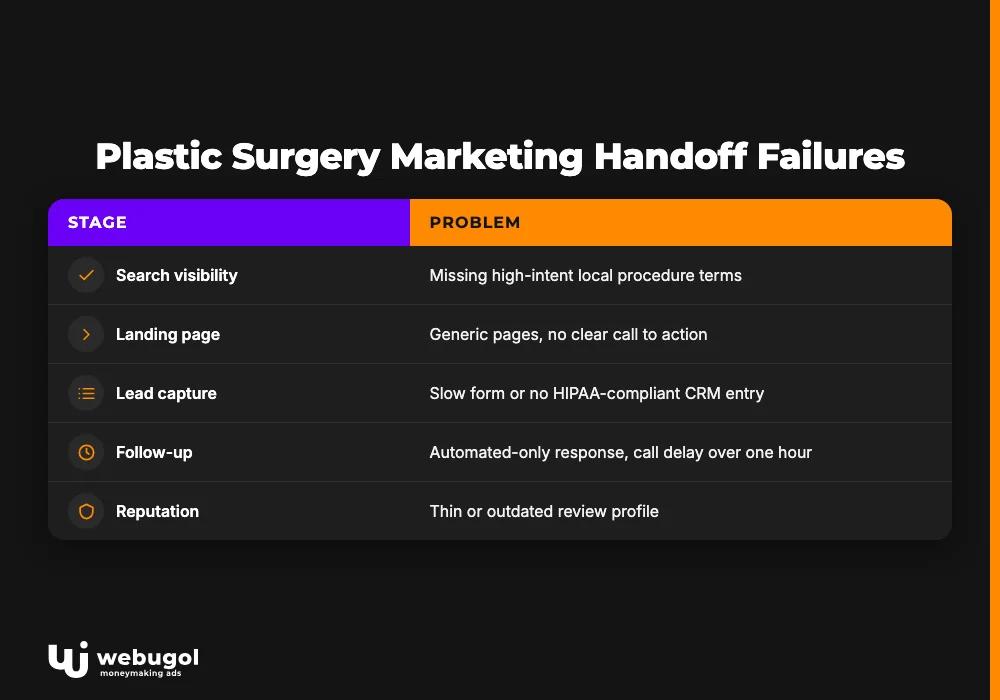
The table below maps common failure points across the plastic surgery patient journey.
| Stage | Common failure | Business cost |
|---|---|---|
| Search visibility | Missing high-intent local procedure terms | Zero organic traffic from ready-to-book patients |
| Landing page | Generic procedure pages, no clear CTA | High bounce rate, wasted paid spend |
| Lead capture | Slow form or no HIPAA-compliant CRM entry | Prospect books elsewhere before you respond |
| Follow-up | Automated-only response, call delay over one hour | Low show rate, inflated CPL |
| Reputation | Thin or outdated review profile | Prospect chooses a higher-rated practice |
Fixing one row in isolation produces a temporary bump. Fixing the full path compounds.
How to market a plastic surgery practice online?
The most effective way to market a plastic surgery practice online is to run paid and organic acquisition in parallel, with a reputation layer that handles the final conversion step. Paid search fills the pipeline now. SEO builds a lower-cost acquisition base over time. Reviews convert the traffic both channels generate.
Your website is the operational center of everything. For plastic surgery marketing to work at any budget level, the site needs fast load times, mobile-first design, and procedure pages built around the specific questions patients ask before they call. Before-and-after galleries build trust, but only after the page has already established credibility through accurate information and clear surgeon credentials.
Healthcare social media marketing plays a supporting role in this mix. Instagram and TikTok work well for before-and-after content and surgeon presence, but social rarely closes a high-consideration elective procedure on its own. It reinforces decisions for prospects already in your funnel, not a primary acquisition driver.
What digital marketing strategies work for cosmetic surgeons?
The strategies that consistently deliver results for cosmetic surgeons fall into three categories: search acquisition (SEO and paid), conversion infrastructure (website and landing pages), and reputation (reviews and trust signals). Medical spa digital marketing follows the same framework, with more weight on membership and repeat-visit retention.
Cosmetic surgery SEO and local search
Cosmetic surgery SEO focuses on two objectives: ranking for procedure-specific terms at the city level, and capturing informational queries from patients in the research phase. High-intent local terms bring in patients close to booking. Informational queries ("rhinoplasty recovery time", "what does a facelift cost") bring in patients earlier and allow more time to build trust before they convert.
For cosmetic clinic local SEO, your Google Business Profile matters as much as your website. A complete, well-managed profile with accurate procedure categories, regular photo updates, and an active review response cadence ranks in the local map pack. Missing from that pack means a competitor books the consult. The complete local search framework for medical practices is in our healthcare local SEO guide.
Blog posts and FAQ pages built around procedure-specific patient questions build topical authority and reduce paid acquisition dependency over time. A well-structured content calendar mapped to procedure seasonality helps concentrate effort where organic demand is highest.
Plastic surgeon Google Ads
Paid search fills the gaps that SEO takes months to close. Plastic surgeon Google Ads campaigns can generate booked consultations from day one, but only when landing pages match the search intent and conversion tracking measures actual consultation bookings, not just clicks.
The highest-converting campaigns use procedure-specific landing pages with a single call to action, call extensions (many patients call directly from ads rather than submitting forms), and negative keyword lists that filter out informational searches with no booking intent. For campaign structure and bidding strategy, the healthcare ppc advertising guide covers the full approach.
One compliance point: Google restricts certain health-related targeting options, including some retargeting audiences. HIPAA-compliant conversion tracking is a requirement, not an optional upgrade. Campaigns running without a compliance review for 12 months or more carry real policy risk.
Does SEO work for plastic surgery practices?
Yes. SEO works for plastic surgery practices, and it compounds over time in a way paid search does not. A well-ranked procedure page generates qualified traffic month after month without incremental cost per click.
The timeline is real: meaningful organic results typically emerge three to six months after publishing or updating optimized content. That delay is why SEO and paid search work best together. Paid fills the near-term pipeline while SEO builds the long-term acquisition base at a structurally lower cost per consultation.
Google applies heightened quality scrutiny to health-related content under its E-E-A-T guidelines (Experience, Expertise, Authoritativeness, Trustworthiness). For cosmetic surgery practices, that means content needs clear surgeon attribution, accurate procedural information, and a review profile that confirms real patient outcomes. Thin procedure descriptions and generic blog posts do not rank in this category. Generic rewrites of competitor content perform worse still.
Patient reviews and the cosmetic surgery trust gap
A prospect checking patient reviews for a cosmetic surgeon will consult Google, RealSelf, and Healthgrades before committing to a call. That is the final filter in a high-consideration purchase. A prospect may find the practice through paid search and validate it on the website, then stop at a thin review profile and choose someone else.
The review gap works in both directions. A practice with 90 reviews averaging 4.8 stars is easier to convert than one with 15 reviews averaging 4.2, regardless of actual surgical quality. Volume signals that many patients have gone through the process and are satisfied. Recency signals that the practice is active and consistent.
Review generation requires a system. That means a consistent post-visit request process, a platform that makes submission simple, and a response cadence for all reviews, positive and negative. Responding professionally within 48 hours reduces the influence of negative reviews on future prospects. Manual, ad hoc requests produce uneven results.
One operational detail: review requests that go out before visible recovery results are complete tend to generate lower-quality responses. For procedures with recovery phases, timing the request after results are apparent produces better reviews and a more accurate reflection of the patient experience.

How to get more patients for a plastic surgery clinic?
Getting more patients starts with fixing the acquisition path, not just increasing budget. More ad spend on a broken funnel delivers more leads that do not convert. That raises cost per acquisition without changing consultation volume.
Speed-to-lead is the operational variable most plastic surgery marketing guides skip. The probability that a submitted inquiry converts to a consultation drops sharply after the first hour. Practices that respond within five to fifteen minutes, whether by call or automated text, convert a meaningfully higher share of inquiries than those that respond same-day. For high-ticket elective procedures, the prospect has often submitted to multiple practices simultaneously.
Show rate is the second metric worth attention. A consultation booked is not a consultation attended. SMS and email reminders, pre-consultation materials, and low-friction rescheduling options reduce no-shows. For practices with meaningful consultation volume, a 10-point improvement in show rate compounds faster than the same reduction in CPL because it requires no additional ad spend.
Plastic surgery also has an unusually long consideration window. A patient may research a procedure for several months before booking. Email nurture sequences that deliver relevant content during that period keep the practice visible without requiring ongoing ad spend on prospects not yet ready. The economics improve because you spend once to capture the lead and repeatedly deliver value until they convert.
Plastic surgeon lead generation that scales reliably requires end-to-end measurement: which campaigns produce consultations rather than just clicks, which procedure pages convert, which follow-up sequences book the most appointments. HIPAA-compliant CRM integration is what connects ad platform data to real patient outcomes.
How much does plastic surgery digital marketing cost?
There is no single correct number. Any figure without context misrepresents how cost and return actually work in this category.
The practical frame is cost per acquired patient relative to the revenue value of a new patient relationship. A high-ticket procedure practice can sustain a meaningfully higher cost per lead than one running lower-margin services. The question to ask is not "how much does digital marketing cost" but "what acquisition cost is sustainable given this practice's procedure mix and average patient value."
Established cosmetic surgery practices running active patient acquisition programs invest across paid media, SEO and content, and agency or in-house management. Allocation depends on competitive density in the local market, procedure mix, and growth targets. A practice growing aggressively in a competitive metropolitan area requires more investment than one maintaining steady volume in a less contested market.
The first budget decision worth making is measurement infrastructure. Without accurate attribution from click to booked patient, no other budget decision is well-informed. A practice spending on clicks with no HIPAA-compliant conversion tracking is funding a cost center with no feedback loop.
Ready to build a plastic surgery marketing system?
If your channels are running but consultations are not growing at the rate your spend suggests they should, the gap is almost always in the handoffs: tracking, landing pages, follow-up speed, or show rate. All of them are fixable.
Webugol builds patient acquisition systems for healthcare practices, connecting every layer from search to booked revenue. The healthcare growth system covers strategy, tracking foundation, campaign execution, and ongoing optimization as one managed program.
Book a strategy call to find where your acquisition path is leaking.
FAQ
How long does plastic surgery marketing take to show results?
Paid search can produce consultation bookings within the first few weeks of a well-structured campaign. SEO results take three to six months to become meaningful. The fastest gains typically come from fixing conversion issues on existing traffic before adding new channels or increasing spend.
What is the most effective platform for plastic surgery advertising?
Google Search captures patients actively searching for procedures, making it the highest-converting channel for most cosmetic surgery practices. Instagram and TikTok build awareness and reinforce trust for patients already in the decision process. The right mix depends on procedure type and local market competition.
Do patient reviews affect plastic surgery bookings?
Yes. High-consideration elective procedures involve extensive online research, and reviews on Google, RealSelf, and Healthgrades are a standard step in that process. Practices with more recent reviews and higher aggregate scores convert a larger share of website traffic into consultation requests.
What compliance issues affect plastic surgery digital marketing?
Google and Meta restrict certain health-related targeting options, including some retargeting configurations based on medical interests. HIPAA compliance applies to any tracking that connects user identity to a medical inquiry. These constraints are manageable with the right setup but require deliberate attention before scaling spend.
How do I measure plastic surgery marketing ROI?
Track consultations booked, show rate, and close rate from consultation to procedure, not just form fills or clicks. HIPAA-compliant CRM integration connects ad data to actual patient revenue. The goal is cost per acquired patient relative to average procedure value, not cost per click in isolation.