



AI copywriting tools: what actually works in 2026
AI copywriting tools are software programs that use machine learning and NLP to generate written content at scale. Top platforms produce ad copy, email drafts, and product descriptions in minutes. They handle volume well but require human review for brand accuracy and original judgment. This guide covers how they work, which platforms lead in 2026, and how to choose.
How AI writing tools actually work
Every modern AI content generator runs on a large language model, a statistical system trained on enormous text datasets. ChatGPT, one of the most widely used AI text generators available, was trained on over 45 TB of text drawn from books, news sources, and web pages, according to OpenAI. That dataset lets the model predict which word or phrase should follow a given prompt, producing fluent output from a short brief.
Two core capabilities drive the practical value of modern ai copywriting tools.
Predictive analytics identifies which word combinations are most likely to hold a reader's attention. When you provide a target audience and topic, the model weights its output toward language that performed well in similar contexts during training. The result feels more relevant, even without manual customization.
Natural language processing (NLP) allows the tool to interpret the sentiment and context of a prompt, not just its surface keywords. This is why modern ai writing software can approximate a specific tone, catch grammar errors automatically, and produce output that reads closer to human writing than template-based tools ever achieved. NLP also enables automatic headline generation, giving users multiple title variations from a single brief.
The quality gap between a strong and a mediocre AI content generator is rarely in the underlying model architecture. Both use similar systems. The real difference lies in fine-tuning quality, interface clarity, and how well the platform handles brand-specific constraints.
An AI system trained only on generic web text produces generic copy. One configured with your brand voice and audience context produces something you can use without a full rewrite. Setup quality determines output quality.
What are the best AI tools for copywriting in 2026?
Tools that consistently rank at the top of independent reviews fall into two categories: general-purpose LLM assistants and purpose-built ai writing software designed for marketing. Each serves a different user profile.
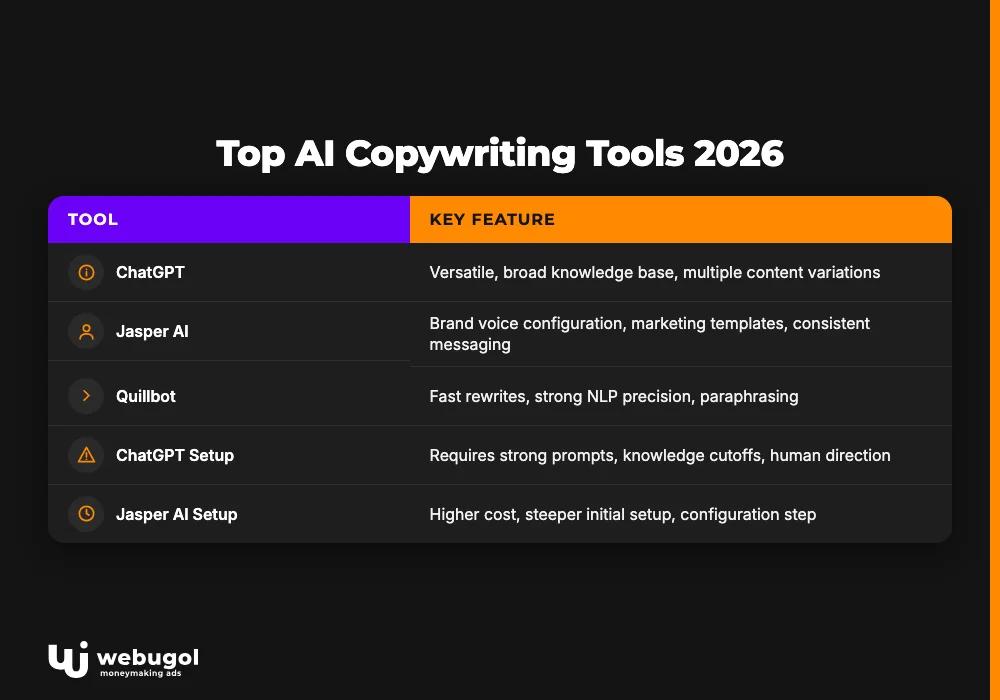
| Tool | Category | Key strength | Main limitation |
|---|---|---|---|
| ChatGPT | General LLM | Versatile; broad knowledge base | Requires strong prompts; knowledge cutoffs apply |
| Jasper AI | Purpose-built marketing | Brand voice configuration; marketing templates | Higher cost; steeper initial setup |
| Quillbot | AI paraphrasing | Fast rewrites; strong NLP precision | Reduces originality; weaker on longer text |
ChatGPT
ChatGPT stands for Generative Pre-trained Transformer. OpenAI upgraded the model in 2021 with additional source material and a redesigned interface, making it more accurate and accessible than earlier versions. The training dataset of over 45 TB gives it wide coverage across industries and formats.
The platform generates multiple content variations from a single brief, removes manual data entry from the writing process, and processes requests faster than any human writer.
The real limitation is setup time. For brand-specific output, you need to supply sample content and define a style before the model produces usable results. Complex campaigns still require human direction at both the brief and review stages.
Jasper AI
Jasper AI is built for marketing output. Users enter a target audience, industry context, and campaign objectives, and the algorithm generates messaging calibrated to those inputs. That configuration step separates generic AI output from copy that sounds like it belongs to a specific brand.
The platform applies consistent messaging rules across all outputs, reducing tonal variation between channels. It also suggests angles and framings tied to the defined brief, cutting time spent on creative ideation.
The known limitation is that its machine learning layer can miss nuances in highly specialized industries, producing text that is fluent but contextually imprecise.
Quillbot
Quillbot focuses on rewriting rather than generating content from scratch. Users paste existing text, and the tool returns a rephrased version with stronger semantic richness while preserving the original meaning. The NLP engine identifies which phrases to modify for better clarity or flow.
The workflow is direct: paste, click rewrite, review. That speed suits editors who need clean versions of first drafts or want to standardize phrasing across a large content library.
Repeated heavy use can make output sound mechanical. Longer pieces sometimes lose coherence once NLP processing reaches its current technology limits.
What is the difference between AI copywriting and AI content generation?
AI copywriting targets persuasion. The goal is to move a reader toward a specific action, whether that is a click, a form submission, or a purchase. Copywriting automation tools are built around short, high-impact formats: ad headlines, email subject lines, product page copy, and landing page sections where every word carries commercial weight.
AI content generation covers a broader scope. It includes informational articles, how-to guides, FAQs, and editorial content where the goal is accuracy and completeness rather than conversion. An article explaining how software works is content generation. A landing page selling that same software is copywriting.
The best AI writer platforms handle both, but they optimize for one or the other by default. Purpose-built tools like Jasper lean toward conversion copy. General LLMs like ChatGPT can serve either purpose depending on how the prompt is written. Knowing this distinction prevents paying for specialized copywriting automation when a general content writing AI would serve the use case better. It also shapes how any ai copywriting tools you adopt should be configured from day one.
If you are deciding where AI-generated content fits within your publishing strategy, an SEO audit of your existing blog and content performance can identify which formats are already working before you add more volume on top of them.
Can AI copywriting tools replace human writers?
No. They reduce the time human writers spend on first drafts and repetitive tasks. They do not replace judgment, factual accountability, or original thinking.
The core limitation is structural. AI copywriting tools are trained on existing text. They recombine patterns from that training data rather than originate new ideas. When a market situation is genuinely novel, or when a brand needs a voice that stands clearly apart from others in its category, the model has limited useful data to draw from.
Three constraints matter for any team evaluating whether to integrate copywriting automation:
Plagiarism risk. Systems trained on large datasets can reproduce passages or structures that resemble existing published content closely enough to create legal problems. Independent review and plagiarism checking remain necessary after any AI-generated output.
Originality ceiling. Human writers draw on personal experience, opinions, and context that exist outside any training set. That is where original angles, genuine comparisons, and counterintuitive positions come from. AI tools produce fluent pattern combinations. They do not produce genuine outliers.
Cost structure. Purpose-built AI writing software often carries significant recurring costs. For smaller organizations, factor in the human review time any AI output still requires, not just the subscription fee. Total cost per delivered, approved piece is what determines viability.
Using ai copywriting tools as a workflow component rather than a wholesale replacement produces consistent results. The tools handle speed and volume. Human editors handle accuracy and quality assurance.

Are AI copywriting tools worth it for marketing agencies?
For most agencies, yes, with specific conditions in place. The efficiency gain is clearest in high-volume, templated formats: paid search ad copy, email sequences, product description libraries, and social captions. Agencies managing multiple clients across similar verticals can build a standardized content writing AI workflow that cuts drafting time without compromising baseline quality.
The condition is structured quality control. Everything an agency produces carries the client's brand, and in regulated sectors, legal obligations as well.
An AI text generator that outputs fluent copy quickly still needs a human to verify facts, match tone precisely, and catch anything that drifts from the approved brief. The review step does not disappear.
It shifts from drafting to editing, a different skill with a different time cost attached.
Cost at scale looks different than it does on a pricing page. Purpose-built ai writing software typically prices by seat count or output volume. Model the actual cost per deliverable against the time saved in drafting before treating any tool as a margin improvement. That calculation changes significantly between a ten-client shop and a hundred-client operation.
The strongest case for ai copywriting tools in agency contexts is throughput, not cost reduction. When a client needs 300 product descriptions before end of quarter, no human writing team matches a well-configured ai text generator in raw speed. The value is in meeting demand that would otherwise require headcount expansion or missed deadlines.
For agencies building content programs that span both organic and paid channels, understanding how those channels interact and which content types serve each one shapes which AI output to prioritize.
How to choose AI writing software for your workflow
Most buying decisions come down to five practical criteria. Work through them before any free trial ends.
Output format match. Not every AI content generator handles every format equally well. A platform built for short-form social captions underperforms on long technical documents. Test against real briefs from your actual work, not demo examples provided by the vendor.
Brand customization depth. Can you configure the tool with your brand voice, or does it always produce generic output? Jasper's brand input system and ChatGPT's system prompts both address this, but through different mechanisms. Understand how before committing time or budget.
Interface complexity. AI writing software spans from single-click generators to full prompt-engineering environments. If your team lacks technical background, a simpler interface reduces errors and speeds adoption. Look for accessible documentation and responsive support channels.
Accuracy on your content type. Grammar checking is now standard across most platforms. The quality gap shows up in edge cases: specialized terminology, regional vocabulary, and format types outside the model's training distribution. Test the tool on samples from your actual content before deciding.
Total cost including human time. Count subscription fees and the hours required for setup, prompt refinement, and post-generation review. A cheaper tool that produces rough drafts may cost more in total team hours than a premium option with cleaner output. Cost per approved, delivered piece of content is the number that matters.

Get more from your content investment
AI copywriting tools work best inside a strategy that knows what it is trying to achieve. If your content output is high in volume but not producing results, or if you are evaluating how to add AI capacity without losing editorial quality, Webugol builds content systems that pair AI speed with the editorial standards your audience expects.
FAQ
What are the best AI tools for copywriting in 2026?
ChatGPT, Jasper AI, and Quillbot consistently rank among the leading platforms, each suited to different needs. ChatGPT handles versatile high-volume work across formats; Jasper is purpose-built for marketing copy with brand voice configuration; Quillbot focuses on rewriting and paraphrasing. The right choice depends on your output formats, team skill level, and budget.
Can AI copywriting tools replace human writers?
No. They accelerate first drafts and reduce time on repetitive tasks, but they cannot originate ideas, verify facts independently, or produce a genuinely distinctive brand voice without human direction. Editorial review remains necessary at every production stage.
How do AI writing tools actually work?
They run on large language models trained on massive text datasets, in some cases over 45 TB of source material, to predict which words follow a given prompt. Natural language processing adds the ability to match tone and interpret context rather than surface keywords alone.
Are AI copywriting tools worth it for marketing agencies?
Yes, particularly for high-volume or templated content like paid search ads, email sequences, and product descriptions. The condition is a structured review process, since AI output still requires human editing before it meets professional client standards reliably.
What is the difference between AI copywriting and AI content generation?
AI copywriting targets conversion through short, persuasive formats like ad headlines and landing pages. AI content generation covers informational material including blog posts, guides, and FAQs. Most platforms optimize for one or the other, so matching the tool to the actual format before subscribing matters.