



Internet marketing for architects: a complete strategy guide
Internet marketing for architects is the practice of using digital channels, including search engines, paid ads, social media, and content, to attract qualified project leads and grow a firm's client base. Done well, it replaces cold outreach with a system where the right prospects find your firm first. Architecture practices that build a coherent online presence consistently generate more inquiries than those relying on referrals alone. A well-ranked website and relevant content work around the clock.
How do architects get clients online?
Most new clients start with a search. They type "residential architect in [city]" or "commercial architecture firm" into Google, scan the first page, and evaluate firms based on website quality, portfolio depth, and reviews. Your first job online is to appear in those searches with a site that earns trust quickly.
Three channels drive the bulk of client acquisition for architecture firms. SEO for architecture firms generates free, compounding traffic over time. Paid advertising delivers immediate visibility for specific services or locations. Content marketing, through project case studies and educational guides, builds authority throughout the longer decision cycles that architecture projects demand. Most practices find that combining all three outperforms any single channel running alone.
Referrals still matter, and they work better when the referred prospect visits a strong website that makes the firm's work immediately credible, current, and easy to contact.
What digital marketing strategies work best for architecture firms?
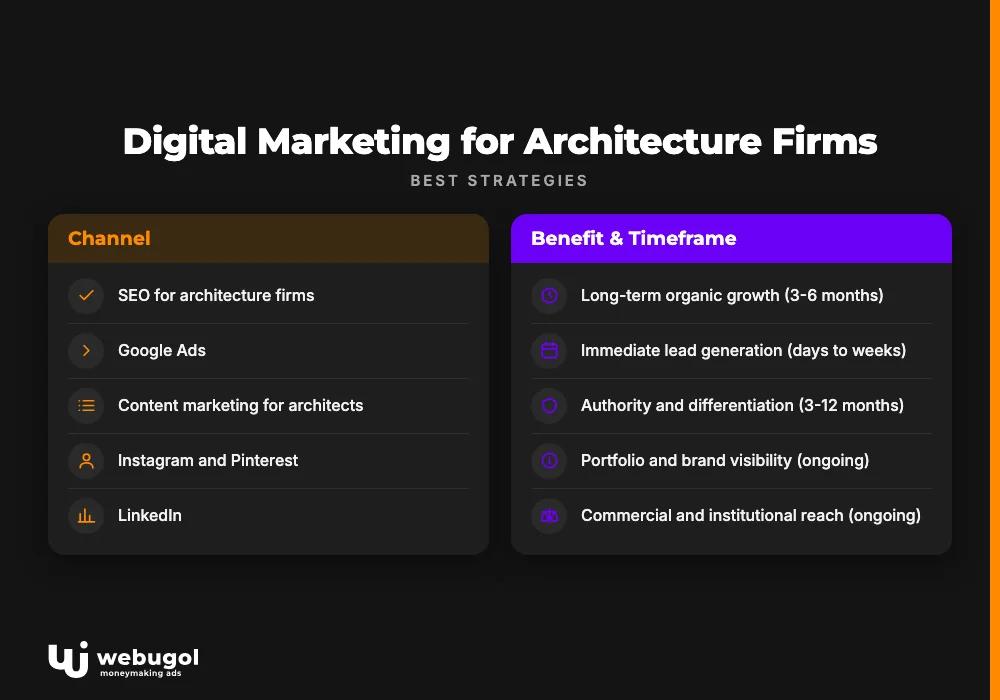
The right mix depends on firm size, service focus, and growth stage. Across practice types, these channels have the strongest track record for architecture firm digital strategy:
| Channel | Primary benefit | Realistic timeframe |
|---|---|---|
| SEO for architecture firms | Long-term organic growth | 3-6 months |
| Google Ads | Immediate lead generation | Days to weeks |
| Content marketing for architects | Authority and differentiation | 3-12 months |
| Instagram and Pinterest | Portfolio and brand visibility | Ongoing |
| Commercial and institutional reach | Ongoing | |
| Local SEO | Geographic market dominance | 1-3 months |
| Email campaigns | Nurturing warm leads | Weeks |
No single tactic replaces a coherent architecture firm digital strategy. Firms that run isolated tactics without a unified plan tying website, SEO, and content together typically stall after early results.
SEO for architecture firms
SEO for architecture firms differs from retail or services SEO because architecture projects involve long sales cycles, significant fees, and trust-intensive decisions. Keyword intent matters as much as search volume.
Prospective clients search for phrases like "modern residential architect Seattle" or "LEED-certified commercial architecture firm." Targeting these specific, high-intent phrases, rather than broad terms, attracts visitors already close to hiring. A well-structured site that loads fast, works on mobile, and clearly showcases completed projects converts that traffic into actual inquiries.
On-page fundamentals that directly affect search rankings include: clean URL structures organized by service and project type; meta titles written for each key page rather than auto-generated; and image alt text on all portfolio images with descriptive, keyword-relevant language. Internal linking between related project and service pages matters equally.
Architecture firm websites are image-heavy by nature, which puts real pressure on load speed. Moving to a performance-first setup helps measurably; our headless CMS services page explains how separating the content layer from the rendering layer improves load times on portfolio-heavy sites, which feeds directly into Core Web Vitals scores that Google uses as a ranking signal.
Local SEO deserves particular emphasis. Most architecture work happens in a defined geographic area. Firms that fully optimize their Google Business Profile and earn consistent client reviews appear in the map pack, capturing a significant share of "near me" search clicks before users ever scroll to organic results.
The full technical picture of on-page and off-page SEO for service businesses covers the deeper layers of this work.
Content marketing for architects
Content marketing for architects accomplishes two things that organic SEO alone cannot: it answers questions prospects ask before they search for a firm, and it demonstrates a firm's thinking and values in depth.
A firm publishing clear project case studies, explaining the client brief, the key design decisions, and the outcome achieved, gives a prospective client far more than a gallery of photos. It shows how the team solves real problems. Blog posts addressing common client concerns, such as budget management, permitting timelines, or sustainable material selection, attract search traffic while reducing friction in first conversations.
Consistency matters more than volume. One thorough, well-researched post per month will outrank and out-trust a firm that publishes eight posts in a burst and then stops.
Video extends reach once the basics are established. Walkthroughs of completed projects, time-lapses of construction phases, and brief explanations of design decisions perform well on both YouTube and social platforms. They extend the value of existing portfolio content without requiring a large production budget.
How does SEO help architecture firms attract clients?
SEO places an architecture firm in front of prospects at the exact moment they are searching for services. Unlike paid ads, organic search rankings continue generating traffic as long as the site maintains quality and relevance. No ongoing media spend required.
The compounding nature of SEO is its main structural advantage. Each new blog post, portfolio page, or service page adds another entry point into the site. Over time, a well-maintained site accumulates rankings across dozens of search phrases, and traffic from those rankings grows month over month without proportional cost increases.
Ranking highly also carries a credibility signal. When a firm appears at the top of a Google search, prospects read that visibility as a mark of authority, even without articulating why. That perception matters when clients are choosing someone to design major buildings or homes.
The layers of effective SEO for architecture practices cover several interconnected areas:
- Concentrate keyword targeting on specific phrases your ideal clients type, including service type, project type, and geographic modifiers.
- Maintain technical health across the site: fast load times, mobile-responsive design, HTTPS, and clean crawlability.
- Structure portfolio pages by service and project type so search engines can map what the firm specializes in.
- Keep local signals consistent, meaning the same name, address, and phone number across all directories and the Google Business Profile.
- Build link authority by earning mentions from architecture publications, award bodies, and local business press.
Is social media marketing effective for architects?
Social media is a real component of internet marketing for architects, but results depend heavily on platform choice and content format. Social media works well for architect website promotion and brand awareness. It rarely generates direct project inquiries without consistent posting and purposeful storytelling behind each image.
Instagram remains the strongest platform for residential and interiors-focused practices because the format rewards high-quality visual content. A consistent stream of completed project images, detail shots, and behind-the-scenes progress builds a portfolio that reaches far beyond the firm's existing network. Pinterest operates similarly and drives search referral traffic that Instagram does not.
LinkedIn is the better choice for commercial and institutional practices targeting corporate clients, developers, or public sector procurement. Thought leadership on urban development, sustainability, or procurement trends positions firm principals as credible voices in industry conversations.
Paid social advertising on Facebook and Instagram lets architecture firms target very precisely: homeowners in a defined postal code, commercial real estate developers in a metro area, or people who visited the firm's website without making contact. Remarketing campaigns to recent site visitors typically produce the highest return on ad spend of any Meta placement.
The most common social media mistake is treating accounts as a passive gallery. Captions that explain the design story, the client brief, or the technical challenge solved generate substantially more engagement and inbound inquiry than images posted without context.

Paid advertising as part of internet marketing for architects
Paid advertising accelerates digital marketing for architecture in a way organic channels cannot. It delivers visibility immediately, before a firm has built the search rankings or content library that take months to develop.
Google Ads for architecture firms
Google Ads places a firm at the top of search results for chosen keywords on a cost-per-click basis. The most valuable campaigns target high-intent phrases, meaning searches from people actively looking to hire, not just researching the profession.
Effective Google Ads campaigns in architecture share these characteristics:
- Concentrate budget on specific service and location phrases; use negative keywords to filter out irrelevant queries such as "architecture school" or "architect salary."
- Write ad copy tied to the specific project type and client concern, not generic claims about design quality.
- Send clicks to a dedicated landing page matching the ad's exact promise, not to the homepage.
- Track conversions by measuring calls, form submissions, and contact page visits, not just clicks or impressions.
- Review campaigns monthly to redirect budget toward the keywords and ads that generate actual qualified inquiries.
Our Google Ads strategy guide explains how different campaign types serve different business objectives and helps firms set realistic expectations before committing budget.
Facebook and Instagram advertising
Meta advertising reaches audiences who have not yet started searching. Targeting by location, homeownership status, income range, or interest in home renovation surfaces a firm's portfolio to people who match the ideal client profile but have not yet opened Google.
Carousel ads work particularly well for architecture, allowing multiple project images to tell a sequential story within a single ad unit. Short video ads showing a project transformation consistently outperform static images in both engagement and click-through rates. Remarketing campaigns, which target recent website visitors, typically produce the strongest return on ad spend of any Meta placement available to an architecture practice.
How much does digital marketing cost for an architecture firm?
No single figure applies across all firms. Budget varies by market size, competitive intensity, and channel mix. The ranges below reflect what architecture practices realistically work within.
SEO retainer: from a few hundred to several thousand dollars per month, depending on the scope of keyword targets, content production volume, and site technical complexity. Smaller firms in moderate-competition markets often see strong results at the lower end of that range.
Google Ads: a minimum viable monthly budget in most metropolitan markets falls in the several-hundred-dollar range to gather meaningful performance data, with actual spend determined by local keyword competition. Management fees are additional.
Content production: individual case studies or blog posts vary in cost with the depth and optimization required. Firms producing content in-house reduce direct costs but must account for staff time honestly.
Social media management: ranges from a principal spending a few hours weekly to mid-range retainers when a specialist handles strategy, creation, and scheduling.
The more useful frame than monthly cost is lifetime project value. Architecture projects generate substantial fees. A digital marketing budget that produces one additional project per quarter, even at a conservative fee level, returns multiples of its cost. The metric that matters is cost per qualified inquiry, not cost per click.

Internet marketing for architects: building a system, not a channel list
The firms that grow consistently online treat internet marketing for architects as a connected system, not a collection of isolated tactics. SEO, content, paid advertising, and social media reinforce each other. A well-ranked blog post becomes social content. Social posts drive traffic that improves engagement signals. A Google Ads campaign reveals which keywords convert, informing what content to produce next.
Effective online marketing for architects starts with a clear picture of the ideal client, builds a website that converts that audience, and then uses organic channels to compound traffic while paid advertising fills the pipeline during the months before rankings develop.
Measurement closes the loop. Google Analytics tracks which pages generate inquiries. Google Search Console shows which queries the site ranks for and where those rankings are trending. A monthly review of these metrics, even a focused 30-minute session, prevents budget from accumulating in channels that show activity but generate no actual leads.
Working with a digital marketing agency that integrates website performance, SEO, and campaign management as one connected system matters here. An agency that builds sites without owning the SEO outcome, or runs ads without understanding the conversion architecture behind a portfolio site, consistently leaves results behind.
Ready to grow your architecture firm's client pipeline?
Webugol builds and runs full digital marketing systems for architecture firms: website performance, SEO for architecture firms, content strategy, and paid campaigns working together rather than as separate budget lines. If you want more qualified inquiries and a clear view of what your digital marketing is actually generating, get in touch with Webugol to discuss your firm's current situation and goals.
FAQ
How long does internet marketing take to generate results for architects?
SEO and content marketing typically show meaningful ranking and traffic improvements within three to six months. Paid advertising can generate leads within days of launch, though campaigns usually need four to six weeks of data before optimization reaches full efficiency.
What digital marketing channel should a new architecture firm prioritize?
For a firm with no existing online presence, Google Ads combined with a well-structured website provides the fastest path to qualified leads. Building SEO and content in parallel ensures a longer-term organic system develops while paid campaigns run.
Do architects need a dedicated website or is social media enough?
A website is essential. Social platforms change their algorithms, reduce organic reach over time, and cannot be fully controlled by the firm. A website is the only owned digital asset that ranks in search engines, holds the full portfolio, and captures contact information directly.
How do architecture firms measure digital marketing success?
The most reliable indicators are qualified inquiries generated by the site, cost per inquiry from paid campaigns, and organic search traffic growth month over month. Follower counts and impression totals rarely correlate with actual project revenue.
Can a small architecture firm compete online with larger practices?
Yes. Smaller firms can dominate specific local markets or specialized project niches by producing focused, high-quality content and fully optimizing for local SEO. Most large generalist firms do not aggressively target niche or local queries, which leaves substantial search opportunity for focused smaller practices.

