



How to Reduce Patient No-Shows: The Show-Rate Playbook for Clinics and Telehealth
The most reliable way to reduce patient no-shows is a multi-touchpoint confirmation sequence tied to a CRM trigger, not a better notification tool. Most clinics already run automated reminders and still see 10-20% no-show rates because the failure lives in the handoff between marketing and ops, not in the reminder itself. This article covers show-rate benchmarks by specialty, the accountability gap that single-blast reminders cannot close, and seven systems-level tactics that reduce patient no-shows for good.
What is the average no-show rate and what does it cost per month
No-show rate is a marketing metric wearing an ops costume. Every patient who books but does not arrive converts ad spend into zero revenue for that slot, which inflates effective cost per acquisition across the entire cohort. Understanding what that rate costs in real dollars per month is the starting point for any fix.
What is a good no-show rate for a medical practice?
A practice averaging below 10% across all appointment types is generally well-managed. Primary care typically runs 5-8%, behavioral health can reach 20-30%, and telehealth sits between 15-25% depending on platform friction, based on published research including Molfenter et al. in *Psychiatric Services* and aggregated Artera industry benchmarks.
The same rate carries very different revenue consequences depending on average visit value. A 15% no-show rate at a primary care practice billing modest per-visit fees is an inconvenience. The same rate at a weight-loss program with high-ticket consultations is a material revenue problem every single month.
| Specialty | Typical no-show rate | Revenue impact |
|---|---|---|
| Primary care | 5-8% | Lower per-visit value; large volume makes cumulative loss significant |
| Behavioral health | 20-30% | Consistent session fees; high frequency amplifies total impact |
| Weight loss / GLP-1 | 10-18% | High-ticket consults; each missed slot represents significant revenue |
| Telehealth (general) | 15-25% | Platform-dependent; lower perceived sunk cost for patients |
| Aesthetics / med spa | 8-15% | High treatment value per slot means each no-show is expensive |
Revenue loss formula: how to calculate your monthly cost
Three inputs tell you your monthly revenue bleed from no-shows. The formula is simple.
- Step 1: Monthly appointment volume x no-show rate = missed appointments per month
- Step 2: Missed appointments x average visit value = monthly revenue lost
- Step 3: Monthly revenue lost / total monthly ad spend = your effective CPA inflation multiplier
For a telehealth practice running 400 appointments per month at a 20% no-show rate, if the average visit value is $150, that is 80 missed appointments and $12,000 in monthly revenue loss. Bring that calculation to your Monday meeting and show rate stops being an ops complaint and starts being a marketing KPI.
Why reminders alone won't fix your no-show problem
Reminders notify. They do not commit. A patient who receives a text two days before their appointment has done nothing active to signal intent. That message lands in the same notification tray as a grocery delivery alert.
The problem is structural. Most reminder tools broadcast one-way. They do not require a confirmation response, do not escalate if the patient goes silent, and do not flag at-risk slots for human intervention. Clinics that layered reminder tools on top of an existing no-show problem and saw no improvement have a workflow gap, not a notification gap.
Booking friction makes this worse. Unclear appointment purpose, excessive intake form length, and missing pre-visit instructions create patients who are uncertain about why they are coming. Reminders reach these patients. They cannot fix the confusion.
Who owns show rate in your clinic?
Ask your marketing lead, your ops director, and your front desk manager who is accountable for show rate. You will get three different answers, or silence. Marketing owns lead generation. Ops owns scheduling capacity. Front desk owns day-of confirmations. Show rate falls in the gap between all three.
That gap costs money in a specific way. It does not appear on a dashboard. Marketing reports CPL, ops reports utilization, and the no-show rate quietly inflates effective CPA without appearing in any team's metrics. The fix requires assigning a single owner with a defined target and a system they can actually control.
Show rate that belongs to nobody gets optimized by nobody. The pre-visit accountability system for healthcare clinics builds the ownership layer across the full pre-visit funnel, from ad click to arrived appointment.
7 strategies that actually reduce patient no-shows
Each tactic requires a CRM trigger, a channel decision, or a policy change to produce a lasting result. One-time tool deployments without a supporting workflow revert within weeks. Understanding how to reduce patient no-shows at the system level means treating each intervention as a permanent workflow, not a one-time setup task.
Automated reminder sequences with confirmation (not just blasts)
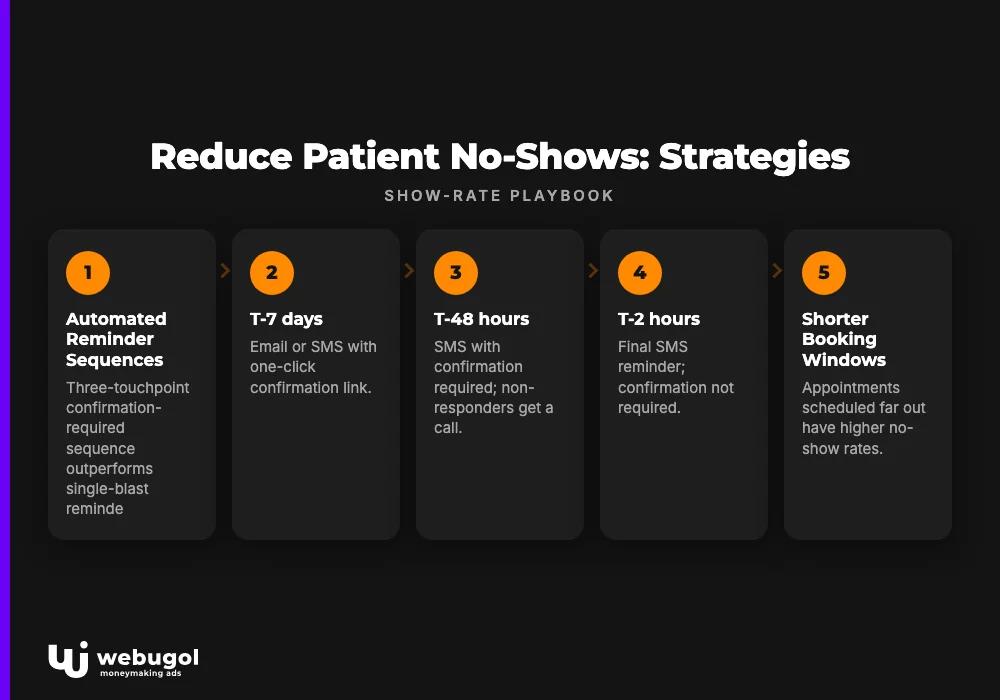
A three-touchpoint confirmation-required sequence outperforms single-blast reminders by creating active commitment rather than passive awareness. The timing: seven days before, 48 hours before, and two hours before the appointment. The first two touchpoints must require a patient response to confirm the slot.
- T-7 days: Email or SMS with appointment details and a one-click confirmation link
- T-48 hours: SMS with confirmation required; non-responders get a phone call within two hours
- T-2 hours: Final SMS reminder; confirmation is not required at this stage
Non-responders after the T-48h touchpoint are the highest-risk slots in your schedule. Flag them for a scheduling team call, not another automated message. Set this workflow up in GoHighLevel or HubSpot with the confirmation status field driving your waitlist fill and front desk prep list. For the email channel architecture behind these sequences, see the healthcare provider email framework for appointment confirmation and patient retention.
Shorter booking windows: evidence and trade-offs
Appointments scheduled more than three to four weeks out carry significantly higher no-show rates, per research published in BMJ Open Quality. Longer lead time means lower patient urgency and lower perceived sunk cost.
The trade-off is real. Shorter booking windows work well for new patients and high-ticket services where urgency is naturally high. For follow-up appointments in chronic care or membership programs, a hybrid approach works better: book the slot on the longer timeline, but add a reconfirmation outreach at T-14 days to re-establish intent before the automated reminder sequence begins.
Two-way SMS and HIPAA-compliant channels
Two-way SMS with explicit patient confirmation moves no-show rates more than any other single channel. The compliance requirement is non-negotiable for US healthcare. HIPAA requires a Business Associate Agreement with your SMS platform, written patient consent collected at intake, and a documented opt-out process before any protected health information moves through a text channel.
Platform selection criteria: BAA availability, message encryption in transit and at rest, audit log access, and native opt-out management. GoHighLevel, Klara, and Luma Health each offer compliant configurations, but you must review each vendor's BAA terms before enabling PHI in message content. Dental practices navigate identical multi-channel compliance challenges, and the consent sequence structure for dental patient outreach across channels covers the workflow in practice. For telehealth practices using video platforms, Zoom's HIPAA compliance configuration in 2026 outlines what BAA terms and platform settings must be verified before sending session links to patients.
Deposit and pre-payment policy
A deposit at booking creates financial commitment. It reduces no-show rates in high-ticket service lines more reliably than any messaging intervention alone. The $25-$50 range works for moderate-ticket appointments; higher-value procedures can justify deposits scaled to treatment value.
Structure the policy to minimize cancellation pressure upstream. Deposits should be fully refundable with 48-hour notice and non-refundable for same-day cancellations or no-shows. Communicate the policy at booking, not at reminder time. Include it in your CRM booking confirmation and intake form acknowledgment so there is no ambiguity when a patient disputes a charge.
- Amount range: $25-$50 for standard consults; scale proportionally for high-ticket appointments
- When charged: At booking confirmation, before the slot is held
- Refund condition: Full refund with 48 or more hours notice; forfeited for same-day cancellations or no-shows
- CRM trigger: Booking workflow sends payment link before the confirmation is issued
- Patient-facing language: "A refundable deposit holds your appointment and is fully returned with 48-hour notice"
Same-day waitlist system
A CRM-based waitlist partially recovers revenue from any no-shows that your upstream prevention tactics did not catch. Tag every patient who requests an earlier or more convenient slot as "waitlist" in your CRM with their preferred appointment type and availability window. When a cancellation opens a slot, an automated outreach sequence contacts the top matching waitlist patient immediately.
The response window matters. Thirty minutes before moving to the next contact keeps fill rates high. Set this as a tag-triggered automation in GoHighLevel or HubSpot, connected to the cancellation status field in your booking workflow. Patient scheduling software with native CRM integrations can automate this waitlist fill process without requiring manual coordination.
Reducing patient friction before the visit
Unclear appointment purpose, long intake forms, and missing pre-visit instructions are no-show causes that reminders never reach. A patient uncertain about why they are coming, what to bring, or how to complete intake has materially higher no-show risk.
Audit three friction points: whether your booking confirmation email states clearly what will happen during the visit, how many form fields your intake requires before the first interaction, and whether pre-visit instructions arrive in a format the patient will actually read. A short video walk-through or a single-page prep sheet reduces intake confusion more reliably than a longer email chain.
Can AI reduce patient no-shows?
Yes. EHR-integrated machine learning models score no-show risk using prior history, booking lead time, appointment type, day and time slot, and new versus returning patient status. Using AI to reduce patient no-shows is increasingly viable for mid-to-large practices with clean EHR data and API connectivity to their scheduling platform.
Implementation requires historical data spanning at least 12-18 months, a defined risk threshold that triggers a specific action (phone call, deposit request, or earlier reminder touchpoint), and a HIPAA-compliant workflow for acting on the score inside your CRM. A risk flag without a response protocol is just a number in a dashboard.
- Prior no-show history (strongest single predictor)
- Booking lead time (longer lead time correlates with higher risk)
- Appointment type (new patient consults typically run higher risk than follow-ups)
- Day and time slot (certain weekday and time-of-day patterns emerge consistently)
- New versus returning patient status
Telehealth vs. in-person: different patients, different rules
Telehealth no-shows are driven by different causes than in-person ones. The perceived sunk cost is lower because there is no transit, no parking, and no physical time blocked from the day. A broken link or login confusion can kill an appointment in the final two minutes. These causes require different tactics, not the same reminder sequence applied to a different channel.
| No-show cause | Telehealth tactic | In-person tactic | Metric to track |
|---|---|---|---|
| Low perceived sunk cost | Pre-payment or deposit at booking | Deposit for high-ticket; reminder sequence for routine | Show rate by payment status |
| Link or login confusion | Send join link 2 hours before; include tech support contact | Send address and parking instructions | Cancellation reason code |
| Long booking window | Reconfirmation outreach at T-14 days | Shorter window plus waitlist fill | No-show rate by lead time bucket |
| No confirmation received | Two-way SMS with required reply | Phone call at T-48h for high-risk slots | Confirmation rate by channel |
| Appointment purpose unclear | Video walk-through sent at booking | Written prep sheet 48 hours before | Pre-visit open rate |
| Technology access barrier | Offer phone-in fallback at booking | N/A | Platform drop-off before session join |
No-show policy template (copy-paste)
Competitors consistently recommend having a no-show policy. None provide a usable template. Below is the five-element structure required for a compliant, enforceable US clinic policy.
[Your Practice Name] No-Show and Late Cancellation Policy
1. Definition: A no-show is an appointment for which the patient does not arrive and does not contact the practice before the scheduled start time. A late cancellation is a cancellation made with less than [48/24] hours notice before the appointment.
2. Notice window: Cancellations made with 48 or more hours notice are fee-free. Cancellations or no-shows with less than 48 hours notice are subject to the fee below.
3. Fee structure: A no-show or late cancellation fee of $[25-75] applies per missed appointment. For appointments where a deposit was collected at booking, that deposit is forfeited in lieu of an additional fee. Fees are charged to the card on file or invoiced within five business days.
4. Hardship exceptions: Fees may be waived at the practice manager's discretion for documented emergencies, acute medical events, or confirmed technology failures for telehealth appointments. First-time no-shows may receive a one-time courtesy waiver.
5. Communication at booking: This policy is disclosed at the time of booking through the confirmation email, the intake form acknowledgment, and verbal confirmation for phone bookings. Patients acknowledge the policy before their first appointment is confirmed.
Review your state regulations before implementation. Some states restrict no-show fees for Medicaid patients. Confirm requirements with your compliance counsel.
Ready to build a show-rate system, not just a reminder blast?
If show rate still sits in the gap between marketing and ops, a reminder tool will not close it. The accountability problem shows up in your marketing numbers: inflated effective CPA, suppressed ROAS, and patient acquisition costs that make your ad spend look worse than it is.
The patient acquisition and show-rate system for US healthcare practices builds the pre-visit patient journey as one accountable system, from ad click to arrived appointment. Book a call to see where your funnel is losing patients before they ever show up.
FAQ
What is a good no-show rate for a medical practice?
No-show benchmarks vary by specialty: primary care typically runs 5-8%, behavioral health can reach 20-30%, and telehealth sits between 15-25% depending on platform friction. A practice averaging below 10% across all appointment types is generally well-managed.
How do I reduce patient no-shows without charging patients?
Confirmation-required reminder sequences, shorter booking windows, and pre-visit friction reduction (clear intake, clear appointment purpose) move no-show rates without any fee or deposit. A same-day waitlist system recovers revenue from the no-shows that still occur.
How do no-shows affect patient acquisition cost?
Every patient who books but does not show converts ad spend into zero revenue for that slot, which inflates effective CPA across the cohort. A 20% no-show rate on a $100 CPA means the real cost per arrived patient is $125 before accounting for other funnel inefficiencies.
What should a no-show policy include?
A compliant US clinic no-show policy needs five elements: a clear definition of no-show versus late cancellation, the minimum notice window for fee-free cancellation, the fee amount and when it is charged, documented hardship exceptions, and the patient communication process at the time of booking.
Can AI predict which patients will no-show?
Machine learning models trained on EHR data can score no-show risk using factors including prior no-show history, booking lead time, and appointment type. Implementation requires clean historical data, a defined action threshold, and a HIPAA-compliant workflow for acting on the prediction inside the CRM.

