



URL Rating vs Domain Rating: What Each Ahrefs Metric Means for SEO
URL rating vs domain rating are the two core backlink authority metrics in Ahrefs. URL Rating (UR) measures how strong a single page's backlink profile is; Domain Rating (DR) measures the overall backlink strength of an entire website. Both come from Ahrefs. Knowing which metric to use, and when, determines whether your link-building efforts move the needle or just burn budget.
What is URL Rating in Ahrefs?
URL Rating (UR) is an Ahrefs metric that scores the strength of an individual page's backlink profile on a 0-to-100 logarithmic scale. It factors in external links pointing directly to that URL and internal links passed from other pages on the same site. Both sources contribute to the page's final score.
UR is granular by design. A viral blog post on a small site can reach UR 70 while the rest of the domain stays below UR 20. A thin product page on a high-DR domain might hold a UR of 3 if no one links to it specifically. The domain's overall authority does not carry a page automatically.
Three inputs determine a page's url rating ahrefs score:
- Direct external backlinks: links from other websites pointing specifically to that URL.
- Internal links: other pages on your own site that link here transfer a portion of their UR to this page.
- Dofollow attribute: only dofollow links count toward UR; nofollow links are excluded.
Internal linking is the lever most sites underuse. A strong homepage can distribute its link equity across product pages and landing pages through deliberate internal link structure, raising UR without any outreach at all.
How is Domain Rating calculated?
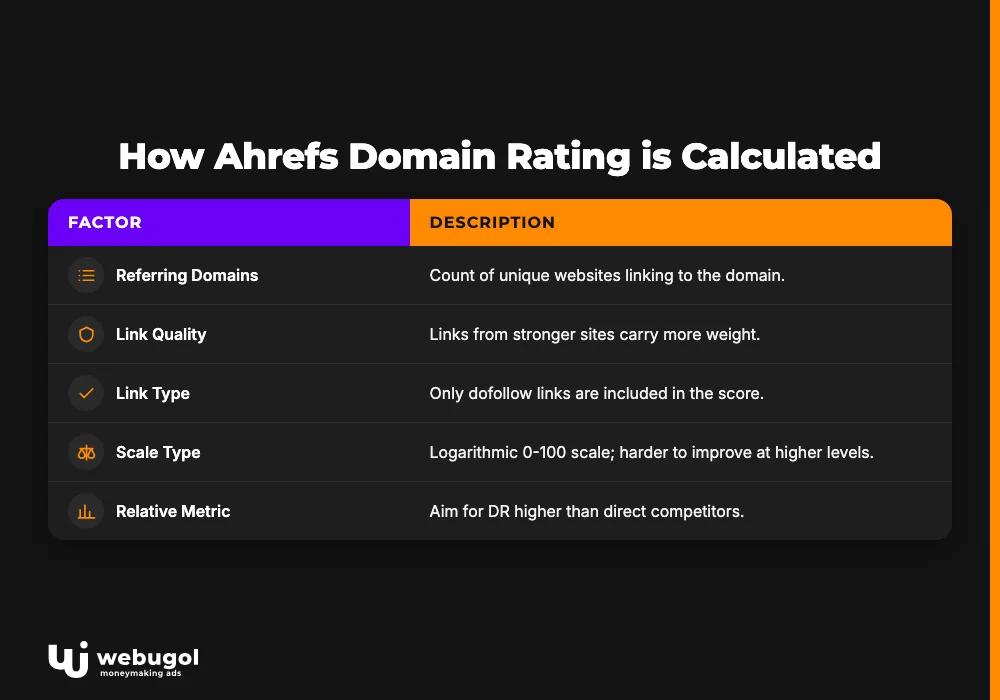
Domain Rating (DR) is the Ahrefs backlink metric that scores the strength of an entire website's link profile. The domain rating Ahrefs calculates runs on a 0-to-100 logarithmic scale and uses three inputs, as documented by Ahrefs:
- Referring domains: the count of unique websites linking to the domain.
- Quality of those links: a link from a DR 90 site carries far more weight than a link from a DR 10 site.
- Link type: only dofollow links count; nofollow links are excluded from the DR score meaning.
The logarithmic scale matters for anyone tracking ahrefs DR explained in monthly reports. Moving from DR 20 to DR 30 is far easier than moving from DR 70 to DR 80. The gap between intervals gets exponentially wider at the top of the scale.
Here is how to read a DR score by site type:
| DR range | Typical site profile |
|---|---|
| 0-20 | New sites or local businesses with few backlinks |
| 21-50 | Established small and medium businesses |
| 51-75 | Popular brands and niche authorities |
| 76-100 | Major internet companies like Google and The New York Times (DR 95) |
DR is a relative metric. A new blog at DR 12 does not need to reach DR 90. The goal is a DR higher than your direct competitors for the keywords you are targeting.
URL rating vs domain rating: key differences
The fundamental difference is scope. DR aggregates backlink authority across an entire domain; UR reflects only the referring domains SEO footprint of a single URL.
This distinction shapes which metric to use in specific decisions:
- Evaluating link partners: use DR. A high-DR site passes more authority through a backlink than a low-DR site, regardless of which page the link comes from.
- Assessing ranking difficulty: use UR. Check the UR scores of the pages currently ranking for your target keyword. High competitor UR means those pages have strong direct backlinks, which is harder to overcome than a high DR alone.
- Planning internal links: think in UR. Link from your highest-UR pages toward the pages you want to rank higher. You can move a page authority score this way without acquiring new external links.
A common misconception is that high DR guarantees high rankings across the whole domain. It does not. A DR 80 site can publish a page that earns no traffic if that page has no direct backlinks and no strong internal links pointing to it. Google ranks pages, not domains.
Does Domain Rating affect Google rankings?
Not directly. Ahrefs states explicitly that DR is not a direct Google ranking factor. It is a third-party estimate built from backlink data, not a signal Google's algorithm reads from your site.
The correlation between high DR and high organic traffic is real, though. Sites with strong DR typically have thousands of referring domains SEO authority signals pointing to them. Those backlinks are what Google uses as a ranking input. DR approximates the effect of that backlink density; it does not cause it.
According to Ahrefs, UR correlates more strongly with rankings than DR does. Google evaluates whether the specific page answering a query is authoritative. DR gives you a head start when Google crawls new content, but the url rating ahrefs score of your individual page is what corresponds most closely to ranking position.
A link equity audit helps you identify which pages are accumulating authority and which are losing it through poor internal link structure.
What is a good URL Rating score?
There is no universal benchmark. A good UR is whatever exceeds the UR of the pages currently ranking on page one for your target keyword. Pull those results in Ahrefs' SERP overview and read the UR column. That range is your actual target.
As a rough guide, UR above 40 is competitive for most mid-tier queries. Head terms with high search volume often require UR 60 or more to break into page one. New sites should expect most pages to start at UR 1 to 10.
Build external links directly to specific pages rather than only to the homepage. Combine that with deliberate internal linking to accelerate UR across the site. Pages with rising UR also reveal which topics are earning organic attention, a signal worth factoring into your next content decisions.
Which is more important for SEO: DR or UR?
The answer depends on your current growth stage.
New websites should focus on UR first. DR takes months to move. A single page that earns strong external links can rank for competitive keywords even while the domain's overall DR is still low. Build links directly to your best content. Let those pages produce early traffic before shifting effort toward broad brand authority.
Established sites (DR 30 and above) should balance both. Your domain has accumulated authority. The more efficient move is internal linking: push equity from high-UR pages toward new or underperforming pages. That raises their UR without additional outreach and makes your existing authority work harder.
Understanding url rating vs domain rating in these terms also clarifies how Ahrefs differs from Majestic and other platforms. Each tool models authority differently, so DR and UR from Ahrefs are not directly comparable to Trust Flow, DA, or other vendor-specific scores. DR tells you how loud your site's voice is across the web. UR tells you how strong one specific page is. Both track backlinks; they just measure them at different levels of resolution.
Put your authority data to work
Knowing the difference between url rating vs domain rating is where strategy starts. Turning that knowledge into rankings requires consistent execution across the right pages. At Webugol, we audit DR and UR together, identify the authority gaps holding your pages back, and build a link strategy around the pages that need it most. Contact us for an SEO strategy grounded in your actual backlink data.
FAQ
What is URL Rating in Ahrefs?
URL Rating (UR) is an Ahrefs metric that scores the backlink strength of a single page on a 0-to-100 logarithmic scale. It counts external links pointing directly to that page plus internal links from other pages on the same site, and only dofollow links count toward the score.
How is Domain Rating calculated?
Ahrefs calculates Domain Rating using the number of unique referring domains, the DR scores of those linking domains, and whether the links are dofollow. Nofollow links are excluded, and the scale is logarithmic, so gains at the top end require far more effort than gains at the low end.
What is a good URL Rating score?
A useful benchmark is the UR range of pages already ranking on page one for your target keyword. For most mid-tier queries, pages in the top five typically hold UR scores above 40.
Does Domain Rating affect Google rankings?
Ahrefs states that DR is not a direct Google ranking factor. Sites with high DR tend to rank well because they have many backlinks, which Google does use as a ranking signal, so the correlation is real even though DR itself is a third-party estimate.
Which is more important for SEO: DR or UR?
For new websites, UR is more actionable because a single well-linked page can rank before the domain builds broad authority. For established sites, using strong DR as a foundation while targeting internal linking to raise UR on specific pages gives the best results.