



Hair transplant marketing: nine strategies to fill your consultation calendar
Hair transplant marketing is the coordinated process of attracting, educating, and converting prospective patients into booked consultations. Strong clinics do not rely on any single channel. They combine local search visibility, documented patient transformations, and a booking process that removes friction at every step. This guide covers nine proven hair restoration marketing strategies, from Google Business Profile setup to a post-procedure referral network that keeps consultations arriving without constant ad spend.
Why strong clinics still struggle to attract patients
The hair restoration market is growing. More patients now research clinics online, compare multiple options, and make their decisions before picking up the phone. Yet many clinics with skilled surgeons and strong outcomes still struggle to maintain consistent consultation volume.
The problem is rarely clinical quality. It is visibility and conversion. A clinic that ranks below competitors in local SEO for hair clinics, has fewer reviews, or makes booking feel complicated will lose patients to less capable competitors that are simply easier to find. Hair restoration marketing strategies that work target those specific gaps rather than trying to do everything at once.
The main channels: a practical comparison
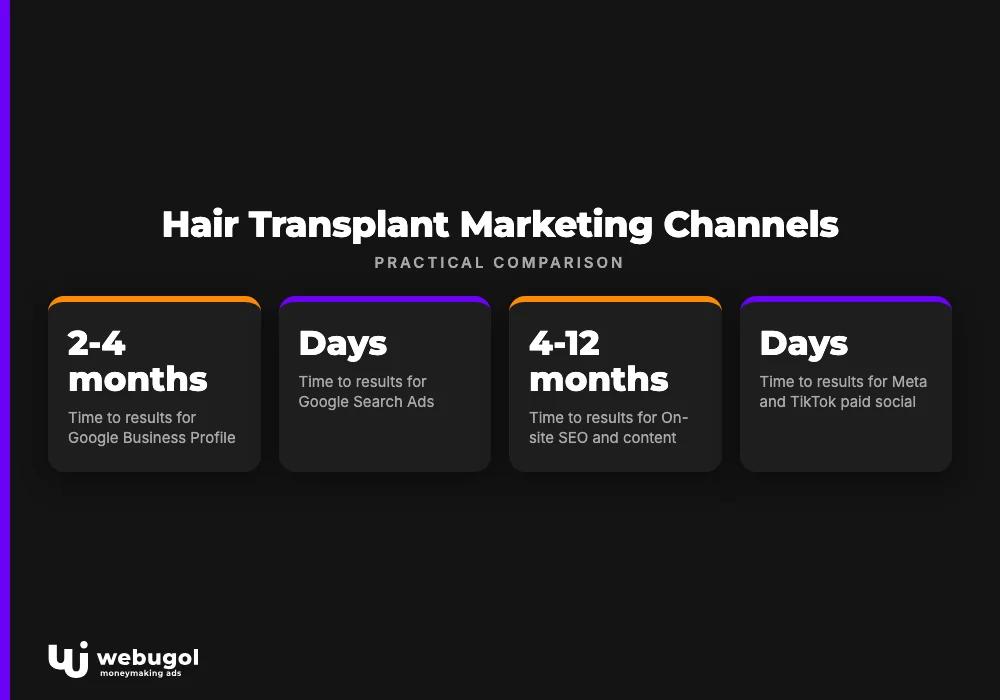
Understanding how each channel performs in hair transplant marketing before committing budget saves time and prevents wasted spend. Here is a practical reference for hair restoration clinics:
| Channel | Time to results | Cost model | Best use case |
|---|---|---|---|
| Google Business Profile | 2 to 4 months | Time, optional agency fee | Near-me and city searches |
| Google Search Ads | Days | Pay per click | High-intent procedure searches |
| On-site SEO and content | 4 to 12 months | Time or agency retainer | Long-term organic acquisition |
| Instagram and YouTube | 2 to 6 months | Content production cost | Before/after trust-building |
| Meta and TikTok paid social | Days | Ad spend plus creative | New audience reach, retargeting |
| Email and follow-up sequences | 1 to 4 weeks | Platform fee plus copywriting | Lead nurture, referral activation |
Clinics at the start of their digital marketing journey should prioritize Google Business Profile and organic content. Clinics ready to scale should layer paid search and paid social on top of that foundation once it is working.
How to market a hair transplant clinic?
Effective hair transplant marketing starts with three foundations: local search visibility to get found, patient transformation content to build trust, and a website designed to convert visitors into consultation requests. Running paid ads without a converting website produces inconsistent results. Posting social content without a clear path to booking wastes the audience. Build those foundations first, then add channels to amplify them.
1. Build a fast, mobile-first website that converts
Every channel you invest in for hair transplant marketing, from paid ads to Google reviews, eventually sends patients to your website. If the site loads slowly or feels cluttered on a phone, most visitors leave before reading a single line.
Three things determine whether a clinic website converts visitors. Speed: according to Google's performance research, mobile pages that take more than three seconds to load lose most visitors before they engage. Clarity: visitors should know within a few seconds what you do, where you are, and how to book. Accessibility: your phone number must be a tap-to-call link on every page, and your consultation booking button should appear above the fold.
Keep the booking form short. Name, phone number, email, and one optional field for their main concern covers everything you need. Each additional required field reduces completions meaningfully. Long forms are one of the most common conversion barriers in digital marketing for hair transplant clinics.
Most patients browse on mobile during short breaks. Short paragraphs, clear headings, and bullet points for practical information help them get what they need quickly.
2. Show real patient transformations
Before-and-after content is the most persuasive asset in any hair transplant marketing program. Prospective patients are not convinced by descriptions of technique. They need visual proof that the procedure delivers real, lasting results for real people.
Effective transformation content goes beyond two static photos. Use high-resolution images under consistent lighting, from multiple angles, at multiple time points: immediately post-procedure, at three months, and at twelve months. Add a brief patient story covering their original concern, the procedure chosen, and the outcome at each stage. Short video testimonials are stronger still. A patient describing in their own words how their result changed how they carry themselves carries more persuasive weight than any written description.
Two requirements are non-negotiable. Obtain written consent before using any patient content and specify exactly where and how it will appear. Be precise about typical outcomes. Stating clearly that individual results depend on donor density, technique, and aftercare is a trust signal, not a disclaimer. Honest expectation-setting increases both credibility and consultation conversion in digital marketing for hair transplant clinics.
What digital marketing strategies work for hair restoration clinics?
The highest-return strategies for hair restoration clinics are local SEO for organic visibility, Google Search Ads for immediate high-intent traffic, educational content for authority-building, and email follow-up for leads who did not book on first contact. These channels work better in combination than any single one alone, covering the patient journey from first search through to booking decision.
3. Dominate local search with hair transplant clinic SEO
Most patients searching for hair restoration use local queries: "hair transplant clinic in [city]" or "hair restoration near me." Appearing in Google's local 3-pack for those searches is the single highest-leverage position in hair transplant clinic SEO, and local search visibility is a cornerstone of any hair transplant marketing plan.
Three factors consistently drive local rankings.
First, a fully completed Google Business Profile. Fill every available field: service categories, individual procedures listed separately, business hours, a keyword-relevant description, and at least ten photos of your clinic, team, and procedure results. Incomplete profiles rank lower and generate fewer clicks than complete ones, regardless of clinical quality.
Second, a steady stream of recent reviews. Reviews influence both ranking position and patient decision-making. Clinics with more recent, positive reviews consistently rank above those with fewer, even when the lower-ranked clinic has a stronger website. Ask satisfied patients within 24 hours of their consultation and send a direct link to your Google review page. Respond to every review, including negative ones. A professional response to criticism shows prospective patients that you take concerns seriously. For a detailed breakdown of building and maintaining local search authority, the complete guide to local SEO for medical practices covers the ranking factors that matter most.
Third, locally relevant on-page content. Your city name, neighborhood, and procedure names should appear naturally in page titles, headings, and body text. If you operate multiple locations, create separate landing pages for each one. Generic, location-neutral content ranks poorly in local hair transplant clinic SEO.
4. Run Google Ads to reach patients who are ready to book
Organic SEO builds compounding visibility but takes months to develop. Google Search Ads place your clinic in front of high-intent patients immediately: people actively comparing clinics and ready to schedule a consultation.
Hair transplant keywords are competitive. Campaigns with the strongest return target specific procedure terms (FUE, DHI, hair transplant cost), limit location targeting to your actual service area, and use ad copy that addresses the exact concern behind each search. Ads that send traffic to dedicated procedure landing pages consistently outperform those pointing to a generic homepage.
Track cost per consultation booked, not cost per click. Without conversion tracking from ad click through to booked consultation, you cannot tell which campaigns are profitable and which are burning budget. For a practical breakdown of how paid search fits within a broader clinic growth plan, this explanation of Google Ads for hair transplant clinic growth covers the core mechanics.
5. Create educational content that builds authority
Patients researching hair transplants arrive with specific concerns: Is the result permanent? What is the difference between FUE and FUT? How long is recovery? How visible will any scarring be? A content strategy built around answering those questions positions your clinic as the credible source before the patient contacts anyone else.
Specific content outperforms general content in both rankings and conversion. "What to expect during FUE recovery: weeks one through twelve" is more useful to a prospective patient than "about hair transplants." Specificity signals genuine expertise and an understanding of what patients actually worry about.
Update content regularly. Outdated information that contradicts your current protocols creates confusion when patients arrive at consultations with misaligned expectations.

What social media platforms work best for hair clinics?
Instagram and YouTube consistently outperform other platforms for hair restoration clinic advertising because both favor visual content. Instagram Reels and feed posts suit before/after images and short patient testimonial clips. YouTube works better for longer patient journey documentation and procedure explainers. TikTok reaches a younger demographic and is growing for aesthetic content. Facebook is most effective for retargeting ads and reaching older age groups. Spreading effort thinly across five platforms produces weak results everywhere. Commit to one or two, build quality content there consistently, and expand only when those channels perform well.
6. Social media for hair restoration: depth over volume
Social media for hair restoration works because patients want to see the real people behind the clinic, not another promotional gallery. The surgeon's approach, the team's experience, the recovery environment. Behind-the-scenes content, staff introductions, and footage from procedure day all humanize what is, for many patients, a deeply personal decision.
The most effective social content for hair clinics mixes three types: patient transformations with consent, short educational videos answering common questions, and team content that builds familiarity. A feed of only before/after photos reads as a sales gallery. A feed combining real results, education, and personality reads as a clinic worth trusting.
Respond to comments and messages promptly. When someone asks about cost or procedure differences in a public comment, answer specifically. That exchange is visible to every person reading the post, not just the person who asked. For more on how healthcare brands build patient trust through social platforms, this guide to social media strategies for healthcare businesses applies directly to hair restoration clinics.
7. Use paid social to reach patients who have not found you yet
Organic social grows relationships with existing followers. Paid social reaches patients who match your target profile but have not yet discovered your clinic.
Meta advertising on Facebook and Instagram allows targeting by age, location, gender, and interest signals associated with hair loss research or cosmetic procedure consideration. Strong hair restoration clinic advertising campaigns on Meta use before/after visuals with specific calls to action: "See our patient results" or "Book your free consultation." Retargeting campaigns, ads shown to people who visited your website but did not book, consistently produce the highest return on ad spend. Those audiences already found and considered your clinic. A targeted retargeting ad brings them back at a fraction of the cost of reaching a cold audience.
How to get more hair transplant patients online?
The fastest path to more online bookings is closing the gaps where prospective patients drop off. Most clinics lose patients not at the awareness stage but at the conversion stage: a slow-loading site, a booking form that asks too many questions, no messaging option, or a warm lead that receives no follow-up. Fix those gaps and your existing traffic produces more consultations without any increase in marketing spend.
8. Make contact frictionless at every touchpoint
Every barrier between a prospective patient and their first consultation is a booking that does not happen. Most common barriers are fixable quickly.
Remove the obvious conversion killers: no tap-to-call on mobile, booking forms with more than five required fields, no messaging option, and contact information that requires scrolling to the bottom of the page. Add WhatsApp or Facebook Messenger to your site. Many first-time contacts prefer messaging to phone calls. It is lower commitment and faster for quick questions: "Do you offer free consultations?" or "What is the rough cost for my situation?" Answering quickly in the channel the patient chose meaningfully increases conversion from site visitor to booked consultation.
Your address, phone number, and business hours should be identical across your website, Google Business Profile, and all directory listings. Inconsistencies create doubt and weaken local SEO signals.
9. Build a referral network from existing patients
A treated patient who achieved a strong result and felt genuinely cared for is the most credible asset in any hair transplant marketing program. No ad spend matches the conversion rate of a direct personal recommendation backed by a visible result.
Build a structured follow-up process. Check in at one week, one month, and three months post-procedure. Recognize milestones and collect feedback. These touchpoints demonstrate genuine interest in outcomes rather than just the procedure fee. They naturally prompt referrals to friends and family who have similar concerns.
Consider a private patient community on social media where former patients support people currently in recovery. Prospective patients see real people, real timelines, and real outcomes. Provide ongoing guidance about maintaining results: hair care routines during the growth phase, what to expect in months three through twelve, and how to assess whether progress is on track. Staying useful after the procedure positions your clinic as a long-term partner in hair health. For a systematic approach to maintaining patient contact through direct communication, these email retention strategies for healthcare practices cover the mechanics that keep patients engaged over time.
How much does hair transplant marketing cost?
Hair transplant marketing costs depend on channel mix, market competitiveness, and whether you manage campaigns in-house or with an agency.
Google Ads for hair transplant procedure keywords are expensive in competitive markets because the procedures are high-value and clinic competition is intense. Paid social advertising is generally lower cost per click but requires quality photo and video content to perform well. Both are pay-as-you-go: stop spending, stop receiving traffic.
Local SEO and content marketing require time or agency fees upfront, but the traffic they generate is not pay-per-click. Once your Google Business Profile ranks and your content earns organic visibility, those channels deliver results at a fraction of the ongoing cost of paid ads.
Most clinics find that blending paid ads for near-term patient acquisition with organic channels for long-term growth produces a better cost per booked consultation than either approach alone. Start with Google Business Profile optimization and a consistent review acquisition process. The direct spend is minimal. The compounding return is not.
Working with a specialized hair transplant marketing agency
Running paid ads, managing content, maintaining social channels, and optimizing local SEO simultaneously while delivering clinical care is genuinely difficult. Many clinics find the operational load too high to handle all of it well in-house.
A specialized hair transplant marketing agency brings existing knowledge of which channel combinations produce results for hair restoration clinics specifically. They know which audiences convert, which ad formats work, and which local SEO factors matter most for cosmetic medical practices. The tradeoff is cost and the relationship management any external partnership involves. For clinics ready to scale patient volume, the speed advantage of working with specialists who already understand hair restoration clinic advertising typically outweighs the months spent building those capabilities internally.
Webugol works with healthcare practices, including hair restoration clinics, to build coordinated digital marketing strategies across search, social, and content, focused on measurable patient acquisition rather than activity metrics.
Ready to accelerate your hair transplant marketing results?
The foundations of effective hair transplant marketing are clear: a converting website, strong local search visibility, patient transformation content that builds trust, and a follow-up process that turns interest into booked consultations. If you have tested individual tactics without consistent results, the issue is usually coordination across channels rather than any single tactic failing in isolation.
Contact Webugol digital marketing agency to discuss a strategy designed around your clinic's specific growth goals. We will assess your current digital presence, identify the highest-impact gaps, and build a measurable patient acquisition plan.
FAQ
What is the most effective hair transplant marketing strategy?
Local SEO combined with Google Ads and patient transformation content consistently delivers the most reliable results for hair restoration clinics. Local SEO captures patients searching in your area, paid search reaches high-intent buyers, and before/after content converts that traffic into consultations. Running all three together outperforms any single channel.
How long does it take to see results from hair restoration marketing strategies?
Google Ads can generate consultation inquiries within days of going live. Local SEO and content marketing typically take three to six months to produce meaningful ranking improvements and consistent organic traffic. The timeline depends on how competitive your market is and how consistently the work is maintained.
How do I get more Google reviews for my hair transplant clinic?
Ask every satisfied patient within 24 hours of their consultation and send a direct link to your Google review page. Make the request personal rather than sending a generic message. Clinics that ask consistently and make the process easy generate substantially more reviews than those that rely on patients volunteering them unprompted.
What social media content works best for hair restoration clinics?
A mix of patient transformations with consent, short educational videos answering common questions, and behind-the-scenes team content produces the best engagement and trust-building results. Posting only promotional or before/after content without educational or human elements significantly limits both reach and patient response.
Do hair transplant clinics need a dedicated marketing agency?
Many clinics manage digital marketing effectively in-house, but coordinating SEO, paid ads, content, and social simultaneously requires substantial capacity. An agency with hair restoration experience shortens the learning curve and typically produces stronger early results. The right choice depends on your budget, your team's available time, and how quickly you need to grow patient volume.