



How to increase organic traffic in 2026: a complete SEO guide
The fastest way to increase organic traffic in 2026 is to align your site with what AI-powered ranking systems actually reward: content that matches search intent precisely, a technically sound foundation, and credible authority signals from relevant sources. Rankings alone no longer guarantee clicks. With AI-generated summaries answering many queries directly on the results page, your goal shifts from ranking high to becoming the cited source. This guide covers every lever that matters.
What affects organic traffic the most in 2026?
Search intent optimization is the single biggest factor in whether your efforts to increase organic traffic succeed or stall. Algorithms no longer match keywords in isolation. They evaluate the reason behind a query, the format that best satisfies it, and whether your page delivers on both. Nail intent, and every other factor compounds. Miss it, and no technical improvement rescues the page.
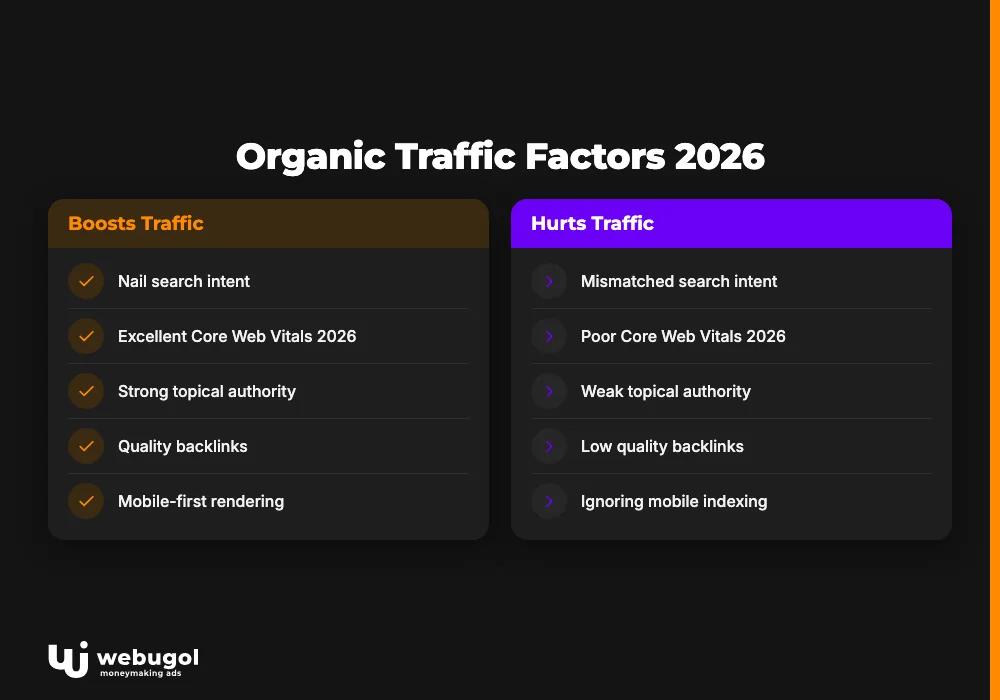
The major ranking factors in 2026 and why each matters:
| Ranking factor | Why it matters in 2026 |
|---|---|
| Search intent match | Mismatched intent causes immediate bounce and directly suppresses rankings |
| Core Web Vitals 2026 | LCP, INP, and CLS are now direct ranking signals, not soft user experience hints |
| Topical authority | Pillar and cluster architecture signals that your site owns a topic area |
| Backlink quality | Trust votes from relevant, authoritative sources still carry substantial weight |
| Mobile-first rendering | Google indexes your mobile version; all rankings flow from that index |
| Multimedia indexing | Video and images now receive the same indexing weight as text |
These factors interact. A page with strong intent alignment but failing Core Web Vitals hits a ceiling. A fast, well-structured page targeting the wrong intent attracts traffic that does not convert and sends negative engagement signals back to the algorithm.
Search intent optimization: the foundation of organic growth
Search intent is the reason behind a query. A user searching "increase organic traffic" wants a practical, actionable guide. A user searching "organic traffic SEO tool" wants to evaluate software. Both queries touch SEO, but they require entirely different content formats. That difference determines whether you rank or get ignored.
Getting intent alignment right has three practical dimensions.
Match the content format to the query type. Informational queries perform best as comprehensive guides or step-by-step tutorials. Comparison queries need feature tables or structured breakdowns. Transactional queries need product or service pages with clear next steps. Publishing the wrong format for the right keyword is one of the most common reasons content fails to rank despite strong topic relevance.
Satisfy the query completely. High bounce rates and pogo-sticking tell Google your page did not deliver. Pogo-sticking is when a user clicks your result, immediately returns to the results page, and clicks a competitor. That signal directly suppresses rankings. The fix is the BLUF method: Bottom Line Up Front. Put the most important answer first so users find it before they consider leaving.
Design for scanning. Most users scan a page before they commit to reading. Clear headers, short paragraphs, and bullet lists reduce cognitive load and increase dwell time. Every additional minute on the page sends a stronger intent-satisfaction signal to the algorithm.
Search intent optimization done consistently is one of the most effective ways to increase organic traffic over time because it aligns your content with actual user behavior, not with keyword patterns that modern ranking systems are increasingly able to see through.
What are Core Web Vitals and why do they matter?
Core Web Vitals are three page experience metrics Google uses as direct ranking signals: Largest Contentful Paint (LCP) measures loading speed, Interaction to Next Paint (INP) measures how fast a page responds to user actions, and Cumulative Layout Shift (CLS) measures visual stability during page load.
They matter because they quantify whether users have a good experience, separate from whether the content itself is strong. A page with excellent writing but a CLS score that makes text jump as the user reads will rank below a structurally equivalent page that does not shift.
For 2026, INP is the most commonly failed threshold on JavaScript-heavy sites. It replaced the older FID metric and measures response time for any user interaction, not just the first one. The threshold for a "good" INP score is 200 milliseconds or under.
Passing all three thresholds rarely requires a full rebuild. Compressing images, reducing unused JavaScript, and setting explicit size attributes on images and embedded elements is enough to move most pages from "needs improvement" to "good" status. For a structured approach to optimize your Core Web Vitals and page speed, start with the metrics causing the most failures before touching the ones you are already passing.
For teams where the underlying tech stack is the root cause of performance failures, a rebuild on a performance-first framework can close the gap faster than incremental fixes. Our Next.js development services are designed for sites where Core Web Vitals and page speed directly limit organic ranking potential.
Technical SEO checklist for 2026
Core Web Vitals are the most scrutinized technical factor right now, but they are one piece of a broader foundation. This technical SEO checklist covers the areas that matter in 2026.
Mobile-first indexing. Google indexes your mobile site and uses it to determine rankings across all devices. A site that works on desktop but breaks on a phone has a fundamental ranking ceiling regardless of content quality.
Structured data (schema markup). Schema tells ranking algorithms what type of content your page contains: an article, a product, a review, a FAQ, an event. It increases the chance of appearing in rich results and in AI-generated summaries. FAQ schema maps particularly well to voice assistant responses and AI Overviews.
Crawl budget management. Search bots have limited crawl capacity per site per day. Use robots.txt and canonical tags to direct that capacity toward your important pages. Filter results, duplicate tag archives, and session-parameter URLs consume crawl budget on pages that will never contribute to organic traffic growth.
HTTPS and accessibility. HTTPS is the baseline requirement. Accessibility standards (WCAG) are increasingly factored into rankings. A site that blocks access to some users signals lower overall quality to ranking algorithms.
Canonical and redirect hygiene. Duplicate content fragments ranking signals. Each piece of content must have exactly one canonical URL, and outdated URLs must redirect cleanly to their current equivalents. Chains of multiple redirects slow crawlers and dilute link equity.
How does AI change SEO in 2026?
AI changed organic search from two directions at once: how users search and how marketers can work.
On the user side, AI-generated summaries now answer many queries directly on results pages. Ranking in positions one through five no longer guarantees click-through rates comparable to a year ago. Being cited in an AI Overview requires authoritative, well-structured answers formatted for extraction. Keyword density alone will not get you there.
On the marketer side, AI SEO tools now automate tasks that previously took hours. Predictive keyword research uses machine learning to surface trends before they peak rather than after. Automated content audits flag which existing pages have drifted from current search expectations and need updating. Meta title and description optimization can test many variations simultaneously to find the combination that maximizes click-through rates.
What AI tools cannot replace is judgment. They cannot tell you which of the SEO strategies 2026 demands fits your specific business constraints, which content angle your audience trusts, or whether a ranking drop signals a technical problem or a content quality gap. AI accelerates execution. Strategic decisions still depend on human input.
The practical implication for teams looking to increase organic traffic: use AI SEO tools for research, auditing, and optimization at scale, and reserve human effort for strategy, original insights, and content that reflects expertise AI cannot replicate.
Content strategy: what drives organic traffic in 2026
Publishing more content on more keywords is a diminishing-return strategy. What works in 2026 is structural.
Topic clusters. Build pillar pages that cover a broad subject in depth, then connect them to cluster pages addressing specific subtopics. This architecture tells ranking algorithms that your site has genuine authority over a topic rather than surface-level coverage. Google Search Console shows which cluster pages are indexing well and where topical gaps remain.
Original research. AI systems can summarize and reframe existing data, but they cannot generate original data. Publishing your own surveys, internal benchmarks, or documented case studies creates content that competitors cannot replicate. This is the strongest differentiation signal available in content-driven SEO.
Video integration. Embedding relevant video in long-form posts increases dwell time and captures traffic from video-specific search tabs. Search engines now index video at the same weight as text, and multimedia-rich pages rank better on average in competitive categories.
BLUF structure throughout. Every major section should lead with its key point. Readers who scan for answers find what they need quickly. This reduces bounce rate, increases time on page, and raises the chance of being cited in AI-generated summaries as a clean, extractable answer.

How to increase organic traffic fast?
The fastest path to increase organic traffic is to improve pages that are already performing at a low level rather than build new content from a position of zero authority.
Pages ranking in positions five through fifteen are the highest-leverage targets. They already have topical relevance and some ranking signal. Improving their search intent alignment, fixing a specific technical issue, or strengthening their internal link structure can produce ranking movement in weeks. New content competing in a crowded niche takes months to build the authority needed to rank at all.
The specific actions most likely to produce quick results:
- Fix Core Web Vitals failures on your highest-traffic pages to remove the technical ceiling limiting their ranking potential.
- Add FAQ schema to pages targeting question-based queries to improve eligibility for rich results and voice responses.
- Update older content where the structure or information no longer matches current search expectations for that query.
- Build internal links from strong, high-authority pages to underperforming cluster pages that sit just outside the top positions.
- Revise title tags and meta descriptions on pages with high impression counts but low click-through rates.
Before optimizing, you need to know where the problems actually are. Audit your current SEO baseline to identify which pages have unrealized ranking potential and which have structural issues preventing them from reaching it.
The timeline for results is relative to competition and domain authority. In low-competition niches with a solid authority baseline, focused optimizations can produce visible movement in two to four weeks. In competitive categories, expect three to six months for meaningful organic traffic growth even with consistent, well-executed work.
Link building strategies that still work
Link building remains one of the most reliable ways to increase organic traffic in 2026. Backlinks are trust signals. Quality and topical relevance of the linking source matter far more now than volume.
The link building strategies producing the best results in 2026:
Digital PR. Creating original research, compelling data, or newsworthy stories that journalists want to cite produces high-authority links that scale. A single feature in a respected publication can deliver more ranking value than dozens of low-quality directory entries.
Relationship-led guest posting. Prioritize a small number of highly relevant, authoritative publications rather than maximizing volume. The goal extends beyond the backlink itself. Referral traffic and brand exposure from well-placed content create compounding benefits that volume-first approaches miss entirely.
Unlinked brand mentions. Search for instances where your brand is referenced without a link, then ask the publisher to add a citation. This converts existing goodwill into a ranking signal with minimal effort. The conversion rate is higher than cold outreach because the publisher already considers your brand worth referencing.
These link building strategies share one principle: they lead with genuine value to the publisher or their audience. Manipulative or transactional approaches are increasingly detected and discounted by modern ranking algorithms.
How does voice search impact organic rankings?
Voice search changes the vocabulary of organic queries. Typed searches are short fragments: "increase organic traffic tips." Spoken searches are full questions: "what are the best ways to increase organic traffic for a small business?" That difference in phrasing requires a fundamentally different optimization approach.
Three adjustments make content ready for voice search SEO.
Target conversational long-tail phrases. Voice search SEO depends on matching how people naturally speak rather than how they abbreviate when typing. Optimize for full-question phrases and natural language queries that reflect actual spoken patterns, not condensed keyword fragments.
Implement FAQ schema. FAQ sections with clearly structured answers are the most common source for voice assistant responses. When a voice assistant reads an answer aloud, it almost always pulls from a directly formatted Q&A with short, precise responses. Adding FAQ schema to relevant pages significantly improves visibility in voice results.
Write for a reader, not a crawler. Content that reads as formal or mechanical will not be selected for voice output. Active voice, shorter sentences, and direct answers outperform academic prose in voice search SEO. If a sentence would sound unnatural spoken aloud, revise it.
Local SEO and organic traffic for location-based businesses
For businesses with a physical presence, local SEO is the most direct path to increase organic traffic that converts. "Near me" searches carry strong purchase intent. A user searching for a nearby service is usually ready to act, not just browse.
Three priorities for local organic visibility:
Google Business Profile. Maintain it with current hours, recent photos, and responses to reviews. An outdated or incomplete profile loses ground to competitors who treat theirs as an active marketing asset.
NAP consistency. Name, address, and phone number must be identical across all online directories. Inconsistencies in this data reduce the trust signals local ranking algorithms rely on and can suppress visibility in local pack results.
Local content. Blog posts addressing local events, area-specific questions, or community topics attract hyper-local organic traffic that broadly targeted national content cannot capture. This works best when it reflects genuine local knowledge rather than generic content with a city name swapped in.

Social signals and brand search as indirect organic drivers
Social media shares do not directly influence search rankings. The indirect effect is real and worth pursuing. High social engagement increases visibility, drives branded searches, and earns organic backlinks from people who discover content through social channels.
LinkedIn and niche community forums tend to produce the strongest downstream SEO signals for B2B content because those audiences are more likely to generate the branded searches and citations that actually feed ranking algorithms. Broad, untargeted social sharing diffuses the effect without meaningfully moving the needle.
The SEO value of social media sits in distribution and brand authority. Content that reaches the right community can generate links and branded searches long after the initial post, and each of those downstream actions contributes to sustained organic traffic growth.
How to prioritize when resources are limited
Most teams cannot execute all of the SEO strategies 2026 requires at once. Prioritization depends on your starting point.
If your site has significant technical issues, such as failing Core Web Vitals, crawl errors, or missing canonical structure, address those first. Technical problems set a ceiling that content improvements cannot break through, regardless of writing quality.
If the technical baseline is solid, the highest-leverage next step is usually search intent optimization: reviewing your top pages and improving how well each one matches the actual user need behind its primary query.
Link building strategies and voice search SEO produce the best returns once content is already technically healthy and intent-aligned. Building links to a slow, poorly structured page wastes budget without improving rankings.
The sequence matters. Technical health enables content quality. Content quality earns links. Link authority amplifies everything else. Organic traffic growth compounds when all three work together, which is why a systematic approach to SEO strategies 2026 outperforms an opportunistic one.
Ready to increase organic traffic with a real strategy?
Building sustainable organic traffic growth in 2026 means combining technical discipline, intent-first content, and credible authority signals. No single factor is sufficient on its own. Together, they create a system that compounds over time in ways paid acquisition cannot match.
At Webugol, we help businesses increase organic traffic sustainably: from technical audits and Core Web Vitals improvements to content architecture, link building strategies, and voice search SEO. If you want to stop guessing and start growing, contact us to map out your SEO strategy.
FAQ
How long does it take to increase organic traffic?
Most sites see measurable movement within three to six months of consistent SEO work. Significant traffic growth typically takes six to twelve months, depending on domain authority, keyword competition, and how quickly technical issues are resolved.
What is the difference between organic and paid traffic?
Organic traffic comes from unpaid search rankings earned through SEO. Paid traffic comes from ads that run only while the budget continues. Organic traffic compounds over time; paid traffic stops the moment spending stops.
Does link building still increase organic traffic in 2026?
Yes. High-quality backlinks from topically relevant, authoritative sources remain one of the strongest ranking signals in 2026. Quality and relevance matter far more than link volume.
What are the most important technical SEO factors in 2026?
Core Web Vitals (LCP, INP, and CLS), mobile-first rendering, structured data markup, and crawl budget management are the most critical. INP replaced FID as a ranking signal and is now the most commonly failed metric on JavaScript-heavy sites.
How does voice search SEO differ from standard SEO?
Voice search SEO targets conversational, full-question phrases rather than short keyword fragments. Content optimized for voice results uses natural language, FAQ schema markup, and concise direct answers structured for extraction by voice assistants.