



What healthcare providers must verify in a HIPAA compliant phone service
A HIPAA compliant phone service encrypts calls in transit, stores no unprotected protected health information, and comes backed by a signed Business Associate Agreement from the vendor. Without all three, any VoIP or answering setup exposes the practice to Office for Civil Rights enforcement, regardless of what the vendor's marketing page claims. For clinics and telehealth programs running real ad spend, non-compliant phone infrastructure also cannot produce the audit logs and attribution records that make patient acquisition measurable.
What makes a phone service HIPAA compliant?
Compliance is not a feature toggle. A HIPAA compliant phone service requires technical safeguards, administrative controls, and a binding legal agreement with your vendor, all implemented together.
Most consumer VoIP products fail the HIPAA bar silently. A system can use TLS encryption for data in transit and still fall short if there is no audit log, no formal BAA, or no access controls separating clinical and administrative staff. The HHS Security Rule guidance requires covered entities and business associates to implement all three safeguard categories in combination. Checking one does not satisfy the rule.
The table below maps each HIPAA safeguard category to the specific phone-system feature it requires:
| HIPAA safeguard category | What it requires from your phone system |
|---|---|
| Technical safeguards | End-to-end call encryption, encrypted voicemail storage, secure authentication, automatic session timeout |
| Administrative safeguards | Signed BAA with vendor, staff training records, defined breach notification protocol |
| Physical safeguards | Data center access controls (vendor obligation, covered in BAA subcontractor clause) |
| Audit controls | Subscriber-accessible call logs with timestamps, caller identities, and call durations |
No single feature substitutes for the full combination. A vendor offering encryption without a BAA, or a BAA without subscriber audit access, still leaves compliance gaps that OCR enforcement can reach.
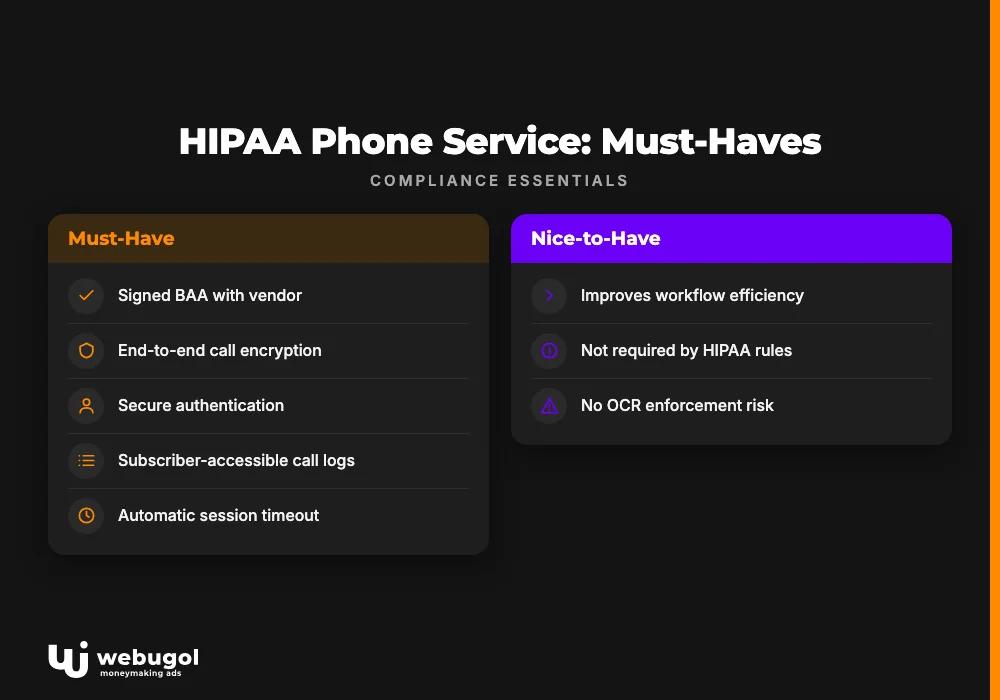
Must-have vs. nice-to-have features
Must-have features are non-negotiable under the Security and Privacy Rules. Nice-to-have features improve workflow efficiency but do not determine whether your practice faces OCR enforcement risk.
Must-have for compliance:
- The vendor signs a Business Associate Agreement, executed before any PHI moves through the system.
- The system encrypts calls end-to-end, including recorded calls and voicemail content stored at rest.
- Role-based access controls separate front desk and clinical staff permissions.
- Audit logging gives you subscriber access to retrievable call records for any OCR inquiry.
- Voicemail access requires PIN or credential-based authentication.
- Automatic session timeout triggers after a configurable inactivity period.
- A defined breach notification protocol specifies the vendor's obligation and timeline in writing.
Nice-to-have for workflow efficiency:
- EHR or scheduling system integration connects call data to clinical workflows.
- Call transcription with PHI handling controls enables searchable records.
- Auto-attendant and IVR call routing reduces manual call handling.
- Call recording with state-specific consent prompts satisfies state law requirements alongside HIPAA.
The audit log that satisfies an OCR inquiry is the same call record that makes patient acquisition measurable. Practices that block subscriber audit access lose both the compliance record and the attribution data showing which campaigns drove answered calls.
Is a personal cell phone HIPAA compliant for patient calls?
No. A standard iPhone or Android on a consumer carrier plan does not meet HIPAA requirements for patient communication.
The carrier holds no BAA with your practice. Call metadata is logged without the encryption controls the Security Rule requires. No audit trail is accessible to you as the subscriber. Three hard requirements fail at once. Solo providers who use a personal number for patient callbacks face real OCR exposure, even when the conversation involves nothing clinically sensitive.
The practical workaround most solo providers use is the layered-app approach. A HIPAA-compliant VoIP application installed on a personal device can create a compliant channel, provided the app vendor signs a BAA before first use. The device itself is not compliant. Only calls routed through the certified app qualify. That distinction matters during an audit.
Four specific compliance gaps on a standard consumer carrier plan:
- The carrier holds no BAA covering call data or voicemail content.
- Call routing uses no encryption meeting the Security Rule's technical safeguard standard.
- The subscriber has no access to an audit log of call times, durations, and caller identities.
- Voicemail access requires no authentication or automatic session timeout.
What should a HIPAA BAA include for phone services?
A compliant BAA must define permitted uses of PHI, set a breach notification timeline, bind the vendor's subcontractors, and specify data destruction procedures when the contract ends. Healthcare BAA requirements go well beyond a checkbox; vague language typically indemnifies the vendor while leaving compliance exposure on the practice side.
Before signing, verify these five clauses:
Permitted uses of PHI. The BAA must define exactly what the vendor can do with call data. A clause permitting use for "service improvement" without restriction is worth negotiating before you commit.
Breach notification timeline. HIPAA allows up to 60 days from discovery, but the BAA must specify the vendor's obligation to notify your practice in writing, not just a general reference to the HHS maximum.
Subcontractor chain obligations. If the vendor routes call data through a third-party data center, transcription provider, or cloud storage partner, the BAA must obligate that subcontractor to the same HIPAA standards. Any BAA that omits the subcontractor chain is structurally incomplete. That omission is the clause most likely to matter when a data breach traces to the vendor's hosting partner rather than the vendor itself.
Audit cooperation requirements. The agreement must require the vendor to provide access logs and cooperate with any OCR inquiry within a defined response window.
Data destruction upon termination. The BAA must specify when and how the vendor deletes or returns your PHI after the contract ends. "Upon reasonable request" is not a defined deadline.
The subcontractor omission is common. It is also the most exploited gap in healthcare phone vendor agreements.
What is the difference between a HIPAA phone service and an answering service?
A HIPAA phone service is the VoIP system your staff uses for daily calls. A HIPAA answering service is a live-agent operation that handles calls on your behalf, typically for overflow and after-hours coverage. Different products. Different BAA scopes.
Neither replaces the other. Practices that contract with a HIPAA compliant phone answering service for after-hours coverage still need a compliant phone system for daytime operations. Both require a signed BAA, but the scope of each agreement differs.
| Feature | HIPAA phone service | HIPAA answering service |
|---|---|---|
| Who handles calls | Your staff | Third-party live agents |
| BAA scope | Technology infrastructure and call data handling | Live agents, call scripts, PHI processing during interaction |
| Staffing model | Software your team operates | Outsourced staffed operation |
| Pricing structure | Per user per month | Per minute, per call, or monthly volume tier |
| Primary use case | Day-to-day inbound and outbound operations | After-hours coverage and overflow |
If patient inquiries go unanswered after hours, an answering service fills that gap. The phone infrastructure underneath still needs to be independently compliant.
Which VoIP providers sign a HIPAA BAA?
Most enterprise-grade medical practice VoIP vendors will sign a BAA, but the offer is rarely automatic. You must request it. And the terms vary significantly between providers.
The fact that a vendor's website mentions HIPAA does not mean they will execute a proper BAA. Three behaviors separate compliant vendors from marketing-first ones:
Proactive BAA delivery. A compliant vendor includes the BAA as part of standard contract onboarding, not as something you unlock by opening a support ticket. Delays at this stage signal the vendor's overall compliance posture.
Subcontractor disclosure. Any vendor processing healthcare call data through third-party infrastructure should name those subcontractors and confirm their HIPAA obligations within the BAA itself. Patient call encryption and audit records must remain accessible to you as the subscriber for OCR audit phone records review.
Subscriber audit access. The vendor provides you direct access to call logs, not just aggregate reporting they control. Without subscriber access, VoIP healthcare regulations still apply but you have no independent way to verify or defend compliance.
Three questions to ask any vendor before signing a contract:
- "Can I review and sign the BAA before committing to a plan?"
- "Which subcontractors handle my call data, and are they covered under your BAA obligations?"
- "What is your specific breach notification timeline and how does your team notify my practice directly?"
A vendor unwilling to answer these before the contract is signed is communicating their compliance posture clearly.

How much does a HIPAA compliant phone service cost per month?
Vendors quote per-line and per-seat pricing after a discovery call. Costs shift with routing complexity, integration requirements, and line count. The table below describes what drives cost at each tier rather than quoting rates that change between vendor conversations.
| Tier | BAA included | Cost drivers | Best fit for |
|---|---|---|---|
| Basic | Yes | Per-seat licensing, line count, basic voicemail storage | Single-location clinic |
| Mid-tier | Yes | Advanced routing logic, EHR/scheduling integration, additional lines | Small multi-provider clinic, telehealth group |
| Enterprise | Yes | Multi-site PBX complexity, dedicated support, high call volume infrastructure | Multi-site health system, high-volume telehealth |
The price gap between tiers reflects routing complexity, integration depth, and the number of included phone lines, not the compliance features themselves. A two-provider clinic does not need enterprise infrastructure to meet the HIPAA requirement. That distinction saves significant budget.
Telehealth groups operating across state lines face an added layer. Telehealth phone compliance varies by state for call recording consent, so the phone system needs configurable consent prompts rather than a single blanket disclaimer. That requirement typically pushes telehealth buyers toward mid-tier plans even at modest team sizes.
Best fit by practice type
Single-location clinic or early-stage telehealth program
A single-location clinic needs a HIPAA compliant phone service that covers the core baseline: a compliant number, encrypted call routing, secure voicemail, and a signed BAA on file before first patient contact. Beyond meeting the regulatory floor, the phone system is the first instrument in the acquisition measurement stack. Answer rate and speed-to-lead are the two metrics most directly visible in the phone channel. A missed call from a paid inquiry is a lost booking.
Without a compliant system that logs answered versus missed calls by source, there is no way to know whether inbound volume is converting or evaporating. Adding administrative staff later means adding a second user seat, not upgrading to a feature tier built for multi-provider operations.
Multi-provider clinic or telehealth group
A multi-provider clinic needs department-level call routing, role-based access controls, and direct integration with patient scheduling software to close the gap between a ring and a confirmed appointment. At this scale, compliance gaps are also operational gaps. Orphaned access credentials after staff turnover mean former employees retain call access you cannot audit. Subcontractors in the vendor's call data chain not covered under the BAA mean a breach traces to a vendor you do not control.
If you are building out the full compliance stack, a HIPAA-compliant CRM is typically the next piece after the phone system, since patient call data and intake records need to connect without unprotected PHI handoffs between systems.
HIPAA phone vendor checklist: red flags before you sign
The most dangerous vendor is not the one that refuses to offer a BAA. It is the one that sells a HIPAA compliant phone service in name only, with a BAA buried in a click-through agreement that indemnifies them and leaves your practice exposed.
Six red flags to check before signing anything:
- The vendor offers no BAA, or claims compliance without providing one.
- The BAA requires opening a support ticket to obtain, rather than arriving in the standard contract package.
- The vendor provides no subscriber audit log access, only internal aggregate reporting they control.
- The breach notification window goes unspecified in the BAA, or defaults to the vendor's discretion.
- The system uses consumer-grade TLS only, with no patient call encryption and no encrypted voicemail storage.
- The vendor discloses no information about which subcontractors process or store call data on their behalf.
VoIP healthcare regulations do not change based on what the vendor's pricing page says. OCR audit phone records requirements apply from the first patient call, regardless of whether the BAA was properly executed.

How to migrate without disrupting patient communications
Migrating to a HIPAA compliant phone service is the step practices delay longest. Number porting creates a gap risk. Patient callbacks on the old number can fall into a dead zone if the cutover is unplanned.
A migration that completes the BAA transfer but overlooks call tracking parameter updates carries a second cost: every inbound call during the transition period becomes unattributable, severing the link between ad spend and booking data until the tracking chain is manually rebuilt. A structured sequence addresses both.
Six-step migration checklist:
- Start number porting 30 days before planned go-live. Carriers require advance notice, and starting late forces a hard cutover with no parallel run and no safety net for missed callbacks.
- Export all voicemail and call logs from the old system before closing the account. These records may be needed for compliance documentation.
- Sign the new BAA before the first patient call routes through the new system. The agreement must be in place before go-live, not after.
- Conduct a test call audit with every staff member. Confirm voicemail PIN setup and verify that role-based access permissions are configured correctly for each user.
- Update your phone number across all directories: Google Business Profile, your website, major patient directories, and insurance portals.
- Decommission the old system only after a two-week parallel run. Forward calls on the old number to the new one, run both simultaneously, then terminate the old account only after confirming no active patient inquiries still route through it.
If your practice also relies on video for consultations, the BAA requirement extends to that platform. Before scaling telehealth services, verify your video platform's compliance posture using the same BAA criteria that apply to your phone system.
Ready to close the click-to-booking gap in your practice?
A HIPAA compliant phone service stops the regulatory exposure. The revenue problem starts after the call connects: slow follow-up, no attribution from ring to confirmed appointment, and intake steps that lose patients who would have converted.
Webugol builds healthcare growth systems that close the entire path from ad click to recognized revenue as one accountable unit. That includes the tracking foundation that shows you whether your compliant phone line is generating booked appointments or just ringing.
FAQ
Is a personal cell phone HIPAA compliant for patient calls?
No. A standard personal phone lacks a BAA with the carrier, encrypted call routing, and the access audit logs required under the Security Rule. You can use a personal device with a HIPAA-compliant app layered on top, provided that app vendor signs a BAA before you use the service.
What should a HIPAA BAA for phone services include?
A compliant BAA must specify permitted uses of PHI, a breach notification timeline (the HIPAA maximum is 60 days from discovery), obligations on the vendor's subcontractors who handle call data, and data destruction procedures upon contract termination. Any BAA that omits the subcontractor chain is incomplete.
What is the difference between a HIPAA phone service and a HIPAA answering service?
A HIPAA phone service is the VoIP system your team uses for daily outbound and inbound calls. A HIPAA answering service is a third-party live-agent team that handles calls on your behalf, typically for overflow or after-hours coverage. Both require a BAA, but they solve different operational problems.
How much does a HIPAA compliant phone service cost per month?
Vendors price per line or per seat and quote after a discovery conversation, so the best approach is to request quotes from two or three shortlisted vendors at the same time. Basic plans cover the compliance essentials: BAA, encrypted calls, and secure voicemail for single-location clinics without EHR integration or advanced routing. Enterprise tiers serve multi-provider groups and telehealth platforms with high call volume and multi-site infrastructure needs.
Which VoIP providers sign a HIPAA BAA?
Most enterprise-grade VoIP providers serving healthcare will sign a BAA, but you must request it explicitly during the sales process. Verify that the BAA covers subcontractors who handle your call data, specifies a breach notification timeline, and grants you direct subscriber access to call logs for audit purposes.

