



Google Ads agency cost: what you're actually paying for
Google Ads agency cost varies because the work behind effective campaigns is not uniform. A capable team runs pre-launch business analysis, builds structured campaigns around researched keyword groups, and monitors the auction daily to cut waste. A less rigorous team publishes campaigns and waits. The gap between those two approaches explains most of the pricing difference between agencies, and most of the results difference as well.
When business owners report that Google Ads did not work for them, the cause typically falls into one of three categories: the specialists managing the campaigns lacked the technical depth to handle them well, the results were never tracked in a way that connected spend to revenue, or the sales process could not close the traffic that arrived. This article focuses on the first category, because it directly determines whether any google ads agency cost represents a sound business investment or a recurring expense without a return.

How much does a Google Ads agency charge per month?
The answer depends entirely on what the agency does, not on how many hours they log. A retainer covering bid reviews and a monthly summary is structured differently from an engagement that opens with full business analysis, builds campaigns from a researched semantic core, tests multiple ad variants per group, and includes a daily audit of auction performance.
Before any pricing makes sense, a qualified google ads specialist needs to understand the client's market, competitive landscape, conversion baseline, and geographic priorities. Without that foundation, a google ads budget is distributed rather than invested. That distinction matters considerably for what results are achievable. Ppc management cost reflects the depth of that upfront work as much as the ongoing hours spent inside the platform.
What factors affect google ads agency cost?
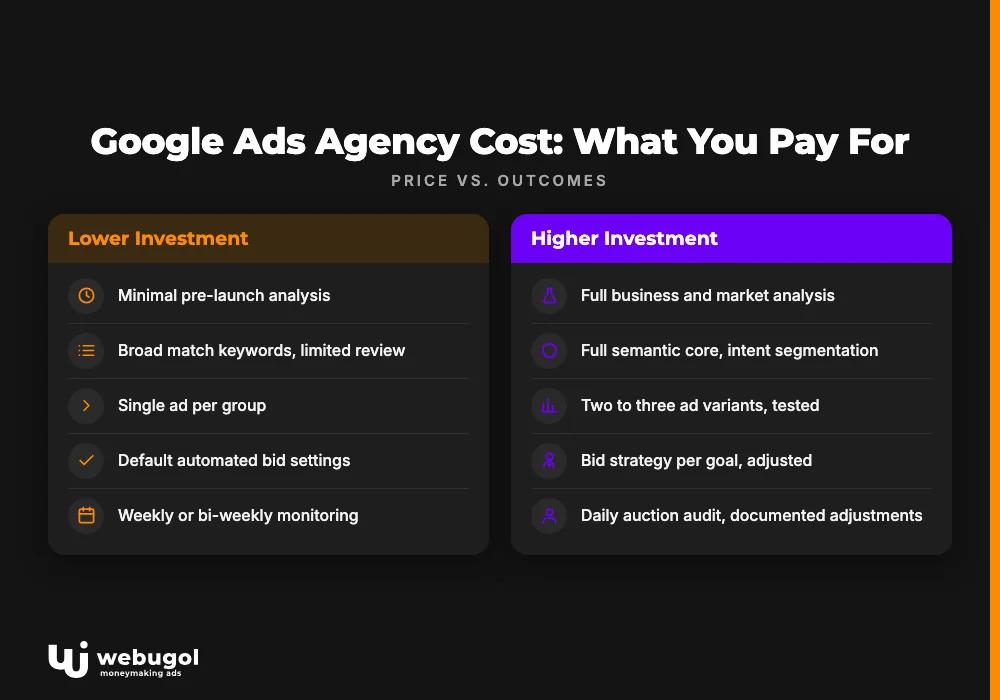
The table below shows how choices at each stage of the engagement affect both price and outcomes.
| Factor | Lower investment | Higher investment |
|---|---|---|
| Pre-launch analysis | Minimal or skipped | Full business and market analysis |
| Keyword research | Broad match types, limited review | Full semantic core, intent segmentation, negative lists |
| Ad creation | Single ad per group | Two to three variants per group, tested |
| Bid strategy | Default automated settings | Strategy selected per campaign goal, adjusted as conditions change |
| Monitoring frequency | Weekly or bi-weekly check-in | Daily auction audit with documented adjustments |
| Reporting | Monthly summary of clicks and spend | Conversion-linked reporting tied to business outcomes |
Each row in that table represents a decision that compounds. An agency choosing the lower-investment approach at every layer will produce predictably weaker results regardless of how large the google ads budget is. The compounding works in both directions.
A meaningful share of what differentiates ppc agency pricing is the pre-campaign work that clients rarely see directly. Agencies charging more for the same nominal deliverable are often doing substantially more analysis before spending a single dollar on media. That upfront investment is where the performance gap is set before campaigns even launch.
Why do Google Ads services cost differently?
Google Ads is technically accessible to anyone. The platform includes simplified campaign types designed for business owners without advertising experience and deliberately reduces the number of decisions they need to make. That path is convenient. It is not optimized.
Professional google ads management requires disciplined decision-making at every stage of the engagement. At the keyword selection stage alone, an inexperienced practitioner includes all queries that appear related to the business. In practice, a significant portion of those queries, roughly 70% in professional campaign management experience, will consume budget without producing conversions. Identifying which queries fall into that category before campaigns launch, or within their first days of running, is one of the primary ways a competent agency justifies its ppc management cost.
The same logic applies to audience selection, geographic coverage, ad scheduling, and bidding strategy. Each layer contains decisions that look minor in isolation but accumulate into the difference between a campaign generating leads at a reasonable cost per acquisition and one producing nothing measurable.
Geographic prioritization is a direct example. A business with a limited google ads budget gets better returns by concentrating spend in locations with the strongest conversion history, typically where the business can actually fulfill demand, rather than spreading the same budget across an entire country where conversion rates are unknown. An agency that recommends and implements geographic concentration is doing work that default platform settings do not perform automatically.
Bidding strategy selection is another area where professional judgment separates agencies. Smart Bidding, Google's automated system, optimizes toward conversions by analyzing thousands of signals from users who have previously converted. This works well when the account has sufficient conversion history and the market is stable. During lower-traffic periods, in markets with limited historical data, or when competitive conditions shift, a manual strategy such as Maximize Clicks gives the account manager direct control over what each lead costs. Moving between these strategies as conditions change requires daily contact with performance data. Agencies that set a strategy at launch and leave it in place are not doing this work.
The three failure patterns that inflate the real cost of poor management
Three specific failure patterns account for most cases where a business concludes that Google Ads does not work.
The first is inadequate specialist quality. The platform is accessible enough that someone with surface familiarity can configure and run campaigns. Those campaigns run. The results are weak. The owner increases the budget looking for improvement, or cancels the service, having concluded the channel does not work. The problem was not the channel.
The second is absent result tracking. Without proper conversion tracking, there is no way to distinguish a campaign generating ten qualified leads per week from one generating none. Spend continues because nobody can trace which campaigns, keywords, or audiences are responsible for actual business outcomes.
The third is a sales conversion problem attributed to advertising. Traffic arrives, the website converts poorly, or the sales process cannot close. The advertising gets blamed. This is a real problem but a different one from google ads agency cost or campaign quality. Identifying which of these three issues is present is part of what a pre-launch business analysis should surface.
What does Google Ads campaign setup include?
A properly scoped google ads campaign setup does not begin with writing ads. It begins with business analysis, a structured process of identifying what the business needs from the campaign, what the market looks like, and what the advertising must accomplish before any keyword is selected or any bid is placed.
Business analysis for a google ads campaign management engagement typically covers five areas:
- Conversion rate audit. The website needs to receive traffic and convert it. This means accessible calls to action, pages that match what the ads promise, and technical performance that does not create friction for arriving visitors. The analysis produces specific recommendations for improving conversion rate before budget is committed to driving traffic.
- Market research and semantic core development. This involves identifying how the target audience searches, which competitors appear in those results, and which keyword categories are worth targeting. The semantic core is the organized set of keyword groups that will structure all subsequent campaigns. An inexperienced team skipping this layer is the origin of the 70% budget waste described earlier.
- Timing analysis. Some products and services convert better at specific hours of the day or during predictable seasons. Identifying those patterns and setting bid adjustments that reflect them prevents budget from running during periods when conversions are unlikely.
- Geographic prioritization. When the google ads budget is limited, concentrating spend in areas with the highest historical conversion rates produces better returns than broad national coverage. This requires knowing where the business's actual customers are located and where fulfillment capacity exists.
- Conversion tracking configuration. Every contact point, including forms, phone calls, and chat interactions, needs tracking in place before campaigns launch. A responsible person inside the client's organization also needs to be identified to record and report on leads and sales, because the feedback loop between results and adjustments depends on that data.
After business analysis is complete, the agency should produce a technical proposal. This document describes recommended website improvements, projected campaign performance at the recommended google ads budget, and expected cost per lead or cost per acquisition based on market data. At that point, the client has a financial picture of the engagement before committing to it.
Agencies that skip this step are either not doing the analysis or not sharing the results in a way that lets the client evaluate the relationship on informed terms. Either way, the client is being asked to commit a google ads budget before understanding what it should produce.
What is included in Google Ads management?
Once analysis and setup are complete, ongoing google ads campaign management is the work that determines whether campaigns continue to perform or begin to decay. This work happens across several dimensions simultaneously.
Ad creation and testing
Each campaign is built around ad groups organized by keyword intent. Within each group, running two to three ad variants simultaneously allows Google to rotate them during auctions and serve the version statistically more likely to produce a click at a lower cost. This is a baseline requirement for any account where performance is actively being optimized, not an advanced refinement for large budgets.
Ad copy development involves several interdependent constraints. Keywords must appear naturally in the ad text, because relevance between the search query, the ad, and the landing page determines Quality Score. Quality Score directly affects how often the ad appears and at what cost per click. The content must be specific enough to filter for genuine purchase intent while persuasive enough to earn the click from someone seeing multiple competing ads in the same result.
Google evaluates the quality of each ad and rewards higher-rated ads with better positioning and lower costs. This means that ad writing is not a one-time task at launch. It is an ongoing process of testing and improving the variants within each group based on actual performance data.
Responsive search ads accept multiple headlines and descriptions, letting Google assemble combinations based on predicted performance. Each element must be written to function independently and in any combination, because the system will test arrangements that may not reflect the writer's original intent. This requires more upfront writing discipline than a single static ad, and it is part of why professionally managed google ads management looks different from a self-managed account from the first week.
Extensions and account completeness
Ad extensions add structured information beyond the core headline and description. A complete extension setup includes sitelinks pointing to specific pages, callout text highlighting service attributes, call extensions with phone numbers, structured snippet extensions describing service categories, and location extensions where relevant.
Extensions increase the physical space an ad occupies in search results, which directly improves visibility and click-through rate. An account with fully configured extensions consistently outperforms one where extensions are incomplete or absent. Configuring and maintaining them is standard scope in google ads campaign management, not an optional feature to be added later.
The practical effect of extensions is that a fully configured ad can occupy a significantly larger portion of the search result page than a bare-minimum ad. For a visitor choosing between a competitor and your ad based on what they see, that difference in visible information can determine whether they click at all.
Bid strategy management
Ongoing google ads management includes selecting the appropriate bid strategy for each campaign and adjusting it as conditions change. Smart Bidding campaigns use machine learning to set bids at each auction based on the likelihood of conversion from that specific user at that moment. Target CPA, a component of Smart Bidding, allows the manager to specify the maximum desired cost per conversion, and the system optimizes toward that number.
When automated strategies underperform due to low conversion volume, limited historical data, or seasonal disruption, switching to a strategy such as Maximize Clicks gives the account manager direct control over bid levels. The professional judgment involved in deciding when to use each approach, and when to switch, is a meaningful part of what ppc management cost should cover. This is not a set-and-forget decision.
Google ads campaign management: the daily work
After campaigns launch, they enter a learning phase during which Google's systems test bid levels, ad combinations, and audience signals. The outcome of that phase depends heavily on how actively the account is monitored and adjusted.
Auction Insight is the Google Ads section that shows how campaigns perform relative to competitors. It reports impression share, average position relative to competitors, and overlap rate. This data drives specific adjustments to bids, budget allocation, and ad scheduling. A campaign that appears to be spending normally may be losing significant auction share to a competitor who recently increased their bids. Auction Insight makes that visible before it compounds into a larger problem.
Daily audit work includes reviewing the previous day's search term report to identify and exclude irrelevant queries, checking conversion rates by time of day to confirm that bid adjustments are producing the intended effect, reviewing geographic performance to reallocate budget toward higher-converting areas, and monitoring Quality Scores to identify ads or landing pages that need revision.
The google ads specialist responsible for daily management also tracks external signals. A competitor launching a new campaign appears in Auction Insight data. A seasonal shift in search volume shows up in keyword performance trends. Responding to those signals quickly, before they compound into larger performance drops, is what active management produces that periodic check-ins cannot replicate.
Adjustments happen at the campaign, ad group, keyword, and audience level. Any one of those layers, if misconfigured or left unreviewed, can undermine performance across the others. For accounts where google ads campaign management represents a meaningful share of marketing spend, daily review is the baseline that makes results reliable, not a premium option.
The previous day of campaign activity should be audited every morning to identify what needs editing, what queries should be added to the negative list, and whether the budget is being consumed by high-performing or low-performing ad groups. This is how the account improves continuously rather than drifting toward mediocrity over time.
How to choose a Google Ads agency?
Evaluating a google ads agency means understanding what they do before campaigns launch, not only what they report afterward.
A rigorous agency starts with business analysis and produces a documented proposal before asking for budget commitment. That proposal should include projected conversion metrics, a recommended keyword structure, a timeline, and cost per acquisition estimates based on market data. An agency that moves directly to contract and campaign configuration without that analysis is skipping the layer of work that determines whether subsequent spending will be efficient.
Ask specifically how they structure ad groups, how many ad variants they run per group, how they approach negative keyword research, and how frequently they review the search term report. These questions have specific correct answers. An agency that cannot explain their approach to these areas clearly is likely not executing them with rigor.
Understanding their approach to bidding strategy matters as much as knowing their ad production process. An agency that applies Smart Bidding by default regardless of account conditions is not making campaign-specific decisions. One that can explain when and why they shift between automated and manual strategies demonstrates the analytical work that a reasonable google ads agency cost should be purchasing.
Ask how they measure success. The answer should connect advertising activity to business outcomes: leads, calls, appointments, sales, and cost per acquisition. A reporting framework centered on click-through rates and impression volume is not aligned with business goals. Transparent reporting shows what changed from one period to the next and explains why specific adjustments were made. The client should be able to evaluate the reasoning, not simply accept the summary.
Consider asking for examples of how they handled a campaign during a low-traffic period or a market shift. This reveals whether they actively manage bidding strategy or rely on platform automation to compensate for their absence. The answer to that question often reflects the real difference in google ads agency cost between agencies charging similar rates on paper.
Selecting a google ads specialist who treats the engagement as a financial investment, not a media placement, is the distinction that determines whether ppc agency pricing delivers returns or generates invoices without corresponding results. You can read about how to optimize Google Ads campaigns for sustained performance and what Google Ads can accomplish for your business goals to set realistic benchmarks before entering an agency relationship. For the keyword research stage specifically, how to use the Google Ads keywords tool effectively is a useful reference for evaluating the quality of an agency's semantic core development.
Get a clear picture of what your Google Ads budget should produce
If your current campaigns are running without a documented pre-launch analysis, without daily auction monitoring, or without conversion tracking tied to business outcomes, the real cost of that arrangement extends beyond the retainer you are paying. Webugol builds Google Ads engagements that start with thorough market and website analysis before touching campaign settings. Contact us to understand what your google ads budget should be generating and what it would take to get there.
FAQ
How much does a Google Ads agency charge per month?
Google ads agency cost varies based on scope rather than a fixed industry rate. Agencies that conduct pre-launch business analysis, build campaigns from a researched semantic core, and perform daily monitoring operate at different price points than those offering basic setup and periodic check-ins. The relevant measure is cost per lead or cost per acquisition, not the monthly retainer amount in isolation.
Why do Google Ads services cost differently?
The variation in ppc agency pricing reflects the depth of work at each stage of the campaign. Agencies investing in pre-launch analysis, negative keyword management, ad variant testing, and daily auction review consistently produce different outcomes than those relying on default settings. The pricing difference between them is typically smaller than the performance difference.
What is included in Google Ads management?
Full google ads management includes pre-launch business analysis, keyword research and semantic core development, ad creation with multiple tested variants per group, extension configuration, bid strategy selection and adjustment, daily search term review, geographic and time-of-day bid adjustments, and reporting connected to conversion outcomes. Accounts receiving all these elements consistently outperform those where any layer is absent.
How do I know if my Google Ads specialist is managing the account well?
A well-managed account shows documented negative keyword additions, regularly tested ad variants, bid adjustments based on conversion data by time of day and location, and reports that connect spend to leads or sales. If you cannot get a specific explanation of what changed in your account last week and why those changes were made, the management is not operating at a sufficient level.