



How to launch an online TRT clinic that doesn't stall at the compliance review stage
An online TRT clinic is a telehealth platform, a licensed prescribing physician, and a pharmacy fulfillment loop built into a subscription-based men's health practice. Launching one requires that your compliance stack, infrastructure, and patient acquisition model are designed together, not in sequence, because building them separately is precisely what stalls launches at the compliance review stage. That structural gap does not belong only to new operators. It is what keeps established $500k+/mo men's health practices stuck at a scaling plateau when they try to grow beyond what the founder manages personally. Scaling reveals every gap.
What an online TRT clinic actually is, and why the model demands a system
The business model looks simple on paper: a patient answers a symptom intake, orders labs, consults with a physician by video, receives a prescription, and gets medication shipped to the door. Revenue comes from a recurring membership, so unit economics depend on patient LTV rather than a single transaction.
The complexity lives in the system holding that loop together. Each stage involves a compliance decision, a platform dependency, and an acquisition touchpoint that must work in concert. When operators build compliance first and acquisition later, they discover that the acquisition channels available to a TRT practice are constrained in ways that change platform and intake design requirements from the start. Getting those requirements wrong in month one means rebuilding under live-fire conditions.
The 5-step patient journey you're building
Understanding the full loop before you build any single component prevents the most expensive re-works.
- Symptom intake. The patient completes an online questionnaire. Compliance decision: consent language must meet HIPAA standards, and the form must not collect protected health information through a pixel-fired event.
- Lab order. The practice orders baseline bloodwork, typically testosterone, hematocrit, PSA, and a metabolic panel. Operational requirement: a lab partner integration that keeps results inside your HIPAA-compliant environment.
- Telehealth consult. A licensed physician reviews labs and conducts a synchronous or asynchronous video consultation. Compliance decision: the Ryan Haight Act and your state's telehealth prescribing laws govern what must happen before a controlled substance prescription is issued.
- Prescription and pharmacy dispatch. The physician issues a prescription to a 503A or 503B compounding pharmacy or an FDA-approved dispenser. Operational requirement: a pharmacy partner whose fulfillment workflow integrates with your EHR and ships to the states where you are licensed.
- Ongoing monitoring. Labs are re-ordered at 90- and 180-day intervals. Compliance decision: continued prescribing under telehealth regulations requires documented follow-up, and monitoring cadence also determines your membership retention rate.
Mapping your patient journey mapping before choosing a platform is not a planning exercise. It is a build requirement. Start here, not later.
What compliance requirements define a legitimate online TRT clinic?
A compliant online TRT clinic satisfies the Ryan Haight Online Pharmacy Consumer Protection Act, applicable state telehealth prescribing laws, DEA Schedule III registration requirements, and HIPAA infrastructure standards before the first patient consult is booked. Missing any one layer does not create a minor compliance gap. It creates a prescribing violation.
The Ryan Haight Act and state prescribing rules
The Ryan Haight Act requires that a prescribing physician conduct at least one in-person medical evaluation before issuing a controlled substance prescription via the internet. During the COVID-19 public health emergency, the DEA issued waivers that permitted telehealth prescribing without an in-person visit. Those waivers have been extended in modified form, but their long-term enforcement status is not settled, and your practice's prescribing posture must be reviewed against current DEA guidance before launch.
State-level rules add a second compliance layer that national operators consistently underestimate. Roughly two dozen states require a prescribing physician to hold a state-specific controlled substance license separate from their DEA registration. If your acquisition model targets patients nationally, you are building a multi-state DEA registration and licensing stack from day one. Each new state you open to patients triggers a credentialing timeline of weeks to months, so geographic expansion decisions must be made before the intake workflow is scoped, not after growth reveals the ceiling.
HIPAA-compliant infrastructure before patient #1
Your telehealth platform, EHR, and data handling stack must meet HIPAA requirements before any patient record is created. That means Business Associate Agreements with every vendor that processes protected health information, audit logging on all data access, and role-based access controls. For a TRT practice, the controlled substance prescribing workflow adds state prescription drug monitoring program (PDMP) reporting obligations that many general-purpose EHRs do not handle natively.
The intake form is where HIPAA violations are most commonly introduced. Standard web analytics tools fire events on form submissions that can include form field values, transmitting PHI to a third-party advertising platform. Choosing a platform built for this model from the start is cheaper than a compliance retrofit. Most operators miss this. See a comparison of hipaa compliant telehealth platforms covering BAAs, audit logging, and controlled substance prescribing workflow requirements specific to TRT.
TRT delivery formats: what to offer and what affects your compliance exposure
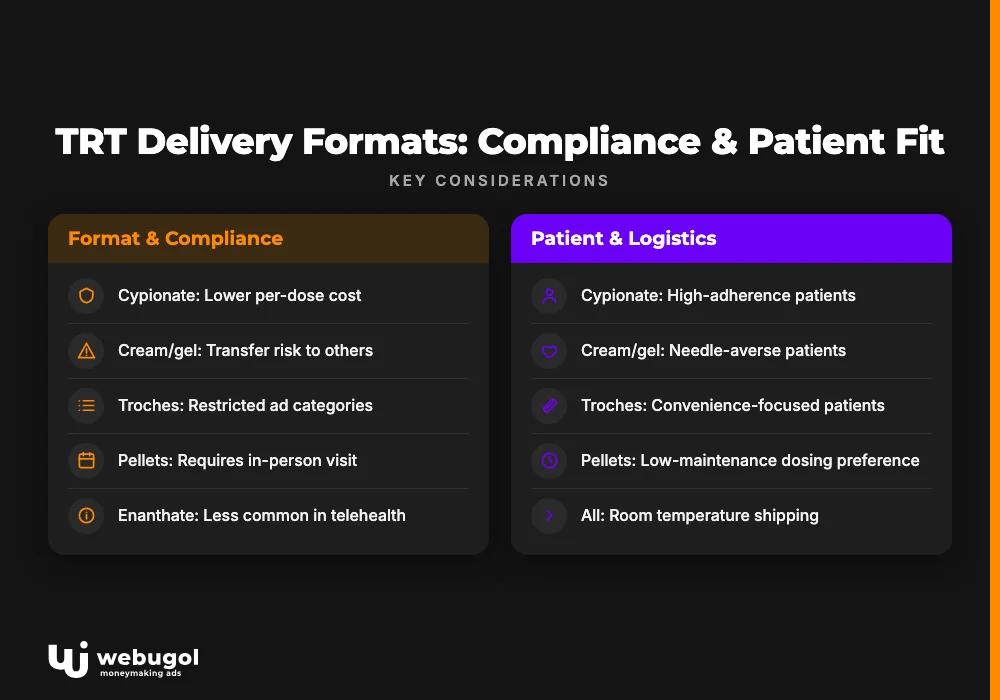
Your delivery menu is a launch decision, not a post-launch one. The format you offer determines which pharmacy partners you can work with, what shipping and storage requirements apply, and which ad platform policies you will face. Deciding this after the platform is built means renegotiating partner agreements and rebuilding intake forms mid-launch.
| Format | Compounded or FDA-approved | Shipping and storage | Patient segment fit | Operator compliance risk |
|---|---|---|---|---|
| Testosterone cypionate injections | Both available | Room temperature, standard shipping | High-adherence patients, performance-focused | Lower per-dose cost; self-injection training required |
| Testosterone cream / gel | Primarily compounded | Room temperature; transfer risk | Needle-averse patients | Transfer risk to partners/children; labeling requirements |
| Oral troches | Compounded | Room temperature | Convenience-focused patients | 503A/503B rules apply; restricted ad categories |
| Pellets | FDA-approved and compounded | In-office insertion only | Low-maintenance dosing preference | Requires in-person visit; limits fully-remote model |
| Enanthate injections | Both available | Room temperature, standard shipping | Similar to cypionate; longer half-life | Same as cypionate; less common in telehealth |
Compounded vs FDA-approved testosterone: the decision that shapes your risk profile
FDA-approved testosterone products are manufactured under full current Good Manufacturing Practice standards and carry no FDA enforcement risk. Compounded testosterone from a 503A pharmacy is legal when prepared for an individual patient under a valid prescription, but it falls outside FDA approval and has faced periodic agency scrutiny. 503B outsourcing facilities operate under stricter standards and can produce larger batches, but their product list is constrained by FDA's designated drug shortage criteria.
The compliance implications extend beyond FDA exposure. Many ad platforms classify compounded hormone products under sensitive health category policies that restrict targeting options or require prior approval. Choosing compounded testosterone for cost-per-patient reasons without mapping the ad platform restrictions first can close acquisition channels before you launch. The cheapest option on the pharmacy invoice is not always the cheapest acquisition path.
Which patient segments to build for, including performance and bodybuilding
The clinical oversight intensity and delivery menu your practice requires differ meaningfully by patient segment. Men seeking treatment for hypogonadism symptoms typically accept a broader range of delivery formats and require standard monitoring protocols. Performance and bodybuilding patients, the segment behind "best online TRT clinic for bodybuilding" searches, often seek specific injectable formats, higher-frequency dosing adjustments, and ancillary medications such as aromatase inhibitors. Serving that segment requires a physician team comfortable with performance-oriented protocols and a pharmacy relationship that covers the full medication menu.
That segment is also more research-active and community-influenced. Online TRT clinic reviews are posted more frequently by performance patients than by men being treated for primary hypogonadism. The acquisition angle for a performance-focused trt online clinic differs from a general men's health positioning, and so does the ad platform risk profile for the claims you can make.

Does an online TRT clinic need to accept insurance?
Most online TRT clinics launch cash-pay, and there are structural reasons for that. The billing infrastructure required to accept insurance adds credentialing timelines, clearinghouse integrations, and prior authorization management that increase pre-revenue operating complexity significantly. The revenue math changes at scale, but the billing infrastructure decision must be made before the intake workflow is built, because switching models after launch requires rebuilding the intake, payment, and reporting stack.
Cash-pay vs insurance: what the revenue model actually looks like
A membership model on a cash-pay basis offers meaningful operating advantages at launch. Revenue is predictable, billing is simple, and there is no prior authorization delay between the physician's prescribing decision and the patient starting treatment. The constraint is the CAC ceiling: monthly subscription pricing must generate enough LTV to absorb acquisition costs within a 60- to 90-day payback window, the operational threshold where the model either works or stalls.
Operators marketing the cheapest trt clinic online compete on price in a market where patients bear full cost. That segment is real, but competing on price as the primary acquisition angle compresses margin and attracts the highest-churn patient cohort. Churn follows price. Most operators building the best TRT clinic online for sustainable unit economics position on clinical quality and monitoring depth rather than price. Becoming an online TRT clinic that accepts insurance becomes worth the billing overhead when volume is high enough that reimbursement rates justify a credentialing and billing staff investment.
Billing infrastructure if you accept insurance
Accepting insurance for TRT requires NPI registration, CPT code mapping for the consult and lab components, clearinghouse integration for claims submission, prior authorization workflows for each payer, and credentialing with each insurance network. That credentialing process takes three to six months per payer. If your launch timeline assumes insurance revenue in month two, the credentialing timeline alone will force a revision.
The prior authorization burden for TRT specifically is high. Many commercial payers require documentation of two or more testosterone readings below the lab reference range, a trial of lifestyle interventions, and a diagnosis code that matches their coverage criteria. Building intake forms that capture the documentation required for prior auth, without that documentation touching a pixel-fired event, adds design complexity that must be scoped at the intake design stage, not discovered during a billing audit.
Patient intake: the workflow that converts leads and keeps you compliant
The intake workflow is both a conversion asset and a compliance boundary. A form that asks too many clinical questions before the patient has been qualified will inflate drop-off rates and waste paid acquisition budget. A form that collects insufficient clinical data will fail the clinical review and push the physician consult back, increasing no-show risk. Getting the balance right requires knowing both the conversion bottleneck and the clinical documentation requirements before the first line of form logic is written.
Lab order integration is the step where most telehealth platforms reveal their limitations for a TRT practice. Ordering labs through a third-party network requires that the requisition and results flow through systems that maintain PHI segregation. If your platform requires the patient to upload a PDF lab result to a form that fires a completion event to Meta, you have a HIPAA problem in the first week of operation.
Choosing patient intake software that handles TRT-specific consent requirements and lab-order integrations without requiring custom development reduces both the build timeline and the ongoing compliance maintenance burden.
Clinics that build intake without a compliant tracking layer end up rebuilding the system under live-fire conditions. That rebuild costs significantly more than the original build, and it happens at exactly the moment when paid acquisition is running and every day of downtime is a measurable revenue loss. The same structural fragility that breaks new launches is what stalls established practices at the scaling plateau when they try to add a second acquisition channel without auditing the first. If you are ready to build intake and acquisition as one accountable system, the Healthcare Growth System starts with a diagnostic before a dollar of ad spend is committed. Book a strategy call.

Patient acquisition for online TRT: building a system within platform constraints
Standard healthcare acquisition tactics do not transfer cleanly to a TRT practice. Controlled substance advertising faces category-level restrictions on Google and Meta that go beyond standard healthcare content policies. HIPAA-compliant tracking requirements change the default analytics and pixel configuration that most agencies treat as standard setup. Building a patient acquisition architecture that survives a platform policy enforcement cycle requires designing the channel and attribution stack before the first campaign goes live, not after the first suspension.
The gap in almost every underperforming TRT acquisition program is not a channel problem. It is a measurement problem that looks like a channel problem. That gap is expensive. When the pixel fires PHI to the ad platform, that platform's optimization signal is polluted. The campaign appears to have a CPA problem when the actual problem is that half the conversions are not being reported cleanly.
Google and Meta ad policies for TRT: what gets approved and what gets your account suspended
Google Search allows TRT-related advertising under its healthcare and medicines policy, but requires certification for certain categories and prohibits claims that imply guaranteed outcomes or promote unapproved uses of controlled substances. The gap between approved language and suspended language is narrow. Creative that passes review in month one can trigger a suspension in month three when a policy update changes the enforcement threshold.
Meta imposes special ad category restrictions on health conditions and treatments that limit audience targeting options for a TRT practice. Lookalike audiences built on health condition signals, retargeting based on on-site health content engagement, and interest-based targeting that uses condition-related categories are restricted or prohibited. A compliance review of creative and landing page copy must precede campaign launch, not follow the first suspension, because an account suspension during launch is not a minor inconvenience. It is the period where your CAC data is most critical and you can least afford dark days.
Tracking and attribution in a HIPAA-constrained environment
A default GA4 and Meta Pixel implementation on a TRT telehealth intake form is almost certainly a HIPAA violation. When form field values, page URLs that contain health context, or user identifiers are transmitted to advertising platforms through standard event tracking, you have shared PHI with a third party without a BAA. The fine exposure is real, but the operational damage is often the discovery that your attribution data has been wrong for months.
Server-side tracking with a consent management layer allows you to send conversion signals to ad platforms without transmitting PHI. It also allows you to implement Google's consent mode so that modeled conversions partially compensate for opt-outs, maintaining optimization signal even in a compliant configuration. Building this correctly takes more time than a standard pixel setup. It also makes your CPA numbers trustworthy, which changes every acquisition and scaling decision you make. Practices focused on long-term discovery should also consider ai visibility as a secondary channel once the data foundation is clean.
How important is ongoing monitoring, and what does a compliant protocol look like?
Ongoing monitoring is both a clinical requirement for continued TRT prescribing under telehealth regulations and the operational mechanism that keeps patients subscribed to a membership model. Without a structured protocol, neither the compliance nor the retention model holds.
The clinical requirements for continued prescribing under most state telehealth frameworks include documented follow-up at defined intervals, lab re-orders to monitor hematocrit, PSA, and testosterone levels, and a physician review of results before the prescription is renewed. These are not optional. They are the documentation record that protects both the patient and the practice in a DEA or state board audit.
The retention model runs on the same cadence. Build the cadence now. A patient who receives a 90-day lab re-order and a scheduled follow-up consult has three structured touchpoints with the practice before a renewal decision. A patient who receives a prescription and no structured follow-up faces a single decision point before renewal: the monthly billing line, where churn is entirely price-driven. Designing the monitoring protocol as a retention and LTV system, rather than a compliance checkbox, is one of the most direct ways an online TRT clinic improves unit economics without increasing acquisition spend.
Practically, this means the monitoring workflow must be built into the platform at launch. The lab re-order trigger, the consult scheduling logic, and the renewal notification sequence are all intake design decisions. Operators who treat monitoring as a clinical afterthought discover it is a churn driver only after the first cohort reaches the 90-day mark. Patients asking "what is the best online trt clinic" are comparing clinical oversight depth and monitoring cadence alongside price, and that comparison happens in online TRT clinic reviews before they convert.

Ready to build a patient acquisition system for your online TRT practice?
The launch-without-a-system fragility covered in this article is not a beginner problem. It is the same structural gap that keeps $500k+/mo men's health practices stuck at a scaling plateau when they try to grow beyond what the founder manages personally. Webugol eliminates the coordination gaps between compliance, platform, and acquisition so your practice builds to a standard that holds under growth rather than needing a rebuild at the first scaling test. The Healthcare Growth System starts with a diagnostic before a dollar of ad spend is committed. Book a strategy call.
FAQ
How long does it take to launch an online TRT clinic?
A compliant launch typically takes 60 to 120 days from entity setup through DEA registration, platform build, clinical hiring, and first patient onboarded. The compliance and credentialing track, including DEA Schedule III registration, state controlled substance licenses, and PDMP enrollment, is almost always the longest path and must start before platform development begins, not after.
What are the biggest compliance risks when launching an online TRT practice?
The highest-risk exposures are Ryan Haight Act violations from inadequate telehealth prescribing documentation, state-level controlled substance restrictions for states where your physicians are not licensed, HIPAA breach exposure from improperly configured intake forms and pixel implementations, and ad platform policy violations that result in account suspension before the practice reaches breakeven. Each of these risks is preventable at the design stage and expensive to remediate after launch.
Can an online TRT clinic operate profitably on a cash-pay model without insurance?
Yes, most successful operators launch cash-pay and add insurance as a secondary channel only after the core acquisition system is proven. The membership model works when monthly subscription pricing generates sufficient LTV to absorb acquisition costs within a 60- to 90-day payback window, and when the monitoring cadence reduces churn enough to protect that LTV assumption.
Which ad channels work for TRT patient acquisition without triggering platform policy violations?
Google Search with approved claim language and healthcare certification, Meta under special ad category restrictions with compliant targeting, and SEO-driven content are the primary channels. Referral programs and affiliate partnerships with men's health publications are compliant supplements to paid acquisition. SEO is the most durable channel for a TRT practice because it does not carry account suspension risk.
Is online TRT as scalable as other telehealth verticals?
Online TRT is scalable, but the controlled substance prescribing constraints create growth ceilings that GLP-1 or general wellness practices do not face. Each new state requires a physician with that state's DEA registration and controlled substance license, so multi-state expansion has a credentialing timeline built in. Operators who plan the licensing stack before it becomes the ceiling typically scale faster than those who discover the constraint after demand outpaces prescribing capacity.
What is the best online TRT clinic?
The best online TRT clinic combines rigorous telehealth compliance, transparent monitoring protocols, and physician oversight that satisfies both federal and state prescribing standards. Clinical quality, monitoring cadence, and HIPAA-compliant tracking infrastructure matter more to long-term unit economics than introductory pricing.
What is the best online TRT clinic for men?
The answer depends on clinical profile and treatment goals. Men addressing primary hypogonadism prioritize diagnosis rigor and structured monitoring. Performance-oriented patients seek injectable formats, ancillary medication access, and higher-frequency dosing adjustments. The right clinic matches its protocol depth to the segment it serves.

