



Is Your Clinic Invisible in ChatGPT? The Healthcare Marketer's Guide to AI Search
AI visibility measures how often and how prominently a clinic is named or cited when patients ask AI assistants for provider recommendations, independent of Google rank position. Patients use ChatGPT, Perplexity, Gemini, and Claude to find providers, often making booking decisions before visiting any website. A clinic can rank first on Google for "weight loss clinic near me" and still receive zero referrals from AI-generated answers if its name never appears in those answers. Measuring this citation rate is a direct patient acquisition variable that does not appear in Search Console.
Your CEO comes back from a conference with one question: "What's our AI strategy?" The Head of Marketing needs a concrete answer. "We're not sure if AI assistants even mention us" is not an answer that survives a Monday-morning budget review.
This guide covers what AI visibility is, which tools measure it, how to connect citations to patient bookings, and what a 90-day improvement roadmap looks like. A clinic without citation tracking is operating with a systematic blind spot in its patient acquisition data. Closing that blind spot requires the same discipline as any other revenue channel: measurement first, then optimization.
What is AI visibility?
AI visibility is a clinic's presence in the generated answers that AI engines produce in response to patient queries. It is distinct from search engine ranking. A Google rank reflects where a page appears in a list of links; an AI visibility score reflects whether the clinic is named in an answer at all, and how prominently.
The metric matters most when patient intent is high and the query is explicit: "What is the best weight loss clinic near me?" or "Which telehealth provider offers GLP-1 prescriptions online?" These are conversion-ready questions. The clinic named in the AI answer has a substantial first-mover advantage regardless of its Google position.
How AI visibility differs from traditional SEO
Traditional SEO measures rank position, impressions, and click-through rate. AI visibility measures citation rate and mention share in AI-generated answers. A clinic can hold the number-one Google rank for a core service query and still be absent when a patient asks ChatGPT the same question, because the two systems pull from different signals and produce different output formats.
The revenue implication is direct. When a patient searches Google, they see a results page with listings and ads. With AI-generated answers, the channel collapses to a synthesized recommendation. If the clinic is not in that answer, it is not in that decision. That gap represents the structural difference between traditional search visibility and AI citation visibility. For a deeper look at how this connects to your overall acquisition funnel, see the guide on AI visibility as a patient acquisition variable.
Which AI engines should healthcare providers track in 2026?
Track ChatGPT, Perplexity, Gemini, and Claude at minimum; each behaves differently, and no single platform captures the full picture.
Perplexity cites sources explicitly and re-crawls the web frequently, making it the highest-transparency platform for auditing which pages earned citations. ChatGPT synthesizes from training data plus live browsing via Bing; citation behavior is less predictable and harder to trace without manual prompt testing. Gemini integrates Google's index signals, so your local SEO foundation affects its citation patterns more directly than it does Perplexity's. Claude is different. It tends toward conservative, source-grounded answers, often favoring health authority pages and established directories over practice-site content.
For a multi-location clinic competing for local patient intent, the platform breakdown matters. A clinic may appear prominently in Perplexity results while being invisible on ChatGPT, which pulls from an older training snapshot. Tracking all four prevents a false sense of security from monitoring only the most familiar platform.
Why AI visibility matters for patient acquisition right now
The core shift is zero-click acceleration. Patients increasingly receive a provider name from an AI assistant and book directly, without visiting a search results page at all. The citation displaces your clinic from a booking decision before you ever appear on the patient's radar.
A structural factor amplifies this. Major health publishers have been moving to restrict AI crawler access, citing licensing concerns. As authoritative sources reduce their AI-crawlable footprint, the pool of citeable content contracts. Early citation positioning establishes your clinic's pages as reliable, well-structured, and AI-crawlable sources, and that positioning becomes harder for latecomers to displace over time.
Understanding where AI search discovery enters the picture relative to other touchpoints shapes how to prioritize investment. Clinics that have mapped their patient flow find that AI-assisted discovery now appears earlier in that chain than most offline and digital touchpoints tracked in a patient journey analysis. Clinics that have not measured this gap are likely underestimating the revenue exposure.
Best AI visibility tools in 2026
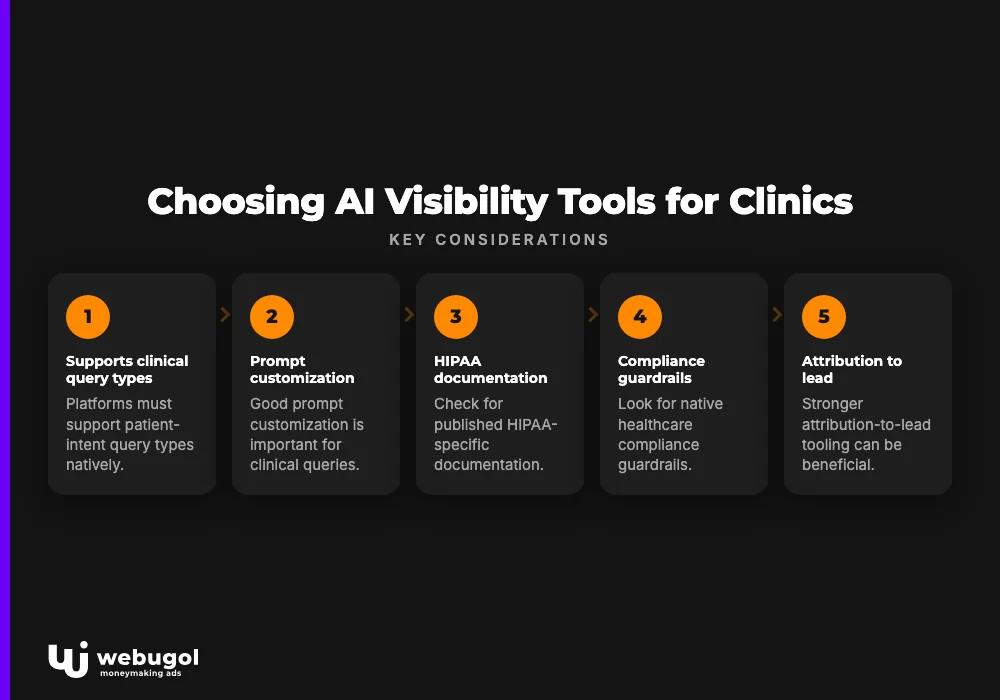
No competitor in the current top-10 for this topic combines tool pricing tier with healthcare-relevant evaluation notes in a single table. The comparison below fills that gap. Picking among the best AI visibility tools starts with knowing which clinical query types each platform supports natively.
| Tool | Pricing tier | Best for | Engines covered | Healthcare notes |
|---|---|---|---|---|
| OtterlyAI | Free tier; paid plans per seat | Teams starting with AI search monitoring | ChatGPT, Perplexity, Gemini | Good prompt customization; no HIPAA-specific documentation published |
| Peec AI | Subscription, per-seat model | Multi-brand or multi-location tracking | ChatGPT, Perplexity, Gemini, Claude | Strong share-of-voice reporting; custom prompt sets work well for clinical query types |
| Ahrefs Brand Radar | Included in Ahrefs subscription tiers | Existing Ahrefs users adding AI visibility tracking | ChatGPT, Perplexity, Gemini | Largest database per vendor claims; integrates with existing Ahrefs SEO data |
| Semrush AI Visibility Toolkit | Add-on to Semrush subscription | Existing Semrush users; agency reporting | ChatGPT, Perplexity, Gemini | Useful for teams already in Semrush; no native healthcare compliance guardrails |
| ZipTie | Per-seat subscription; enterprise pricing on request | Deep analysis and cross-channel attribution | ChatGPT, Perplexity, Gemini, Claude | Stronger attribution-to-lead tooling than most; requires setup time for clinical prompt sets |
The best AI brand visibility tools for healthcare share one requirement that generic tools miss: prompt sets must be calibrated to patient-intent query types, not just brand name monitoring. A prompt set built for a DTC SaaS company will undercount a clinic's actual citation exposure.
What to look for in an AI visibility tool for healthcare
Five criteria matter most when selecting among AI search visibility tracking tools for a clinic or telehealth practice.
- Multi-engine coverage: the tool must track ChatGPT, Perplexity, and Gemini at minimum; Claude coverage is a meaningful differentiator for evaluating conservative citation behavior.
- Prompt customization: clinical query types ("best GLP-1 clinic near me," "telehealth men's health online") must be configurable; generic brand queries undercount patient-intent exposure.
- Data freshness cycle: Perplexity re-crawls frequently; a tool that updates citations weekly or faster catches meaningful shifts; monthly snapshots lose the signal in the noise.
- Attribution-to-lead capability: the best AI search visibility tracking tool for revenue-focused teams connects citation volume to UTM-tagged traffic and intake-form source data, not just mention counts.
- HIPAA-compatible data handling: when evaluating AI brand visibility tracking software for a healthcare context, the first filter is data type. Most tools operate on public web data only and do not touch PHI; confirm this before connecting any CRM or intake data to the platform.

How do AI engines decide what to cite?
Three signals drive citation decisions: source authority, content structure, and topical match between the prompt and the page. Healthcare adds a fourth layer that none of the top-10 results for this keyword currently address: clinical credibility signals that function as citation eligibility criteria, distinct from their standard SEO role.
How to run provider prompts across ChatGPT, Perplexity, and Gemini
You can see how these signals play out for your own clinic with a structured prompt test. Write the questions a patient would actually ask, such as "best weight loss clinic near me" or "which telehealth provider offers GLP-1 prescriptions online," and run each one on every engine. For each prompt, record three things: the exact prompt, the full AI output, and a source trace showing which pages, listings, or reviews the answer drew on. Then read the results as a pattern rather than as individual answers. Which clinic types get named, and which get left out? Does each platform lean on local directories, clinic websites, or review platforms? Perplexity makes the trace straightforward because it lists its sources. ChatGPT and Gemini show sources less consistently, so a follow-up prompt asking where the recommendation came from helps, though that answer is a lead to verify, not proof. Finally, open the cited pages and compare them with your own on the factors covered below: physician attribution, schema, heading structure, and whether the provider name and address match directory listings exactly. The differences between those pages and yours become your working fix list.
Medical authority and E-E-A-T signals for healthcare providers
E-E-A-T functions differently in AI citation decisions than in standard Google ranking. For healthcare content, the signals that elevate citation eligibility are physician bylines on health-topic pages, board certification disclosure for the named providers, evidence of a medical review workflow, and citation of clinical sources. PubMed-indexed studies and CDC or NIH guidelines are the most recognized clinical sources in this context.
These are not SEO decoration. They are the structural markers that allow AI engines to classify a page as a credible medical source rather than marketing copy. A service page written by a marketing team with no physician attribution is structurally indistinguishable from advertising, and AI engines treat it that way.
The practical action for a Head of Marketing: audit the top 20 service pages on the clinic website. How many carry a named physician author with credentials? How many link to a clinical source that supports a central claim? Those two changes can be initiated without a development sprint and have an outsized effect on AI citation visibility.
HIPAA-compatible content and AI citation eligibility
HIPAA does not govern AI citation directly. What HIPAA shapes is what content is safe to publish in crawlable form, and that shapes citation eligibility indirectly.
Educational, de-identified content is citation-eligible across all major AI platforms. This includes condition explainers, treatment overviews, and clinical FAQs with no individualized claims. Content that includes individualized treatment assertions, outcome language that reads as a guarantee, or PHI-adjacent details fails both compliance review and AI platform health-content filters.
The robots.txt configuration for AI crawlers is a step healthcare tech teams frequently miss. Three crawler names to verify: GPTBot (ChatGPT), PerplexityBot, and ClaudeBot. If your robots.txt disallows these bots globally or via an outdated wildcard rule, your clinic's pages are invisible to those engines by policy, regardless of content quality. Check the current configuration before diagnosing citation gaps.
Content structure that gets cited vs. ignored
Seven structural factors consistently separate cited pages from non-cited pages in AI search outputs:
- MedicalOrganization schema active on all location and service pages, with accurate NAP data and service-area information
- FAQ schema markup on top service pages, with questions drawn from actual patient search queries
- Entity-clear provider names and addresses that match directory listings (Google Business Profile, Healthgrades, Zocdoc) exactly
- Page speed under 2.5 seconds on mobile across the pages most likely to be cited: service pages, condition pages, provider bio pages
- Clean canonical tags with no duplicate provider or location pages competing against each other
- Question-phrased headings that match the syntax of common patient queries, making it easier for AI engines to match the page to a prompt
- Unambiguous service-area data in both page text and schema, so a multi-location clinic is cited for the correct location in local patient queries
How do you measure AI visibility?
Measurement combines third-party tracking tools with a structured monthly prompt-audit protocol. No AI engine provides a native citation dashboard equivalent to Google Search Console, so the process is manual at the prompt level and tool-assisted at the volume and trend level.
Core metrics: mention rate, citation rate, and share of voice
Three metrics form the foundation of any AI visibility tracking program. Setting them up as a monthly reporting cadence is the first step toward connecting AI search data to actual patient acquisition decisions.
Mention rate is the percentage of target prompts where the clinic is named in the AI-generated answer. It tracks brand awareness at the top of the AI-discovery funnel. As an illustrative example: a clinic running a 20-prompt monthly test and appearing in 6 answers has a 30% mention rate.
Citation rate is the percentage of mentions that include a source link back to the clinic's website. High mention rate with low citation rate means the AI is naming the clinic from training data or directories, not from crawling the site directly. That is a signal the website's citation eligibility needs structural work.
Share of voice is the clinic's mention count relative to named competitors on the same prompt set. This metric ties most directly to CPL and booking volume: a clinic with 60% AI share of voice in a competitive market is in a materially different position than one with 15%.
Each metric maps to a downstream KPI. Mention rate connects to brand awareness and top-of-funnel demand. Citation rate connects to referral traffic from AI-sourced sessions. Share of voice connects to competitive CPL trends and total booking volume over time. Tracking AI search visibility alongside traditional SEO data provides the complete picture of where new patient demand is being generated.
Tracking AI citations to your lead flow
Attribution from AI mention to patient booking is where AI visibility measurement meets actual clinic revenue. It requires three infrastructure pieces.
First, UTM parameters applied to all pages likely to earn citations: service pages, condition explainers, provider bio pages. The UTM source parameter should capture organic AI referrals distinctly from standard organic search, since the two channels perform differently and improving one does not automatically improve the other. Teams building this tracking layer often start with a Google Analytics permissions and tracking structure audit before adding a new UTM configuration on top of existing gaps.
Second, intake-form optimization to capture "how did you hear about us: AI assistant (ChatGPT, Perplexity, Gemini)" as a distinct source option. Patients who arrive via AI recommendation tend to have higher intent and lower price sensitivity than paid ad arrivals. Separating this cohort early allows the team to calculate a credible AI-sourced CPL.
Third, the diagnostic pattern for correlating AI mention-volume shifts with booking-volume changes. This is not clean attribution: the confidence interval is wider than paid channels where click data is deterministic. The realistic position is a probabilistic correlation over three-plus months. When mention rate rises, does booking volume from new patients follow within two to four weeks? That correlation, tracked consistently, provides a decision-quality signal for investment.
Contextual CTA: If your team needs the tracking infrastructure before running this audit, the Healthcare Growth System M1 phase covers an AI visibility baseline as part of market intelligence setup, alongside funnel diagnostics and tracking foundations. See how the audit works.

How to improve your AI visibility: a 90-day roadmap
Every competitor guide covering AI visibility optimization stays abstract: "create quality content," "build authority," "optimize for AI." This roadmap delivers a clinic-specific phased plan with week-level specificity and clear outputs at each stage.
Weeks 1-2: audit baseline and technical gaps
The first two weeks produce a baseline you can measure against later. Run a 20-prompt test across ChatGPT, Perplexity, and Gemini using the clinical query types most relevant to your service lines. Document every citation gap versus named competitors. Note which platforms cited competitors and what sources they used.
Simultaneously: check robots.txt for GPTBot, PerplexityBot, and ClaudeBot access; audit MedicalOrganization schema completeness across all location and service pages; configure a tracking tool and set a baseline dashboard. Ahrefs Brand Radar and Peec AI are strong choices for a best AI visibility tracker at this stage; both support clinical prompt customization without enterprise pricing overhead.
Output: a gap list and technical fix queue ranked by effort versus citation impact.
Weeks 3-8: content structure and authority signals
This phase is the highest-ROI window for AI visibility optimization. Update the top 20 service pages with schema markup and E-E-A-T signals. Create or refresh FAQ sections around high-frequency patient-intent queries using FAQPage schema markup. Publish expert-bylined educational assets on the most-cited clinical topics in your specialty. Build citation-eligible condition and treatment explainers that follow the structural criteria covered in the previous section.
Output: 10-15 pages optimized for citation eligibility across the four target AI engines.
Weeks 9-12: measure, iterate, and scale
Re-run the full 20-prompt audit and compare against the baseline. Connect AI mention data to the booking funnel via UTM and intake-form source data. Identify which content types earned citations and at what rates. Prioritize production that replicates proven citation patterns.
This phase establishes the operational cadence for ongoing AI visibility tracking. Clinics that complete it have a monthly measurement schedule, a known prompt set, a baseline citation rate, and a competitor share-of-voice dashboard. That is the minimum viable monitoring program for a clinic operating in AI-influenced patient markets.
AI visibility checklist for healthcare providers
Technical
- robots.txt permits GPTBot, PerplexityBot, and ClaudeBot
- MedicalOrganization schema is live on all location and service pages
- Page speed is under 2.5 seconds on mobile across all cited pages
- Canonical tags are clean with no duplicate provider or location pages
Content
- Physician or clinical expert byline is present on all health-topic content
- FAQ sections with FAQPage schema markup appear on top service pages
- Entity-clear NAP (name, address, phone) is consistent across all pages and directories
- Educational, de-identified content is published at a minimum monthly cadence
- No individualized treatment claims appear in AI-crawlable content
Measurement
- A tracking tool is configured (Ahrefs Brand Radar or Peec AI as a minimum)
- A 20-prompt test set is defined and run on a monthly schedule
- UTM parameters are applied to all pages likely to earn citations
- The intake form includes "how did you hear: AI assistant" as a source option
- Competitor share of voice is tracked within the same monthly prompt set

Ready to find out if ChatGPT is sending patients to your competitors?
A one-time prompt audit shows where your clinic stands today across ChatGPT, Perplexity, and Gemini. The Healthcare Growth System includes an AI visibility baseline audit as part of the M1 market intelligence phase, alongside funnel diagnostics, offer review, and tracking setup. Your team starts with a complete picture of where patients are finding you, and where they are not.
Webugol builds this kind of tracking-first acquisition infrastructure as one integrated system, not a set of coordinated vendor deliverables. When citation volume shifts and booking volume follows, you have one team accountable for both numbers. Book a Strategy Call through the Healthcare Growth System page to run the AI visibility baseline.
FAQ
What is AI visibility for a healthcare provider?
AI visibility is a measure of how often your clinic is named or cited when patients ask AI assistants for provider recommendations. Unlike Google rank, it reflects your presence in generated answers across ChatGPT, Perplexity, Gemini, and Claude, channels that do not surface in Search Console.
How is AI visibility different from SEO rankings?
SEO rankings measure where your pages appear in Google's link results; AI visibility measures whether AI engines cite your clinic in their generated answers. A clinic can hold the top Google rank and still be absent from AI-generated provider recommendations because the two systems use different citation signals.
Which AI engines should my clinic monitor for patient mentions?
Track ChatGPT, Perplexity, Gemini, and Claude at minimum. Perplexity cites sources explicitly and updates frequently, making it the highest-transparency platform; ChatGPT and Gemini synthesize from training data plus live browsing and require manual prompt audits to surface mention patterns.
Does HIPAA affect what content AI engines will cite?
HIPAA does not govern AI citation directly, but it shapes what content is safe to publish in crawlable form. Educational, de-identified content is citation-eligible; individualized treatment claims and PHI-adjacent language are not, and several platforms apply additional health-content filtering on top of your own compliance guardrails.
How long does it take to improve a clinic's AI visibility?
Clinics that complete the technical audit and update structured data and E-E-A-T signals in weeks 1-2 typically see measurable citation improvement within 60-90 days on platforms like Perplexity that re-crawl frequently. ChatGPT's training cycle makes improvement on that platform less predictable and harder to attribute to a single content change.

