


Software Development Process: Stages, Models & How to Choose the Right One
The software development process is a structured sequence of phases that turns a product idea into a working, deployed application. It governs your timeline, budget, and the quality of what ships. For non-technical founders mapping the build journey before engaging a development partner, understanding how this structure works is the difference between a project that stays on scope and one that spirals into rework. This article covers the six core stages, four popular models, and a framework for choosing the right one.
What is the software development process?
The software development process is the operating system of your project: the structure that determines how decisions get made, who owns each phase, and when working software actually ships to users. It is not just a technical workflow. It is the foundation of accountability between you and the team you hire.
For a non-technical founder, that distinction matters immediately. Without a defined process, every conversation with a vendor is a negotiation with no ground rules. Scope expands. Budgets drift. A formal product development process locks in expectations before the first line of code is written and gives you a basis for holding the team to commitments.
What separates founders who reach product-market fit efficiently from those who stall is rarely the idea. It is whether the team building their product follows a process designed to surface problems early, when they are cheap to fix, rather than late, when they are not.
What are the main stages of the software development process?
Most software projects follow six stages: discovery, design, development, testing, deployment, and iteration. Each stage has a defined output, and skipping any one of them increases cost and rework at every stage that follows.
Discovery and requirements
This stage documents business goals, user stories, and technical constraints before anyone opens a design tool. It is the primary prevention mechanism for scope creep and budget overruns.
A proper discovery phase ends with a written brief that you approve. It answers three questions: what problem does the product solve, who uses it, and what must be true for the first version to succeed. Skip it, and every disagreement in development costs more to resolve than it would have here. A thirty-minute kickoff call is not a discovery phase. A documented, approved specification is.
Design and prototyping
Wireframes, architecture decisions, and technology stack selection happen here. You see and approve a clickable prototype before a single line of code is written.
This is where many vendors rush to look productive. Moving fast into code without an approved design creates the most expensive type of rework: rebuilding something that was already built. Getting sign-off on a prototype is not a formality. It is a contract.
Development
Modern teams structure work in sprints or fixed cycles. AI-assisted tools like Cursor and GitHub Copilot are compressing coding timelines on boilerplate features and standard integrations, reducing hours on predictable work. That compression has a direct effect on your budget: less time on scaffolding means more capacity for the custom logic that actually differentiates your product.
That compression does not mean speed at any cost. Well-structured code at this stage makes testing faster, deployment safer, and future iteration cheaper. Teams that use AI tooling effectively pair it with strong code review. Speed and quality are not in conflict.
Testing and QA
Testing covers three layers: unit tests that verify individual functions, integration tests that confirm components work together, and user acceptance testing that validates the product against the original business requirements.
The most common shortcut is having developers test their own code. It fails because the person who wrote the logic is least likely to find the edge cases in it. A proper QA gate uses a separate reviewer or dedicated QA engineer, and runs before every deployment, not just before the final release.
Deployment
Going live means more than pushing code to a server. The production checklist includes a staging environment that mirrors production exactly, a CI/CD pipeline that automates and verifies each deployment step, and a rollback plan if something breaks.
Production parity with staging is non-negotiable. If your staging environment does not reflect the actual production setup, the deployment test means nothing.
Iteration and maintenance
The development process does not end at launch. It continues through feedback loops, performance monitoring, and scheduled update cycles that protect the product investment over time.
Products that go dark after launch decay. User needs shift, security vulnerabilities emerge, and performance degrades under real traffic. Teams that build a growth system into the product from day one see post-launch metrics improve rather than stagnate. Building an iteration plan into the original engagement is what separates a product you own from a product that owns your budget.
Popular development process models and when to use each
Waterfall, Agile/Scrum, Shape Up, and Lean MVP each suit different project types and risk profiles. The right choice depends on how clearly your requirements are defined before the build begins.
| Model | Team size | Project type | Budget predictability | Release speed | Risk tolerance |
|---|---|---|---|---|---|
| Waterfall | Any | Fixed scope, fixed requirements | High | Slow (end of project) | Low |
| Agile/Scrum | 3–12 | Evolving requirements, ongoing product | Medium | Fast (sprint cadence) | Medium |
| Shape Up | 3–8 | Product teams with defined bets | Medium-high | 6-week cycles | Medium |
| Lean MVP | 2–5 | Early-stage validation | Variable | Very fast | High |
Waterfall
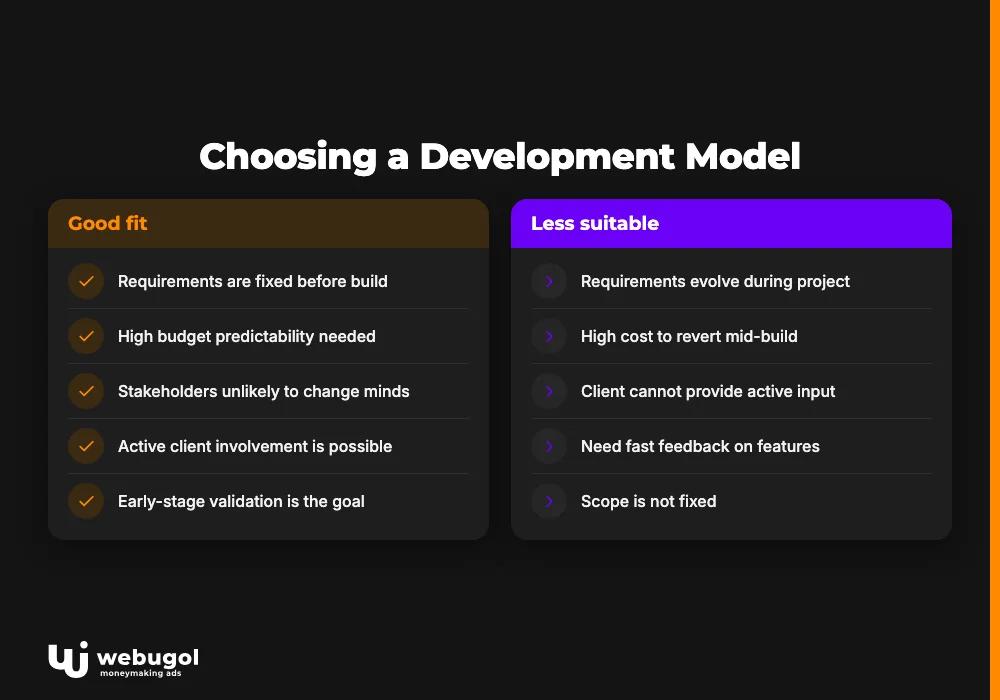
Waterfall delivers the full product after all phases complete in sequence. No phase starts until the previous one is signed off. This suits fixed-scope, fixed-budget projects where requirements will not change mid-build, such as a compliance integration or a migration with fully documented specifications.
Its weakness is rigidity. If a client discovers mid-build that the original requirements missed something material, the cost of reverting is high. Waterfall works best when you have done thorough discovery before committing to a model, and when the stakeholders unlikely to change their minds once the brief is signed.
Agile and Scrum
The agile development process organizes work into short sprints, typically one to two weeks, with client feedback built into each cycle. Features ship incrementally, which means the product generates feedback before it is complete.
Agile works well for products with evolving requirements. It demands active client involvement: a managed backlog, regular sprint reviews, and a willing product owner on your side. Without those inputs, the agile development process becomes a series of disconnected coding sessions with no shared direction, and velocity metrics replace product thinking as the primary measure of progress.
Shape Up
Shape Up is Basecamp's sprint-free methodology: fixed six-week cycles with variable scope, no daily standups, and no backlog. The team is handed a shaped problem with a time budget, not a task list.
Product teams that adopt Shape Up often cite the same motivation: escaping the overhead of sprint ceremonies and endless backlog grooming. The model attracts founders who are tired of managing velocity charts instead of product outcomes. Some teams that have made this shift describe a move toward cycle-based thinking, with more uninterrupted focus time for engineers and less ceremony overhead slowing product decisions down.
Lean MVP
Build the smallest working product to validate assumptions before full investment. The output is not a finished product. It is a decision tool.
For founders considering this path, build an MVP is the step-by-step resource for execution. The goal is validation speed, not feature completeness. You learn what users actually do, not what they said they would do, and you make the full build decision with real evidence rather than a business plan assumption.

How is AI changing the software development process?
AI tools accelerate the development and testing phases but do not replace the discovery, architecture, and security judgment layers. The process still requires experienced humans at every decision point.
Where AI accelerates the process
Cursor, GitHub Copilot, and Lovable are the most widely adopted AI tools in the current software development process. They speed up code generation for standard patterns, scaffold boilerplate structure, and generate test cases for predictable paths.
The practical effect for founders is a lower entry cost for a working prototype. Consumer product teams using iterative AI-assisted builds have compressed their path from early concept through production iteration cycles. That pattern holds across consumer products where fast testing beats slow perfection. It is also the basis for entry-level builds starting at $3–5k, a price point that classical agency pricing structures cannot reach because their cost base is built for a world before AI tooling existed.
Where human judgment stays essential
Architecture decisions, security reviews, UX tradeoffs, and requirements scoping cannot be delegated to AI. These are judgment calls that depend on understanding the business context, not just the code pattern.
This is the ceiling founders who have built in Lovable or similar no-code platforms eventually hit. The tool handles predictable structure well. It breaks on custom integrations, production security requirements, and anything that requires reasoning about system behavior under load. Knowing where that ceiling sits helps you plan the transition before you are blocked by it, rather than after a failed launch attempt.
Signs your development process is broken
A broken build setup costs more time and money with every sprint. The signals appear early. Most founders miss them because they assume the friction is normal.
Watch for these patterns:
- Deadlines are consistently missed, and estimates keep shifting without explanation.
- Scope expands on every sprint without a formal change order or budget adjustment.
- There is no staging environment, so every change goes straight to production.
- QA is done only by the developers who wrote the code.
- The team delivers features and disappears with no post-launch iteration plan.
- You have no visibility into how the product performs after launch.
- Every fix creates two new bugs, suggesting structural debt has accumulated in the codebase.
If four or more of these describe your current build, the process is not struggling. It is broken. The fix is a process audit before the next sprint, not a faster sprint.
If you are mapping the build journey and want to understand what a sound process looks like before committing to a vendor, mvp development services is the natural next conversation.

How do you choose the right development process for your project?
Match the model to how clearly your requirements are defined and how often they will change. That single question determines more about project success than team size, technology choice, or budget.
For a startup building an MVP
Lean MVP or Shape Up delivers the speed and early validation a first build needs. The goal is not a perfect product. It is a product that teaches you something true about your users before you invest in the full version.
Start by defining one core user action you want to validate, the action that proves or disproves your central assumption. Everything else waits. Speed is the asset here, and the development approach should protect it rather than add ceremony around it.
For a business migrating or rebuilding a platform
Agile with a defined discovery phase is the right model when you are replacing an existing system. The discovery phase protects you from replicating the problems of the old system in the new one, which is the most common and expensive mistake in platform migrations.
Before selecting a model or a vendor, an audit of the current state often reveals where the setup is failing. Product development consulting covers how businesses audit their existing setup before committing to a new model and vendor.
For an AI-powered product
Iterative Agile or Shape Up with explicit AI-integration sprints suits products that use language models, agents, or retrieval-augmented generation. These products require more experimental cycles because AI component behavior is harder to specify upfront than conventional code.
The practical implication is higher testing requirements. AI outputs need evaluation frameworks, not just unit tests. Teams building in this space need experience with LLM production behavior, not just LLM API calls, and that distinction matters when you are choosing a development partner.
What a healthy development process looks like in practice
A healthy software development process starts with a thorough discovery phase, treats QA as a gate rather than an afterthought, and doesn't stop at launch. Across Webugol's portfolio, including Valhalla Vitality and Ways2Well, we see the same pattern: development is paired with a marketing growth system from the first sprint instead of being bolted on after the product ships. Most agency relationships break down at the handoff from "the site is built" to "the site generates leads." When development and growth are designed together, there's no handoff to fail. For owners, this means cost per booking stays predictable, conversion data feeds back into the product roadmap, and the team that built the product owns the outcome, not just the delivery. That's the difference between a vendor who ships and a partner who's accountable for growth.

Ready to build with a process that works?
If you are a non-technical founder who has just mapped the full build journey, the most expensive decision you can make is starting without a clear process. The model you choose in week one shapes every cost and timeline decision that follows.
Webugol pairs AI-accelerated development with a marketing growth system from day one. The result is a product that ships and grows. MVP development starts at $3–5k for founders who want to validate before committing to full build investment.
Book a free scoping call and walk through the right development process for your specific build.
FAQ
What are the main stages of the software development process?
Most software projects follow six stages: discovery, design, development, testing, deployment, and iteration. Each stage has defined outputs that keep the project on schedule and prevent costly rework if any stage is skipped.
What is the difference between Agile and Waterfall in software development?
Waterfall delivers the full product after all phases complete in sequence; the agile development process ships working features in short iterative sprints with ongoing client feedback. Waterfall suits fixed-scope projects; Agile works better when requirements are likely to evolve during the build.
How is AI changing the software development process?
AI coding tools like Cursor and GitHub Copilot compress the development and testing phases by automating boilerplate and generating test scaffolding. Discovery, architecture design, and security reviews still require experienced human judgment and cannot be automated away.
How do you choose the right development process for your project?
Match the model to how clearly your requirements are defined and how often they will change. Fixed requirements favor Waterfall; evolving requirements favor Agile or Shape Up; early-stage validation favors a Lean MVP approach.
What are the signs that your development process needs to change?
Consistent missed deadlines, scope creep on every sprint, no staging environment, and no post-launch iteration plan are the clearest signals. If the team delivers and disappears with no handoff or iteration cycle, the entire build sequence needs redesigning from the discovery phase.