



Email Marketing Under HIPAA: Rules, Risks, and Platforms That Actually Comply
HIPAA does not prohibit email marketing, but every hipaa compliant email marketing program requires a signed Business Associate Agreement with your ESP, PHI-safe tracking, and written patient authorization for most promotional communications. If a compliance audit surfaced that your current email service stored patient contact data without a valid BAA, that is exactly the trigger that blocks healthcare marketing teams from launching nurture flows. This article covers which email types trigger compliance obligations, which platforms meet the standard, and how to build automation flows your compliance approver will sign off on.
Healthcare marketing leaders at growing clinics and telehealth operators consistently hit the same wall. They inherit an email list built on general opt-ins, a CRM with health condition fields syncing to the ESP, and a compliance approver who flags the entire setup after platform evaluation is already complete. The core problem is not the platform. It is that the email stack, the CRM, the consent layer, and the analytics environment were never designed together as one compliant system. Building a hipaa compliant email marketing infrastructure that can survive compliance review means auditing every system in that data path before configuration begins.
Is email marketing allowed under HIPAA?
Yes, with conditions tied to the email type and the data it uses. HIPAA distinguishes between Treatment, Payment, and Operations (TPO) communications and promotional marketing messages, and that distinction determines what authorization is required before you configure a single flow.
The practical implication: an appointment reminder and a GLP-1 program drip sequence can sit in the same ESP, but they operate under different HIPAA rules, require different documentation, and must not share list segments or trigger logic.
General newsletter vs. appointment reminder vs. condition-targeted campaign
Each email category falls into a different compliance zone. The table below maps each type to its HIPAA coverage level and consent requirement so you can audit existing flows before evaluating any platform.
| Email type | HIPAA category | BAA required | Authorization required |
|---|---|---|---|
| General health newsletter (no PHI) | Outside PHI scope | Recommended | No |
| Appointment reminder | Treatment/TPO | Yes | No |
| Re-engagement (recency-based, no condition data) | May be TPO | Yes | Depends on content |
| Condition-specific campaign | Marketing (PHI) | Yes | Written authorization |
| Program enrollment drip | Marketing (PHI) | Yes | Written authorization |
A general health newsletter covering wellness topics without referencing any patient's condition, diagnosis, or treatment history does not trigger HIPAA's PHI protections. Appointment reminders fall under the Treatment exception and do not require marketing authorization. Condition-targeted campaigns and program drips that use health data for segmentation require both a signed BAA and written patient authorization before the first message goes out.
When does personalization cross into PHI territory?
Personalization crosses into PHI territory when any identifying information, such as a name, email address, or device identifier, is combined with a health condition or treatment context. PHI under HIPAA is not just a clinical record. It is any individually identifying health information, defined by the 18 identifiers OCR enumerates.
Combining a patient's name with a health condition in an email body creates PHI. Using a patient's email address to link them to a treatment-specific landing page open, when that activity is stored in your ESP, creates PHI. A subject line reading "Here is your follow-up after your weight loss consultation" is PHI even if the email body contains nothing clinical.
Safe personalization tokens: first name in a general newsletter, appointment date and time, non-condition-specific program welcome messaging. Unsafe: subject lines referencing a service category the patient purchased, segmentation driven by a diagnosis field in your CRM, or dynamic content blocks that reveal care history.
Which email platforms are HIPAA-compliant? What the BAA actually covers
An email platform is HIPAA-compliant only when it offers a substantive BAA and you have signed it. No BAA, no legal basis for processing PHI. That holds regardless of the platform's encryption certifications or security marketing claims.
This is why compliance approvers block every new platform evaluation. They need documentation that most general-purpose ESPs cannot provide. Getting the BAA reviewed before platform configuration, not after, saves weeks of rework.
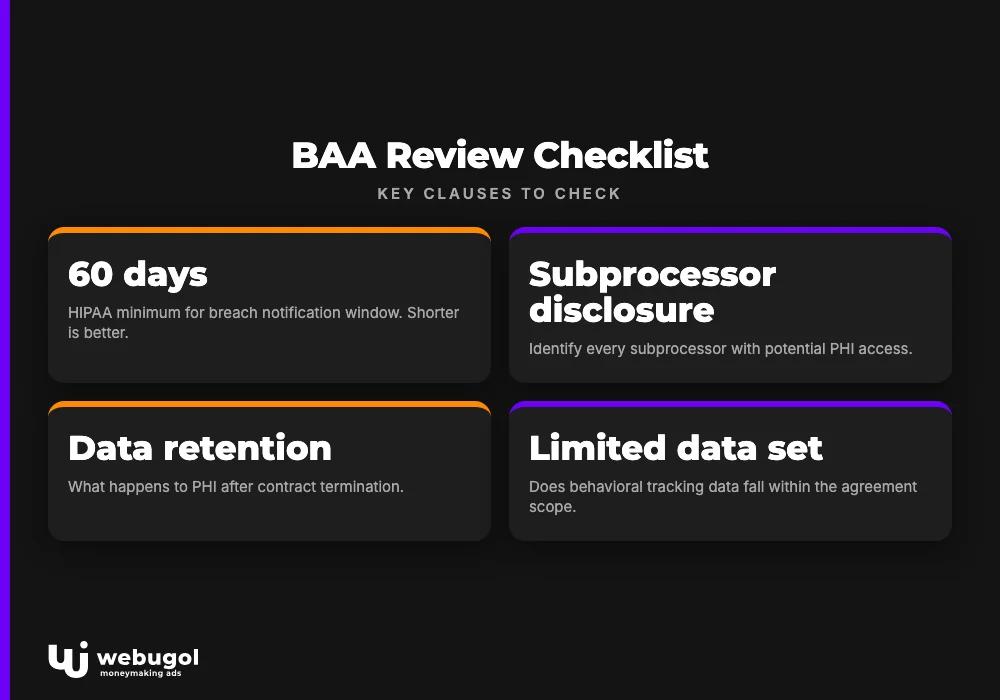
BAA review checklist:
- Subprocessor disclosure: does the BAA identify every subprocessor with potential PHI access?
- Breach notification window: is it 60 days (the HIPAA minimum), or does the platform commit to a shorter window?
- Data retention and deletion: what happens to PHI after contract termination, and is deletion guaranteed in writing?
- Limited data set scope: does the BAA specify whether behavioral tracking data, such as open and click events, falls within the agreement?
- Indemnification: does the platform accept responsibility for breaches caused by their infrastructure?
What to look for in a BAA before you sign
Two clauses get overlooked in nearly every BAA review. First, subprocessor access rights. A platform's core BAA often covers their primary infrastructure but excludes third-party analytics vendors, CDN providers, and subsidiary tools that touch your data. A blanket "and our affiliates" clause without named subprocessors leaves real gaps in your coverage.
Second, post-termination data handling. Many standard platform agreements allow the vendor to retain PHI in backup systems for weeks after a deletion request. If the BAA is silent on termination-triggered deletion timelines and audit rights, that data may persist in environments you can no longer access or verify.
The "limited data set" designation matters here as well. A limited data set removes direct identifiers such as name, address, and phone, but retains dates, geographic data, and clinical identifiers. Some platforms qualify for limited data set processing, but the BAA must explicitly designate it. And clinical behavioral data, such as who opened which condition-specific campaign, may not qualify under a limited data set agreement.
Platform comparison: BAA, pixel-free tracking, automation support, pricing tier
An email platform is only as compliant as its lowest-covered data path. The table below covers the key variables for evaluating hipaa compliant email marketing platforms: BAA availability, tracking pixel approach, automation capabilities, and the pricing tier where HIPAA features unlock. No competitor in the current top-10 SERP provides this comparison.
| Platform | BAA available | Pixel-free tracking | Automation support | HIPAA tier |
|---|---|---|---|---|
| Paubox | Yes | Yes (native) | Limited | Business tier |
| ActiveCampaign | Yes (enterprise) | Requires config | Yes | Enterprise plan |
| LuxSci | Yes | Yes (native) | Moderate | Base healthcare plan |
| Salesforce Marketing Cloud | Yes | Configurable | Full | Enterprise (quote-based) |
| Constant Contact | Yes (select plans) | Requires config | Limited | Healthcare add-on |
| Oracle Eloqua | Yes | Configurable | Full | Enterprise (quote-based) |
| Mailchimp | No | No | No HIPAA tier | Not available |
HIPAA compliance tiers across these platforms range from dedicated healthcare add-ons to enterprise-only plans. Expect custom or enterprise pricing conversations at the compliance tier, not self-serve signups. Use this table as a shortlisting tool, not a final ranking.
Before evaluating any gmail hipaa compliant scenario, note that standard Gmail and Google Workspace are excluded from BAA-eligible configurations for email marketing. The platform-specific breakdown covers what workspace configurations do and do not qualify.
Can email tracking pixels violate HIPAA?
Yes. Standard open-tracking pixels capture IP addresses and device identifiers. When those identifiers are linked to a patient's email address in your ESP's system, the combination constitutes PHI under OCR's December 2022 tracking technology guidance.
Most ESPs implement pixel tracking by default because it is the standard method for open rate measurement. The marketing team typically never touches this setting. The compliance exposure exists whether or not the email body contains any clinical language.
OCR's December 2022 guidance on tracking technologies confirmed that tracking pixels in emails that connect user behavior to health-related contexts create PHI. That enforcement posture has not changed since the guidance was published.
What to use instead of pixel-based open tracking
Three technical approaches replace pixel-based opens in any hipaa compliant email marketing software configuration:
- Link-click events with anonymized parameters: track engagement at the link level without individual pixel returns. This measures campaign effectiveness without capturing IP-linked identity data per open event.
- Server-side open proxy within BAA scope: some platforms route open tracking through a first-party proxy that falls within the signed BAA rather than a third-party pixel network. The data stays in the covered environment.
- Campaign-level aggregate metrics without individual pixel returns: report on delivery rates, click rates, and downstream conversions rather than individual open attribution. This approach loses per-contact open data but eliminates the pixel PHI vector entirely.
Paubox and LuxSci offer pixel-free tracking natively. ActiveCampaign and Salesforce Marketing Cloud require explicit configuration to disable default pixel behavior. Disabling it is not the default. You are opting out of an exposure that ships enabled.

Building HIPAA-compliant email automation flows
Hipaa compliant email marketing automation is the highest-volume secondary keyword in this topic cluster, with no coverage in the current top-10 SERP. That gap reflects a real operational problem: healthcare marketing teams either avoid automation entirely after a compliance rejection, or they build flows on general-purpose platforms without understanding where the exposure lies.
Automation is not inherently non-compliant. Trigger event design and data scoping determine whether a flow is safe or exposed. The question is not "can we automate" but "what data fires the trigger, and what data does the message reference."
Safe vs. unsafe automation triggers:
- Safe: form submission that does not capture condition data
- Safe: appointment booking confirmation
- Safe: general program interest form without condition-specific fields
- Safe: re-engagement based on recency alone (last activity date, no health fields)
- Unsafe: trigger fires on a condition-specific page visit stored as a behavior event
- Unsafe: trigger uses a diagnosis or treatment stage field synced from the CRM
- Unsafe: message body dynamically references the service category that drove the signup
Welcome and onboarding sequences: what's safe to trigger on
A welcome sequence triggered by a general health program signup stays outside PHI territory when two conditions hold: the trigger event does not include condition data, and the email content does not reference a health condition.
Safe trigger patterns by program type:
- Wellness and longevity programs: trigger on form submit with interest category only; content covers program logistics, not health status
- Telehealth general intake: trigger on appointment booking confirmation; content covers how-to-prepare, not diagnosis context
- Membership programs: trigger on purchase event; content covers access and onboarding, not condition-specific guidance
Subject lines and preview text must stay condition-neutral in onboarding sequences. Even if a patient enrolled in a GLP-1 program, a subject line referencing weight loss medications in the context of their account creates the identifier-plus-condition combination that constitutes PHI.
Re-engagement and win-back flows: healthcare-specific rules
Recency-based segmentation carries lower compliance risk than condition-based segmentation. A win-back flow that triggers on inactivity over a defined period does not use health data. It uses time data. That carries a meaningfully lower risk profile than a flow targeting patients who had a consultation for a specific condition and did not convert.
When a lapsed-patient re-engagement flow requires explicit re-opt-in rather than standard permission re-engagement: when the original consent was scoped to a specific communication type and the win-back falls outside that scope, or when time elapsed since the last communication exceeds your BAA's data retention terms.
Avoid win-back subject lines that reference the patient's last service category. Even "We noticed you have not continued your [program name] journey" creates a condition association if the program name implies a health condition.
Appointment reminders vs. marketing drips: different rules, different risk
Appointment reminders operate under HIPAA's Treatment communications exception and do not require marketing authorization. Marketing drips require written authorization when they use PHI. The compliance difference is significant, and the enforcement risk of conflating them is real.
The compliance risk is not in running both types of communications. It is in mixing them in the same ESP flow or list segment. If your appointment reminder system and your marketing nurture sequence share the same list in the same ESP, a misconfigured trigger can send a marketing message under Treatment exception rules, or a reminder can inadvertently reference marketing data.
Keep them architecturally separate: appointment reminder workflows in one flow, marketing nurture in another, with clearly documented data sources for each. Your compliance approver will ask for this documentation during review.
Understanding the full patient journey mapping framework helps clarify where Treatment communications end and marketing drips begin. The boundary is earlier in the acquisition path than most teams assume.
If the platform your team is evaluating was built for general marketing and adapted for healthcare, a stack audit surfaces PHI exposure before a compliance review does. Webugol's Healthcare Growth System starts there. Book a strategy call.
CRM and email platform integration: keeping PHI contained
Every system in the data path that touches PHI requires its own BAA. The CRM, the ESP, the form tool, and the analytics layer are each covered entities or business associates in the data chain. A gap in any BAA at any point creates exposure for the entire flow, regardless of how compliant the other systems are.
The pattern that creates the most exposure in HubSpot, ActiveCampaign, and GoHighLevel integrations: a CRM field containing health data syncs to an ESP contact record without the team recognizing that the sync carries PHI. The ESP may have a signed BAA. But if the specific data fields involved are not within that BAA's defined scope, the transfer is not covered.
A hipaa compliant crm is the foundation the email stack sits on. Without compliant data at the source, a compliant ESP still receives non-compliant input.
CRM-to-ESP integration audit checklist:
- Which fields sync between CRM and ESP? List all, including custom fields.
- Do any synced fields contain PHI, such as name plus condition, diagnosis stage, treatment history, or appointment type?
- Is the data sync explicitly within the scope of both the CRM and ESP BAAs?
- What happens to ESP contact data when a contact is deleted from the CRM?
- Does the deletion cascade to the ESP, or does data persist in the email platform?
- Does the analytics layer downstream also receive any of these fields, and is that layer BAA-scoped?
GoHighLevel deserves specific attention here. The platform markets aggressively to healthcare operators and positions itself as an all-in-one CRM, email, and SMS solution. BAA availability in GoHighLevel has been inconsistently documented across plan tiers. Verify the current BAA scope before using it as a PHI-touching system in a compliant stack.
The integration audit also needs to cover your reporting layer. If your ESP's behavioral data feeds into a reporting tool that falls outside your BAA scope, that is a data path without coverage. Many teams discover this only when a compliance reviewer asks for the full data architecture diagram.

What's the difference between HIPAA authorization and a marketing opt-in?
A CAN-SPAM opt-in does not satisfy HIPAA's written authorization requirement for marketing communications that use PHI. Full stop.
CAN-SPAM governs commercial email and requires an unsubscribe mechanism and accurate sender identification. HIPAA's marketing authorization is a separate legal instrument. It requires a signed patient document naming the specific information used, the marketing purpose, the recipient organization, an expiration date or triggering event, and the patient's unconditional right to revoke without penalty or conditioning of care.
Standard checkbox opt-ins fail this test. They do not specify what PHI is used, for what purpose, by whom, or for how long. Most healthcare operators running any kind of hipaa compliant email marketing program discover this gap only after a compliance review surfaces their existing consent forms.
What a compliant healthcare email consent form must include
The minimum language changes to bring a standard opt-in into compliance:
- Description of PHI used: "We may use your name, email address, and information about your past services at [Practice Name] to send you information about related programs."
- Specific marketing purpose: what the communications will cover, explicitly stated and not open-ended
- Identity of information recipient: the organization sending, and any third-party ESP that will process the data
- Expiration date or triggering event: when does the authorization end, or what event ends it
- Right to revoke: the patient can revoke at any time without affecting their care, with the method to revoke clearly stated
- No-conditioning statement: care cannot be conditioned on signing the authorization
Existing subscribers who signed up under a non-compliant form represent a real operational problem. The options are to run a re-consent campaign before sending any marketing communications that use PHI, or to segment them to PHI-free general content only until they re-consent. Neither option is painless, but both are preferable to running non-compliant communications on a list built under inadequate authorization.
A properly built hipaa compliant forms workflow makes the re-consent process manageable. The forms layer is the first link in the compliance chain. A properly structured hipaa compliant email marketing program starts with compliant data collection at the front of the funnel.
The compliance approver workflow: how to ship without getting blocked
The marketing lead at a clinic doing significant monthly revenue is not blocked by a bad platform. They are blocked by an approval cycle where the compliance approver reviews platform, content, consent language, and automation design sequentially, with no documented scope for what marketing can configure independently.
The fix is structural separation of review scope. It is not faster email chains.
Who approves what, and in what order
Defining review scope by role breaks the sequential bottleneck and makes it possible to run legal and IT reviews in parallel with platform evaluation, rather than sequentially after platform selection.
Approval scope by role:
- Legal reviews BAA language, authorization forms, and any content referencing health outcomes. This is a one-time review per document version, not per campaign.
- IT/security reviews subprocessor access, data architecture, field-level sync configuration, and breach response procedures. Also one-time per platform, not per campaign send.
- Compliance reviews content claims, consent mechanics, and whether a given email type requires marketing authorization or qualifies as Treatment/TPO. Per-campaign for new message types; template review reduces the per-campaign load significantly.
- Marketing owns platform configuration, list segmentation logic within defined data boundaries, subject lines, and campaign scheduling.
Document the outcomes of each review in a compliance memo: one per platform, one per consent form version, one per automation blueprint. Future campaigns reference the memo, not the approver's availability. That documentation layer turns a sequential review cycle into a scalable approval process.
Tracking what access your team actually has, and what they cannot see because of permission structures in the stack, is a related operational problem. If your marketing team lacks access to the data they need to audit their own hipaa compliant email marketing setup, that is covered in google analytics permissions.

Telehealth and GLP-1 programs: higher stakes, stricter rules
For telehealth operators and GLP-1 program managers, email is often the primary patient touchpoint between visits. That makes the compliance profile more complex, not simpler. Every educational email, program enrollment drip, and clinical milestone message is condition-adjacent even when it is not explicitly clinical.
Remote patient consent introduces a challenge that in-person clinics do not face at the same scale. Patients sign up and consent digitally, without a point-of-care conversation that contextualizes the authorization. The consent form is the entire consent process. This means the form language, the BAA coverage, and the ESP configuration all carry more weight in a telehealth operation than in a clinic where intake staff can walk a patient through the authorization document.
GLP-1 program operators face elevated PHI exposure compared to general health newsletters because the program itself names a condition. A subject line reading "Your GLP-1 program update" is a condition-linked identifier. Segmenting by program enrollment is condition-based segmentation. The automation triggers that drive GLP-1 drips require the same level of BAA scoping and authorization documentation as any condition-specific campaign.
Platform configuration requirements that are non-negotiable in this vertical:
- Pixel-free tracking enabled before the first send
- Condition-specific list segments housed only within BAA-scoped environments
- Subject line and preview text reviewed against the condition-reference test before every schedule
- Consent documentation stored in a system that can produce it on demand for an audit
The stakes are higher because the audience is more valuable and more vulnerable. A HIPAA enforcement action that disrupts a GLP-1 program's email channel does not just hurt marketing metrics. It disrupts a clinical communication system that patients depend on for program continuity.
For telehealth operators building out the full patient acquisition and retention architecture, ai visibility is becoming a relevant channel consideration as patients increasingly discover providers through AI assistants before visiting a website.
Ready to audit your HIPAA email marketing stack?
A hipaa compliant email marketing program is a systems decision, not a platform decision. The ESP, CRM, forms layer, and consent documentation must function together as one covered architecture. Most healthcare marketing teams inherit a stack that was never designed with these constraints, built by a general marketer, adapted piece by piece, and never audited end-to-end.
The compliance audit that surfaced your current platform's PHI storage problem is the right starting point. The next step is a structured review of every system in the data path: what it stores, what BAA covers it, and whether the consent you have on file actually authorizes the communications you are sending. What most teams stop losing after that audit is not just compliance risk. It is the marketing velocity that the sequential approval cycle was blocking.
The Healthcare Growth System starts with exactly that audit. Book a strategy call.
FAQ: HIPAA-compliant email marketing
Is email marketing allowed under HIPAA?
HIPAA does not prohibit email marketing for covered entities and their business associates. Marketing emails are permitted when a valid BAA is in place with the ESP, the email content meets HIPAA's marketing authorization standard, and tracking does not capture PHI without patient consent.
Do general patient newsletters need to be HIPAA-compliant?
General health content newsletters that do not reference a specific patient's health information typically fall outside HIPAA's PHI protections. The moment a newsletter uses individually identifying health data for segmentation or references a patient's condition or treatment, full compliance obligations apply.
What must a Business Associate Agreement cover for email marketing?
A valid BAA must identify all subprocessors with access to PHI, specify a breach notification window, address data retention and deletion requirements, and define whether tracking and behavioral data fall within the agreement's scope. Many standard platform BAAs leave the last two terms vague enough to provide no real protection.
Can email tracking pixels violate HIPAA?
Yes. Standard open-tracking pixels capture IP addresses and device identifiers that constitute PHI when linked to a patient's email address, under OCR's December 2022 tracking technology guidance. HIPAA-compliant ESPs offer pixel-free tracking modes that eliminate this exposure.
What's the difference between a HIPAA authorization and a CAN-SPAM opt-in?
A CAN-SPAM opt-in grants permission to send commercial email and does not satisfy HIPAA's written authorization requirement for marketing communications involving PHI. HIPAA requires a separate signed authorization that specifies the type of information used, the marketing purpose, and the patient's unconditional right to revoke at any time.