



TRT Clinic Near Me: How to Find One You Can Trust
A trustworthy TRT clinic near you requires lab-confirmed diagnosis before prescribing, a licensed physician overseeing every protocol, and scheduled follow-up monitoring built into the program. These are the minimum standards that separate a reputable men's health practice from one cutting corners. If a clinic offers testosterone therapy before seeing bloodwork, that is a clinical red flag and a liability for any marketing manager whose reputation depends on the patients who walk through the door.
What is TRT and who needs it?
Testosterone replacement therapy is a physician-supervised treatment for hypogonadism, the clinical diagnosis given when a man's body produces insufficient testosterone and that deficiency is confirmed by blood testing. It is not a supplement protocol or a performance shortcut. TRT differs from over-the-counter boosters in one critical way: it is a controlled medical intervention that requires a diagnosis, a prescription, and ongoing monitoring.
The candidate is a man, typically in his 30s to 50s, who presents with symptomatic low testosterone and whose lab results confirm the condition. For men's health practices and patient acquisition strategy, this is the highest-LTV patient in the funnel: motivated, medically qualified, and actively searching for a provider rather than browsing out of curiosity.
Signs you may have low testosterone
Low testosterone typically produces a cluster of symptoms that build gradually and are often mistaken for stress or aging.
- Persistent fatigue that does not resolve with adequate sleep disrupts daily productivity and is one of the most common presenting complaints.
- Reduced libido or changes in sexual function affect quality of life and are a primary driver of men seeking evaluation.
- Difficulty concentrating or brain fog reduces work performance and often appears alongside mood changes.
- Loss of muscle mass despite consistent exercise signals a shift in anabolic hormone balance.
- Mood changes including increased irritability or low-grade depression accompany hormonal decline in many men.
- Disrupted sleep, particularly difficulty staying asleep, correlates with low testosterone and compounds fatigue.
- Unexplained weight gain, especially abdominal fat accumulation, reflects the metabolic impact of testosterone deficiency.
What should I look for in a TRT clinic near me?
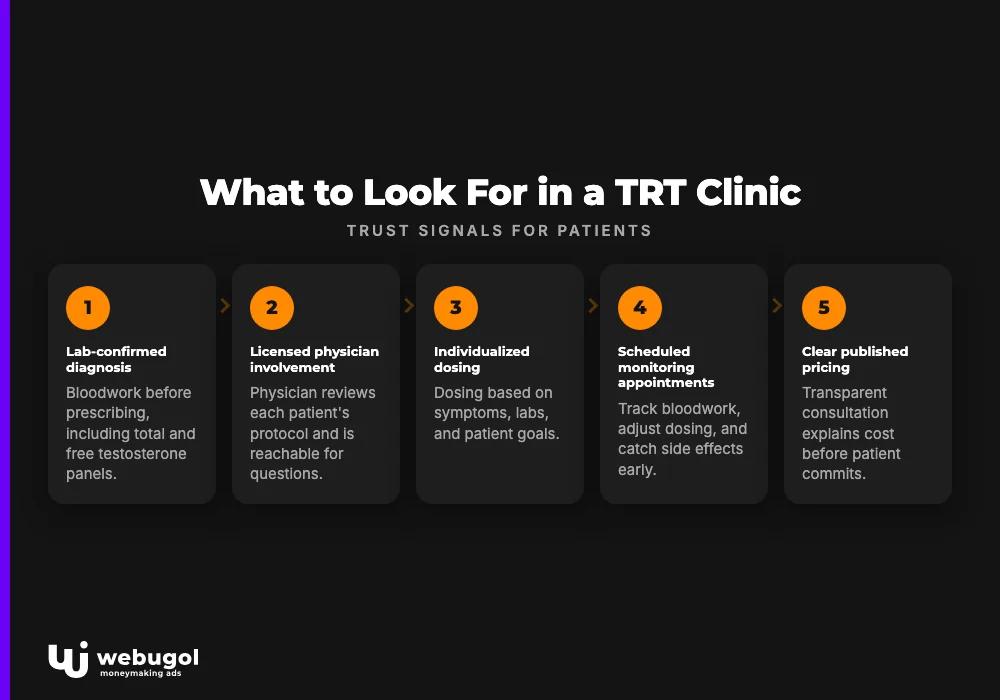
A qualified trt clinic near me requires bloodwork before prescribing, physician involvement in every protocol, individualized dosing, monitoring appointments, and published pricing. These are not aspirational standards. They are the floor. Any men's trt clinic near me that skips one of these elements is operating below the standard of care and below the trust threshold that high-intent patients use when choosing between practices.
For marketing leads managing local SEO, these are the trust signals that convert a searcher into a booked appointment. A potential patient searching "best trt clinic near me" is not choosing whether to pursue treatment. He is choosing which practice to trust with his health. Your local pages need to demonstrate these standards before he calls.
Five things a good TRT clinic should offer:
- Lab-confirmed diagnosis prior to any prescription, including total and free testosterone panels alongside relevant hormone markers, so treatment decisions rest on objective data.
- A licensed physician who reviews each patient's protocol personally and is reachable for questions, not just an NP operating under distant medical oversight.
- Individualized dosing based on symptoms, labs, and patient goals rather than a one-size program applied across all patients.
- Scheduled monitoring appointments at defined intervals to track bloodwork, adjust dosing, and catch side effects early.
- Clear published pricing or a transparent consultation that explains cost before the patient commits, because pricing opacity is a conversion killer, not a strategy.
Understanding how to get more patients in this vertical starts with recognizing what patients evaluate before they book. Trust signals on local pages directly affect call volume.
Red flags to avoid at any testosterone clinic
A clinic worth avoiding prescribes without bloodwork, skips follow-up monitoring, or makes it difficult to reach the prescribing physician. These are not minor process gaps. They represent clinical and legal risk for the patient and reputational risk for any practice operating in this space.
- A clinic that skips lab testing before prescribing testosterone is operating outside accepted standard of care, regardless of how the intake form is structured.
- No physician on staff, or a physician whose only role is to sign off remotely without direct patient interaction, creates a supervision gap that affects outcomes and liability.
- Refusing to discuss side effects openly, including erythrocytosis, sleep apnea risk, and fertility impact, signals a sales-first rather than patient-first culture.
- Hiding all pricing or requiring a paid consultation before disclosing any cost range creates friction that high-intent patients will walk away from.
- Discouraging questions about fertility implications is a specific red flag for men in their 30s and 40s who have not completed family planning.
None of the top-10 competitors for this query have a red flags section. That gap matters for ranking and for trust.

In-person clinic vs. telehealth TRT: which is right for you?
Both are valid paths to physician-supervised TRT; telehealth suits self-injectable protocols with strong remote monitoring, while in-person is better for clinic-administered injections and comprehensive physical exams. The right choice depends on the patient's protocol type, comfort with self-injection, and how complex his overall health picture is.
This covers the secondary search intent behind "trt therapy clinic near me." Men using that phrase are often deciding between modalities, not just locations.
Telehealth TRT is legal in most US states and has expanded significantly since 2020. It works well when the prescribed protocol involves weekly or twice-weekly self-administered injections, the patient can follow at-home phlebotomy instructions for lab monitoring, and the clinic has a structured check-in process rather than a prescription-and-disappear model.
In-person trt clinic near me visits add value when the patient prefers clinic-administered injections, needs a comprehensive physical exam to rule out complicating conditions, or has risk factors such as sleep apnea or cardiovascular history that benefit from closer oversight. Clinics offering a hybrid model, in-person intake with telehealth follow-up, capture the broadest share of search intent and reduce the friction that causes patients to abandon the enrollment process mid-funnel.

How much does TRT cost, and does insurance cover it?
Injectable TRT at a physician-supervised clinic typically runs $100 to $300 per month; most major insurance plans cover it when lab results confirm hypogonadism. Coverage eligibility turns on the diagnosis code, the prescribing physician's documentation, and the specific plan's formulary.
This is the most significant content gap in the current top-10 for this query. Only one competitor addresses pricing with an H2 heading. That clinic ranks at position 7. Pricing transparency is a trust signal, not a liability.
For cash-pay models, the monthly cost covers the medication itself. Many men's health practices bundle labs and monitoring into a membership fee, which can run from $300 to $600 per month depending on how comprehensive the program is. The bundled model is predictable for patients and reduces the authorization friction that slows insurance-covered pathways.
For insurance-covered TRT, the process requires a diagnosis of clinical hypogonadism, confirmed by two morning testosterone draws typically below 300 ng/dL per American Urological Association guidelines, plus symptomatic presentation. The authorization process varies by plan and state. Practices that help patients navigate this documentation close a higher percentage of insurance-eligible patients.
If inbound calls from "trt clinic near me" searches are not being attributed back to booked appointments, the funnel math is wrong before the first lead is counted. HIPAA compliant call tracking connects what your ad account spends to what your intake actually converts. Webugol builds this attribution layer as part of a unified acquisition system, so the marketing lead can see cost-per-booking rather than cost-per-click and stop having the wrong conversation about ad performance.

What happens at your first TRT appointment?
The first appointment typically includes an intake form, a physician consultation, a blood draw, and a discussion of next steps pending lab results. Same-day results are uncommon; most practices receive lab results within 24 to 72 hours and schedule a follow-up to review findings and discuss protocol options.
What to bring to your first appointment:
- Government-issued ID confirms identity and is required for controlled substance prescribing.
- An insurance card, if applicable, allows the front desk to verify coverage and begin any authorization paperwork before the physician consult.
- A current medications list with dosages lets the physician screen for interactions, particularly relevant for men on cardiovascular medications or finasteride.
- Prior lab results, if available, give the physician a baseline and can accelerate the diagnostic process when earlier testosterone panels already exist.
- Written notes on symptoms and their duration help structure the consultation and ensure nothing gets omitted during a time-limited appointment.
Reducing pre-visit uncertainty is a practice operations lever, not just patient education. Men who arrive prepared stay on task during the consultation, which improves show rate and shortens time-to-treatment-start.
Labs, diagnosis, and starting your protocol
Bloodwork for TRT evaluation measures total testosterone, free testosterone, LH, FSH, and hematocrit to confirm hypogonadism and rule out secondary causes such as pituitary dysfunction. A full panel also typically includes PSA, estradiol, and a metabolic profile.
The diagnostic threshold that commonly triggers a TRT recommendation is total testosterone below approximately 300 ng/dL combined with symptomatic presentation, per AUA guidelines referenced above. Some patients present with levels in the low-normal range but significant symptoms; a good physician considers both the number and the clinical picture.
For the marketing manager reading this, intake quality at this stage determines show rate and close rate. The ad click is not what converts the patient. The first-visit experience is. A patient who arrives knowing what to expect, who gets labs drawn and a clear timeline for next steps, is far more likely to complete enrollment than one who felt unprepared or unclear about the process. Speed-to-lead and intake clarity are where practices lose patients after a successful organic search click.
Will TRT affect my fertility?
Exogenous testosterone suppresses the pituitary signals that drive sperm production, reducing fertility in most men while on treatment. This is not a rare or controversial finding. It is a standard physiological consequence of introducing external androgens, and it is a question every reputable clinic should raise proactively with patients of reproductive age.
For men who want to preserve the option of biological children, two evidence-based paths exist. Human chorionic gonadotropin (hCG) co-therapy can be prescribed alongside testosterone to maintain intratesticular testosterone production and preserve spermatogenesis in many patients. Sperm banking before starting TRT is the more conservative approach and appropriate for men with near-term family planning goals.
The conversation about fertility should happen at or before the first prescription, not after a patient has been on therapy for a year. For practices serving men in their 30s and early 40s, this is a differentiating clinical touchpoint. It also reflects the kind of patient journey mapping that separates practices managing retention from those losing patients to competitors who addressed the question earlier.
No top-10 competitor has a section on TRT and fertility. This gap represents both a ranking opportunity and a genuine patient need.
Stop losing "TRT clinic near me" patients to whoever answers first
Men searching "trt clinic near me" across more than 4,100 monthly searches have already decided they want treatment. They are choosing between practices, not whether to pursue TRT. Winning this SERP and converting those patients requires a local content layer that answers real questions, a Google Business Profile that earns trust before the click, call routing that connects inbound leads in minutes, and an intake process that respects the patient's decision.
These are not separate tactics. They operate as one acquisition system. Speed-to-lead measured in hours while the ad account gets blamed is a symptom of a disconnected funnel, not a campaign problem. The Healthcare Growth System is built to close that gap from click to booked appointment. Book a strategy call.
Frequently asked questions
What should I look for in a TRT clinic near me?
A reputable TRT clinic requires a lab-confirmed diagnosis before prescribing, a licensed physician overseeing your protocol, and scheduled follow-up monitoring. Any clinic that skips bloodwork or offers treatment based on symptoms alone is a red flag worth taking seriously.
Does insurance cover testosterone replacement therapy?
Most insurance plans cover TRT when a lab test confirms clinical hypogonadism, but coverage terms vary by plan and state. Many specialized men's health clinics operate on a cash-pay model with predictable monthly fees that bypass the insurance authorization process entirely.
How much does TRT cost per month at a clinic?
Injectable protocols at a physician-supervised clinic typically cost $100 to $300 per month. Compounded gels, pellets, or comprehensive programs that bundle labs and monitoring appointments can run from $300 to $600 per month depending on the clinic model.
Can I do TRT through telehealth, or do I need to go in person?
Telehealth TRT is legal in most US states and works well for self-injectable protocols with strong remote monitoring. In-person is a better fit when you prefer clinic-administered injections, want a comprehensive physical exam, or have complicating health factors that require closer oversight.
Will starting TRT affect my ability to have children?
Exogenous testosterone suppresses the hormonal signals that drive sperm production, reducing fertility while on treatment. If having biological children is a priority, discuss hCG co-therapy or sperm banking with your physician before starting, this is a standard conversation at any reputable clinic.

