



Digital marketing skills every specialist needs in 2026
Digital marketing skills span SEO, paid search, content strategy, email marketing, social media management, and data analytics. A well-rounded specialist plans campaigns, measures results, and adjusts tactics without waiting for outside input on each channel. That combination of breadth and depth is what hiring managers test for when they evaluate digital marketing candidates in 2026.
What digital marketing skills does a specialist need?
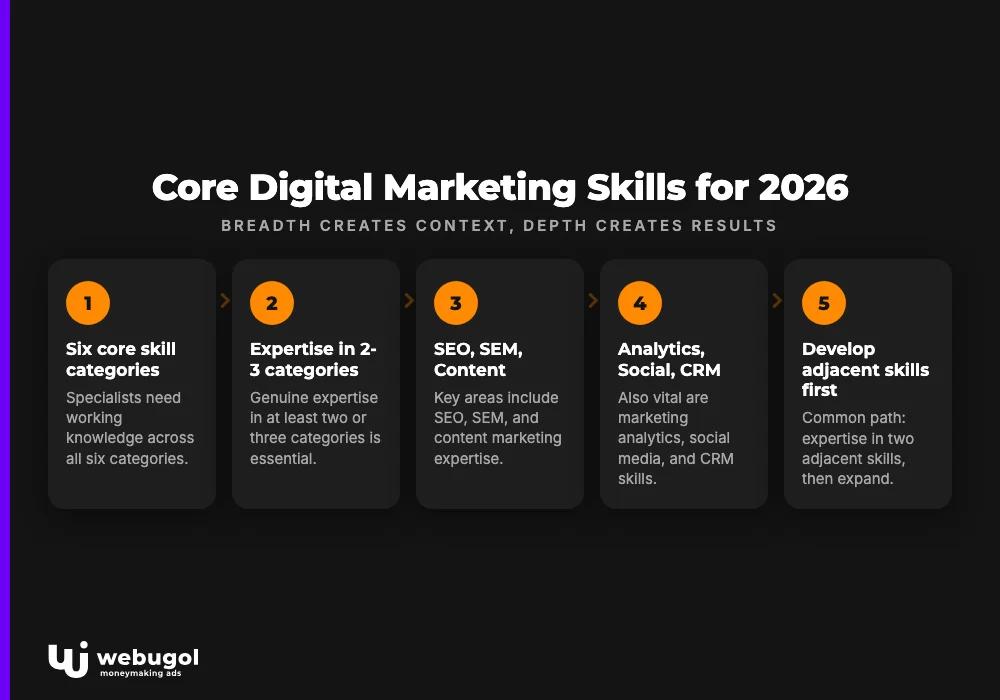
A digital marketing specialist needs working knowledge across six core skill categories, with genuine expertise in at least two or three. Breadth creates context. Depth creates results.
| Skill category | What it covers | Why it matters |
|---|---|---|
| SEO specialist skills | Keyword research, on-page optimization, technical audits, link building | Drives organic traffic without recurring ad spend |
| SEM advertising basics | Google Ads, bidding strategy, Quality Score, campaign structure | Delivers immediate search visibility with full conversion tracking |
| Content marketing expertise | Editorial planning, copywriting, distribution, funnel alignment | Builds category authority and supports every other channel |
| Marketing analytics tools | Google Analytics 4, Search Console, attribution modeling | Turns raw campaign data into decisions |
| Social media specialist skills | Platform strategy, community management, paid social | Grows and retains audience across owned channels |
| CRM and email | Segmentation, automation, lifecycle campaigns | Keeps existing customers engaged and moving toward conversion |
These six categories reflect the taxonomy hiring managers use when they write job postings and evaluate candidates. Not every role demands equal depth across all of them. A specialist who cannot work with analytics operates without real measurement. One who ignores SEO leaves recurring organic traffic uncaptured.
The most common path is to develop genuine expertise in two adjacent digital marketing skills first, such as SEO specialist skills combined with content strategy, or SEM paired with analytics, and then expand from there as experience accumulates.
What does a digital marketing specialist do daily?
On any given day, a specialist monitors live campaign performance, produces or reviews content, and adjusts targeting or spend based on what the previous day's data shows. The work is operational. It demands attention across multiple platforms simultaneously.
A morning might start with reviewing Google Ads cost-per-conversion reports, spotting a campaign that overshot its target CPA, and pausing the ad groups responsible. Short analysis, quick decision.
The afternoon shifts to reviewing a blog draft for keyword coverage and checking which competitor pages rank above it for the same query.
By evening, a re-engagement email sequence running below the expected open rate gets its subject line rewritten for one audience segment.
Comfort with repetition matters here. The same checks and adjustments happen daily until the numbers move. Progress is slow until it is sudden.
What is the difference between SEO and SEM?
SEO builds organic search visibility over time by improving content relevance and technical site quality. SEM buys that visibility immediately through paid ads. Both target search engines. The difference is in timeline and cost model.
The distinction shapes budget planning more than most teams expect. SEO compounds: a page that earns strong rankings today typically keeps delivering traffic with minimal upkeep, lowering cost per visit over time. SEM stops the moment the budget does. Knowing that dynamic helps a specialist advise on which digital marketing skills to invest in at each growth stage.
| SEO | SEM |
|---|---|
| Targets users actively searching, producing cost savings over paid alternatives as rankings stabilize | Delivers immediate search engine visibility; organic rankings can take months to establish |
| Higher organic rankings increase perceived credibility and user trust over time | Allows precise targeting by demographic, geography, and time of day |
| Long-term benefits provide a consistent traffic source once rankings are established | Full conversion tracking lets you measure and adjust campaign performance in real time |
These approaches complement each other in practice. SEM data reveals which keywords convert best, which then informs the organic content plan. Strong organic rankings reduce reliance on paid spend for branded queries. For the detailed cost and trade-off comparison between SEO and SEM, including how to allocate budget across both at each growth stage, the full breakdown covers both models side by side.
Developing SEO specialist skills means building real competence in technical audits, keyword mapping, and link acquisition. Organizations without in-house capacity often work with a professional SEO service to cover those requirements while building internal knowledge.
Content marketing expertise and how it builds authority
Content marketing expertise is the ability to attract and hold an audience through material they actively seek out, rather than content pushed at them. It underpins every other digital channel: SEO needs content to rank, email needs content to stay relevant, and paid social needs content to earn attention without exhausting budgets quickly.
Strong content marketing does several concrete things for a business:
- It establishes category authority. Consistent, well-researched content positions a brand as a source people return to, increasing branded search share over time.
- It improves organic reach. Pages written to genuinely satisfy user intent rank better than pages optimized primarily for algorithms.
- It reduces lead generation cost, particularly for businesses with long sales cycles where content converts prospects not yet ready to respond to direct ads.
- It enables personalization. Knowing the audience allows content that speaks to specific segments, which lifts both engagement and conversion rates.
- It feeds social and email calendars, reducing the marginal cost of producing fresh material across every other channel.
One practical approach: converting client wins into case study pages produces proof-driven material that prospects trust more than general brand claims, and creates assets that competitors cannot replicate.
Content marketing expertise includes planning campaigns by quarter, assigning each piece to a specific funnel stage, and tracking which content actually moves pipeline, not just page views.

What tools should a digital marketer know?
A digital marketer needs Google Analytics 4, Google Search Console, a paid search platform, at least one email automation tool, and one social scheduling or analytics platform. These are the instruments the work runs on. A specialist who cannot navigate them in practice cannot run effective campaigns.
Marketing analytics tools
Google Analytics 4 is the baseline for any digital marketing role. It tracks user behavior across sessions, connects to Google Ads for conversion data, and uses event-based reporting that provides more granular measurement than the session model it replaced.
Google Search Console sits alongside it, showing which queries generate impressions and clicks, where rankings stand, and which pages have indexing issues that need attention.
Beyond Google, marketing analytics tools like SEMrush, Ahrefs, or Moz extend into competitor keyword tracking, backlink analysis, and content gap research. The ability to run an audit in any of these and interpret the output is increasingly expected at mid-level roles.
Attribution modeling matters too. Understanding whether last-click, first-click, or data-driven attribution best represents the customer journey changes how conversion data reads and how budget gets allocated across channels.
SEM advertising basics in practice
Google Ads requires its own technical competency: campaign structure, match types, negative keyword lists, Quality Score optimization, and bid strategies. Most SEM work starts with keyword research in Google Ads Keyword Planner, since the keyword list shapes every subsequent decision in the campaign architecture.
SEM advertising basics extend to auction mechanics. Quality Score is not just a metric to monitor. It directly affects cost per click. A specialist who improves ad relevance and landing page experience can reduce CPC while holding or improving ad position, making the same budget stretch further.
Email automation tools
Email marketing delivers consistent results when segmentation and automation are properly configured. Tools like Mailchimp, HubSpot Email Marketing, ActiveCampaign, Sendinblue, and GetResponse handle the infrastructure. The skill is in knowing how to configure them to fit specific campaign goals.
Segmentation is where most of the value sits. Sending the same message to an entire list produces low open rates and unsubscribes.
A specialist sets up behavioral triggers for post-purchase sequences, cart abandonment, and re-engagement, so the right message reaches the right person without manual effort at scale.
Tracking open rates, click-through rates, and downstream conversions shows which subject lines, send times, and content formats actually move revenue.
Social media specialist skills and community management
Social media specialist skills cover more than scheduling posts. They include platform-specific content strategy, community moderation, paid social campaign management, and the ability to read native analytics and act on what they show.
Each platform has its own content format, audience, and ad system. LinkedIn's professional audience and targeting options suit long-form B2B content. Instagram and TikTok favor short video. Facebook's ad platform provides detailed demographic and behavioral targeting that many B2C advertisers rely on as a primary prospecting channel. A specialist who only knows one platform limits the campaigns the business can run.
Community management is the underrated dimension of social media specialist skills. Responding to comments, handling direct messages, and escalating complaints before they grow publicly shapes brand perception in ways that take years to rebuild if mishandled.
Paid social adds another layer. Managing creative A/B tests, setting audience exclusions, and optimizing for specific campaign objectives turns social platforms from brand channels into performance channels.

CRM and data literacy
CRM (customer relationship management) knowledge connects digital marketing activity to revenue. A specialist who understands CRM sees the full customer lifecycle, not just the acquisition event. They identify customers at risk of churning from behavioral signals, trigger retention campaigns before the relationship breaks down, and track which marketing activities produce customers with the highest lifetime value.
Data literacy underpins all of it. Understanding KPIs like cost per acquisition (CPA), customer lifetime value (CLV), return on ad spend (ROAS), and click-through rate matters. The real skill is knowing when a metric is misleading, when it reflects a genuine trend, and which lever to pull in response.
Key performance indicators should connect directly to business goals. A team tracking website traffic as a primary KPI without tying it to leads or revenue is measuring activity, not outcomes. CRM reporting closes that gap by linking marketing actions to revenue data in a way that is visible to leadership and finance teams.
How to become a digital marketing specialist?
Becoming a digital marketing specialist follows a consistent path. Learn one channel well. Build measurable results. Then expand into adjacent areas, rather than spreading your digital marketing skills thin across too many at once.
Most working specialists start in SEO, content, paid search, or social media. The starting point often reflects what role is available first. What matters is that the first role produces numbers you can explain in an interview: traffic grew by a specific percentage, conversion rate improved from one figure to another. Vague claims do not hold up to follow-up questions.
Building your digital marketing skills set
Career progression typically moves toward hybrid roles, such as SEO combined with content, or SEM with analytics, and eventually toward strategy and team management. Specialists who advance fastest treat marketing analytics tools as a core competency from the start, not something to learn later when the role demands it.
Platform certifications help with fundamentals. Google's free certifications for Ads and Analytics, HubSpot's content marketing certification, and Meta's Blueprint are the ones hiring managers most commonly require or recommend. They establish baseline knowledge but do not substitute for hands-on campaign experience.
Soft skills are real requirements. A specialist who cannot communicate results clearly to a non-technical stakeholder will hit a ceiling early. Adaptability matters equally: algorithms change, interfaces update, and what drove results in 2023 may not work in 2025. The ability to absorb those changes and adjust strategy is what keeps a set of digital marketing skills relevant over a full career.
Ready to grow your marketing capabilities?
Understanding which digital marketing skills matter is the first step. Applying them consistently across channels, measuring what works, and building on what does not is what separates campaigns that grow businesses from those that consume budget without clear return.
At Webugol, we work with businesses at each stage of that process, from initial audit through execution and performance reporting. For businesses in healthcare or regulated markets, our healthcare growth program applies the full digital marketing stack with sector-specific requirements already built in.
Reach out to discuss your current gaps and what a realistic improvement plan looks like.
FAQ
What skills does a digital marketing specialist need?
A digital marketing specialist needs working knowledge of SEO, paid search (SEM), content strategy, email marketing, social media management, and analytics. Most roles require genuine expertise in two or three of those areas, combined with enough cross-channel literacy to coordinate campaigns that span multiple platforms.
What is the difference between SEO and SEM?
SEO builds organic search rankings over time through content quality and technical improvements, while SEM places paid ads in search results for immediate visibility. SEO compounds in value once rankings stabilize, while SEM stops producing traffic the moment ad spend is cut.
What tools should a digital marketer know?
At a minimum: Google Analytics 4, Google Search Console, Google Ads, and one email automation platform such as Mailchimp or ActiveCampaign. Mid-level roles often expect familiarity with SEO research tools like SEMrush or Ahrefs and CRM platforms such as HubSpot or Salesforce.
What does a digital marketing specialist do daily?
A specialist typically reviews campaign performance data, adjusts bids or targeting based on recent results, and produces or reviews content. Managing active email sequences and social accounts rounds out most days. The specific channel mix depends on the role, but data review and tactical adjustment are constant across all specializations.
How to become a digital marketing specialist?
Start by building measurable results in a single channel, whether SEO, paid search, content, or social. Take platform certifications from Google, Meta, or HubSpot to establish foundational digital marketing skills, then expand into adjacent channels once your primary area delivers results you can demonstrate clearly.