



Digital Marketing for Building Materials: Key Strategies for Success
Digital marketing for building materials covers the online channels suppliers use to reach contractors, architects, and developers: search, paid ads, content, social, and email. Done right, digital marketing building materials strategies shift purchase decisions in your favor before a prospect ever calls. Suppliers who combine SEO, targeted paid campaigns, and useful content consistently outperform those still relying on trade shows and cold outreach alone.
What digital marketing strategies work for building materials companies?
The most effective approach for building material suppliers marketing combines SEO, PPC, content, and email, each targeting a different stage of the buying cycle. No single channel carries the full load. Construction professionals research products online for weeks or months before contacting a supplier, which means your digital presence must be active at every research stage.
| Channel | Primary role | Works best for |
|---|---|---|
| SEO | Organic visibility and long-term authority | Specifiers in early research |
| PPC (Google/LinkedIn) | Immediate reach to active buyers | New markets, seasonal demand |
| Content marketing | Trust-building and specification support | Architects, engineers, design-build firms |
| Lead nurturing and customer retention | Long-cycle buyers, repeat purchasers | |
| Social media | Brand awareness and project showcase | Visual products, residential contractors |
Each channel reinforces the others. A technical blog post earns organic traffic and supplies material for email campaigns and LinkedIn posts. An SEO-optimized product page lowers cost per click when you run PPC against the same terms.
The construction industry marketing strategy with the strongest compounding return is content-led SEO. Specifiers share technical content, link to useful resources, and return repeatedly to suppliers they trust. That pattern builds authority that paid spend cannot replicate. When digital marketing building materials programs integrate search, content, and nurture into a single system, each channel amplifies the others rather than competing for the same budget.
How to generate leads for building material suppliers?
Building materials lead generation works when the offer matches the buyer's research stage. Generic contact forms on a homepage rarely convert. Targeted landing pages tied to specific product categories, certifications, or project types perform consistently better.
The most reliable lead sources for building material suppliers:
- SEO-driven product pages rank for specification-intent queries such as "Class A fire-rated exterior cladding" or "structural insulated panel load tables" and include a clear next step for the buyer.
- Gated technical content such as specification sheets, CAD files, compliance guides, and installation manuals captures leads at the research stage by requiring an email address to download.
- Retargeted PPC campaigns follow visitors who viewed product pages but did not submit a form, keeping your brand visible throughout extended decision cycles.
- LinkedIn sponsored content reaches commercial construction decision-makers by job title and company type before they begin actively searching.
Segmentation determines lead quality. Residential contractors want price certainty and fast delivery. Commercial developers need certifications, load ratings, and compliance documentation. A single nurture sequence sent to both loses both. Segment from the first touchpoint.
Long sales cycles require automation. A lead who downloads a specification guide today may not be ready to order for four months. An email sequence delivering relevant case studies and product updates at spaced intervals keeps you in consideration without daily manual effort from your sales team.

What SEO tactics help building materials websites rank higher?
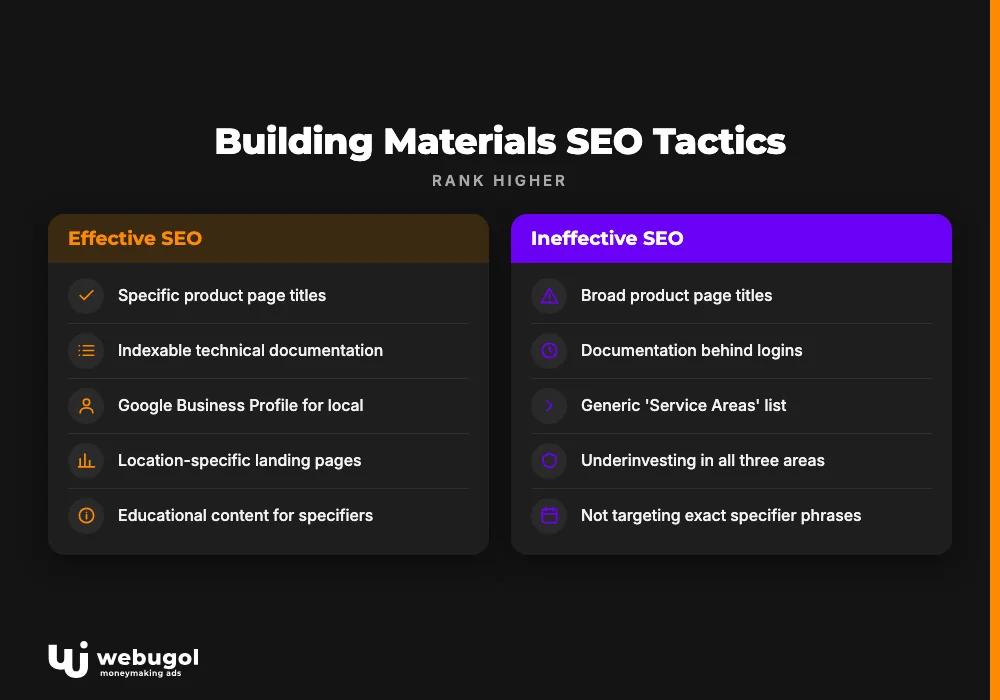
SEO for building materials rests on three foundations: product page optimization for transactional queries, local SEO for region-specific buyers, and educational content for specifiers at the research stage. Most suppliers underinvest in all three simultaneously. The specificity that defines effective digital marketing building materials SEO, targeting the exact phrases specifiers use, not just broad categories, is what separates suppliers that rank from those that don't.
Product page optimization means each page targets a specific specification-intent search phrase. Broad pages titled "Roofing Products" rarely rank for terms contractors use. A page titled "Metal Standing-Seam Roof Panels for Commercial Construction" can rank for the exact phrases estimators search when they are ready to specify.
Technical documentation must be indexable. Specification sheets, load tables, and compliance certificates locked behind logins are invisible to search engines. They should exist as crawlable HTML pages or as PDFs with proper metadata and dedicated landing pages.
Local SEO connects regional suppliers to nearby buyers. Google Business Profile, citation directories, and location-specific landing pages improve visibility for searches like "concrete block supplier Chicago." Suppliers serving multiple regions need one landing page per market, not a single generic "Service Areas" list.
Educational content captures early-stage traffic. When an architect searches "how to specify fiber cement for coastal environments," they are not yet buying. If your content answers that question well, you become the supplier they consider when the project reaches procurement. A SEO audit that identifies where your pages rank and which competitors outrank you is the right starting point before creating new content.
Backlinks from trade publications, manufacturer associations, and specification databases carry real authority in this niche. Earning them requires contributing genuinely useful technical material to the industry.
SEO for building materials checklist:
- Target specification-intent phrases on product pages, not just brand or category names.
- Make technical documentation crawlable rather than gated behind logins.
- Build one landing page per served region for local search.
- Publish educational content that answers specifier questions at the research stage.
- Earn backlinks from trade publications and specification databases.
- Optimize for mobile, since field contractors increasingly search on phones.
Which social media platforms work best for building materials marketing?
LinkedIn and Instagram deliver the most consistent results for building materials companies, each reaching a distinct audience.
LinkedIn works for B2B suppliers targeting architects, project managers, and commercial developers. Sponsored content and direct outreach reach decision-makers by job title, industry, and company size. Product launches for commercial-grade materials, completed project case studies, and technical webinar promotions all perform well. The targeting lets you narrow to, for example, senior project managers at mid-size construction firms in a specific region.
Instagram suits suppliers with visually strong products: architectural cladding, decorative concrete, specialty tile, and modular facade systems. Finished project photos, material close-ups, and installation sequences attract residential contractors and architects who use the platform for visual research and early specification discovery.
Facebook retains value for reaching independent residential contractors through local groups and targeted ads. Organic reach for business pages is limited. Treat it as a paid channel rather than expecting organic growth.
YouTube is underused by most building materials companies despite being the second-largest search engine. Installation guides, product performance tests, and project walkthroughs build credibility with contractors who need to understand how a material installs before specifying it. A short video showing installation on a demanding substrate answers questions that a spec sheet cannot.
Building materials online presence on social media grows when content is platform-specific. A technically focused social media advertising strategy tailored to the building sector consistently outperforms generic creative recycled from other industries.
PPC for construction companies: when paid ads deliver
PPC for construction companies makes the most sense when entering a new geographic market, launching a product, targeting seasonal demand, or competing for terms where organic rankings are not yet strong. In a complete digital marketing building materials program, paid search complements SEO rather than replacing it.
Google Ads reach contractors and estimators who are actively searching for specific materials. Geographic targeting keeps budget focused on regions you can serve. Ad copy that leads with technical specifications and certifications converts better than generic benefit statements. "ASTM E136-certified mineral wool insulation, cut to size" outperforms "premium insulation solutions" for a buyer who already knows what they need.
LinkedIn Ads suit commercial building material suppliers targeting architects, engineers, and procurement teams. Sponsored content promoting case studies or compliance documentation reaches decision-makers before they begin actively searching. Cost per click on LinkedIn runs higher than Google, but the audience precision is better suited to B2B applications in this sector.
Retargeting is essential here. Building material purchases involve extended research and multiple approval steps. A contractor who viewed your product pages last week without submitting a form is a warm lead. Retargeted display and search ads keep your brand visible throughout that full decision process.
A structured competitor PPC analysis shows which terms rivals bid on and where gaps exist that you can exploit with more specific targeting.
Content marketing for building products: trust before the sale
Content marketing for building products works because construction professionals educate themselves long before contacting a supplier. A contractor researching a new facade system watches installation videos, reads performance comparisons, and downloads specification sheets. If your content appears at each of those moments, you reach the short list without a cold call.
Content types that consistently work for building material suppliers:
- Technical guides explain performance requirements, specification criteria, and installation best practices for specific product types, giving architects and engineers what they need to spec confidently.
- Video content covering product demos, installation walkthroughs, and completed project showcases works particularly well for contractors who learn visually and want to see real-world applications.
- Project case studies document materials used, challenges overcome, and outcomes achieved on real builds, giving procurement teams the social proof that spec sheets alone cannot provide.
- Sustainability documentation covering environmental product declarations, recycled content percentages, and certification status increasingly drives specification decisions among architects and developers on green-rated projects.
Content marketing trends show a clear shift toward highly specific, application-focused material rather than broad category overviews. Suppliers who publish detailed technical content for niche applications earn both organic traffic and specification consideration that generic content cannot achieve. In digital marketing building materials, content that answers a specifier's technical question at the right research moment compounds in value over time, building a library that generates qualified leads long after publication.

How to measure ROI of digital marketing for building materials?
Measuring ROI for digital marketing for building materials connects online activity to actual business outcomes, not just traffic and clicks. Most suppliers track the wrong things early and cannot justify their spend as a result.
Digital marketing building materials: four measurements that matter
Focus on four measurements:
- Cost per qualified lead (CPQL): total channel spend divided by leads that meet your target criteria. One hundred unqualified leads are less useful than ten that convert. Track qualification rate by channel, not just total lead volume.
- Lead-to-sale conversion rate: the share of qualified leads that become paying customers. A low rate often indicates a sales process gap rather than a marketing problem.
- Revenue influenced by channel: attribution is imperfect in long sales cycles, but multi-touch models give a clearer picture than last-click alone. CRM tagging from the first contact supports this.
- Customer acquisition cost vs. customer lifetime value: a supplier with high repeat purchase rates can justify higher acquisition costs. One with mainly one-time buyers needs tighter cost control throughout the funnel.
Organic search performance tracks separately. Rankings, organic sessions to product and category pages, and the share of traffic arriving from specification-intent keywords are leading indicators of pipeline health.
Reporting cadence matters. Monthly reviews catch trend shifts before they compound. Weekly dashboards covering paid campaign performance let you reallocate budget quickly when a campaign underperforms.
Build your digital marketing building materials strategy
A complete approach to digital marketing for building materials starts with understanding where your current buyers find you online. Building materials online presence audits reveal where websites, search visibility, and competitive positioning can improve before any spend increases.
Website analysis covers technical performance, content quality, mobile experience, and lead capture. Many suppliers find that slow load times and non-indexed product specs block leads before any marketing begins. Fix the foundation first.
Setting realistic KPIs protects budgets from short-cycle pressure. Building materials sales cycles often run six to eighteen months. Tie short-term metrics (organic traffic growth, form completions, cost per lead) to medium-term outcomes (qualified pipeline, close rate) so stakeholders can see the program working before revenue arrives.
Building materials online presence compounds through consistency. Regular publishing, link building, and technical SEO maintenance over twelve to twenty-four months creates a search position that paid traffic cannot easily displace. For broader context on how digital fits into construction industry marketing across the full channel mix, the dynamics of audience segmentation and budget allocation are worth reviewing before committing to a plan.
Start building your digital marketing program today
Webugol works with building materials suppliers who want a structured path from their current online position to measurable growth in qualified leads. The work starts with an honest assessment of where you stand, followed by a prioritized roadmap covering SEO for building materials, paid campaigns, content, and lead capture.
Contact Webugol to request a digital marketing audit for your building materials business. We identify your highest-value opportunities and outline a plan that connects your online activity directly to sales pipeline.
FAQ
What is digital marketing for building materials?
Digital marketing for building materials uses search engines, paid ads, content, social media, and email to reach and convert contractors, architects, developers, and distributors online. It complements or replaces traditional methods like trade shows and cold outreach with measurable, scalable programs.
How long does SEO for building materials take to produce results?
Most building materials websites see meaningful organic traffic growth within six to twelve months of consistent SEO work, with compounding gains through the second year. Paid campaigns can generate leads within days but require ongoing budget. Combining both channels produces the fastest and most durable pipeline results.
Which metrics should building material suppliers track for digital marketing?
Track cost per qualified lead, lead-to-sale conversion rate, organic traffic to product and category pages, and customer acquisition cost against lifetime value. Avoid focusing only on impressions or total traffic, which rarely correlate directly with revenue in long-cycle B2B building materials sales.
How does content marketing for building products differ from other sectors?
Unlike generic content strategies, content marketing building products suppliers rely on must be highly technical to reach architects, engineers, and contractors who specify materials. Specification sheets, performance guides, installation tutorials, and compliance documentation drive meaningful engagement at the research stage, while generic brand content rarely ranks or converts in this sector.
What is the biggest mistake building materials companies make in digital marketing?
The most common mistake is treating the website as a brochure rather than a lead generation asset. Suppliers invest in paid traffic but send visitors to pages without gated content, clear calls to action, or follow-up sequences. Fixing lead capture before scaling ad spend delivers faster results than increasing media budget alone.