



What healthcare marketers need to win patient growth (tools, mistakes & metrics)
Healthcare marketers are accountable for the patient acquisition number but rarely control the website, the CRM, the dev queue, or the attribution data. That structural gap explains why performance stalls even when campaigns look healthy, and why the week fills with vendor coordination rather than strategic decisions. The tools, the five common mistakes, and the KPIs in this article are built around that accountability framework, developed by Webugol as the team behind tracking-first, conversion-led patient acquisition systems for US clinics and telehealth operators.
What is a healthcare marketer?
A healthcare marketer owns patient acquisition and revenue growth for a clinic or telehealth operator, with direct accountability for CPL, CPA, and booked appointment targets. This is not generic digital marketing with a healthcare badge on it. The role carries HIPAA compliance constraints, platform health category restrictions, and cross-functional dependencies with intake teams and compliance approvers. Most healthcare marketers hold the revenue number while controlling only a fraction of the systems that determine it.
What does a healthcare marketer do day to day?
Healthcare marketers spend most of the working week bridging the gap between ad performance and business outcomes. The core daily responsibilities:
- Running paid campaigns on Google and Meta within platform health category restrictions
- Tracking CPL, CPA, show rate, and speed-to-lead daily and reporting to leadership
- Coordinating landing page and website changes with the development team
- Routing creative and copy through compliance review before any campaign goes live
- Attributing offline conversions from phone calls and intake forms back to paid channels
- Monitoring intake performance and escalating when answer rate or show rate drops
- Managing audience refreshes, creative cycles, and budget pacing across active campaigns
When in-house bandwidth hits its ceiling, an external healthcare marketing consultant provides strategic lift without adding permanent headcount.
Understanding patient journey mapping from first search to first appointment reveals where the revenue path breaks: the ad platform reports a click, the CRM never sees the lead, and the gap lives somewhere in the booking flow.

The 5 mistakes healthcare marketers make
These five healthcare marketers' mistakes are structural system failures, not personal errors. They persist because the revenue target belongs to marketing, but the systems that drive it are split across vendors and departments.
Trusting ad platform data over your CRM
Ad platforms report in their own favor. When Meta reports 40 leads and the CRM shows 18, the gap signals a tracking break, not a lead quality problem. Adding budget to that configuration accelerates the mismatch, not the results.
Treating speed-to-lead as intake's problem, not marketing's
Show rate collapses when lead response time is measured in hours rather than minutes. Marketing teams own the CPL number but disclaim ownership of what happens after the form submit. Speed-to-lead belongs on the marketing dashboard even when intake controls the follow-up workflow.
Running ads without HIPAA-compliant tracking
Standard GA4 and pixel configurations can expose protected health information and trigger both HIPAA liability and ad account suspension. The compliance baseline for healthcare advertising includes consent mode, server-side event tracking, and offline conversion imports into Google Ads and Meta. Getting google analytics permissions structured correctly before launch is not optional for healthcare advertisers; it is the minimum viable compliance setup.
Scaling spend before fixing the offer
High CPA is almost always a funnel or offer problem before it is a media problem. Running a budget increase through a broken booking flow or an unanswered objection accelerates loss. A funnel audit before a spend increase routinely reveals why conversion rate is low enough to make any media buy unprofitable.
No renewal or reactivation program
Acquisition spend rises to cover churn that marketing officially owns only on paper. Renewal sequences and win-back flows for lapsed patients carry measurable CPL equivalents. Treating them as ad hoc support tasks leaves recoverable revenue untracked and unowned.
Owning the full accountability picture above the in-house marketing team's authority level is the structural argument for a fractional cmo healthcare engagement, where a senior operator holds the whole revenue path without a full-time executive hire.
Before adding budget to any of the five gaps above, a funnel and tracking audit establishes what is actually broken. The Healthcare Growth System starts with that diagnostic in weeks one and two, before any increase in ad spend.

Essential tools for healthcare marketers
The right tool stack closes the data gaps the five mistakes above create. Tips for healthcare marketers on tool selection point to one principle: compliance and PHI handling must be confirmed before capability becomes the deciding factor.
What call analytics tools do healthcare marketers use?
Call tracking closes the offline attribution gap between ad click and booked appointment. Healthcare marketers use platforms like CallRail, Invoca, and WhatConverts to feed call outcomes back into Google Ads and Meta as offline conversions, correcting the platform undercount that skews apparent campaign performance. State-level call recording consent rules and PHI handling in call logs require configuration attention before activating call analytics for healthcare marketers who operate across multiple states.
Market intelligence and competitive research tools
The market intelligence tools healthcare marketers rely on cover three areas: geo-level patient demand estimation, competitor ad creative monitoring, and keyword research for high-intent patient queries. Semrush and SpyFu reveal which claims competitors are testing in paid and organic channels. Google Keyword Planner with healthcare category filters identifies demand signals before committing budget to new service lines or geographies.
HIPAA-compliant CRM and marketing automation
The CRM must hold protected health information under a signed Business Associate Agreement. Standard subscription tiers for most platforms do not qualify. HubSpot's HIPAA BAA tier, GoHighLevel's HIPAA add-on, and ActiveCampaign at the appropriate tier are the common configurations for this stack. Beyond compliance, the CRM ties together lead routing rules, nurture sequences, and renewal triggers, the three automation layers that separate a team running campaigns from one running a patient acquisition system.
The three tool categories at a glance:
- Call analytics: CallRail, Invoca, and WhatConverts feed call outcomes to ad platforms as offline conversions and handle PHI-compliant call recording.
- Market intelligence: Semrush, SpyFu, and Google Keyword Planner with healthcare filters cover geo demand signals and competitor creative monitoring.
- HIPAA CRM: HubSpot (HIPAA BAA tier), GoHighLevel (HIPAA add-on), and ActiveCampaign manage lead routing, lifecycle automation, and renewal triggers under BAA coverage.

How do healthcare marketers measure success?
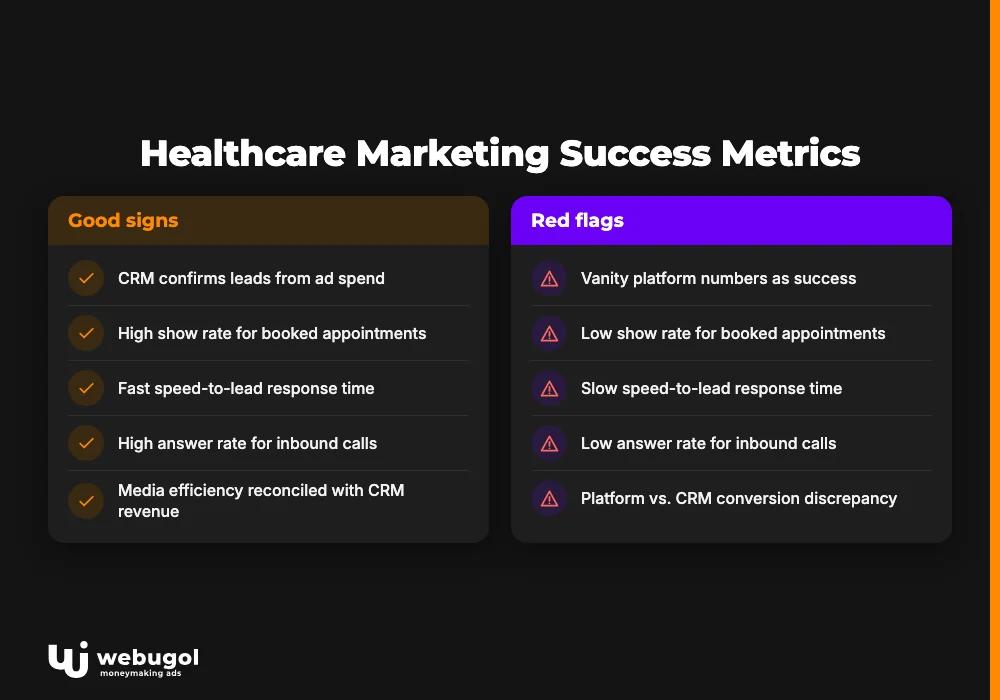
The right KPIs trace from ad spend to recognized revenue, not to vanity platform numbers. Platform dashboards are a starting point. They are not a verdict.
Core performance metrics:
- CPL (cost per lead): The ad platform reports this number; treat it as directional input until the CRM confirms the lead.
- CPA (cost per patient acquisition): This is the full cost to book and show a patient, including creative, ops, and overhead.
- Show rate: This measures the percentage of booked appointments that result in completed consults; a show rate problem is an ops and nurture problem before it is an ad problem.
- Speed-to-lead: This measures time from form submit or call to first contact, in minutes; show rate degrades measurably when response time runs in hours.
- Answer rate: This is the percentage of inbound calls answered by intake during business hours.
- Close rate: This measures completed consults converting to program starts or purchases.
- MER/ROAS: This is the blended media efficiency ratio across all paid channels, reconciled against CRM revenue data.
- Payback window: 60 to 90 days is the operational target for direct-to-patient healthcare programs; LTV projections do not drive daily decisions the way payback clarity does.
The foundational measurement problem to fix first is the platform-versus-CRM discrepancy. When the ad platform, GA4, and CRM report different conversion counts by a wide margin, all downstream KPIs are unreliable until attribution is clean.
Stop coordinating vendors. Start owning the revenue path.
The structural problem is not a channel problem or a creative problem. It is an accountability problem: one team holds the revenue target, four or five vendors hold the systems. Closing that gap requires owning the full path from tracking setup through offer testing to retention, not managing each part as a separate contract.
The Healthcare Growth System is built around that diagnostic priority. Weeks one and two start with measurement and funnel audit, not a spend increase. Book a strategy call to identify exactly where the gap is in your patient acquisition path.
FAQ
What is a healthcare marketer?
A healthcare marketer owns patient acquisition and revenue growth for a clinic or telehealth operator, with direct accountability for CPL, CPA, and appointment targets. The role is distinct from generic digital marketing because it operates under HIPAA compliance constraints, platform health category restrictions, and cross-functional dependencies with intake and compliance teams. Most healthcare marketers hold the revenue number while controlling only a fraction of the systems that drive it.
What does a healthcare marketer do?
Healthcare marketers manage paid campaigns, track CPL and show rate daily, coordinate website changes with the development team, route creative through compliance review, and attribute offline conversions back to ad channels. The operational reality is more coordination than decision-making: data lives in the CRM, the website is owned by IT or a dev vendor, and the follow-up workflow belongs to intake. The KPIs belong to marketing; most of the systems driving those KPIs do not.
What tools do healthcare marketers use?
The three core tool categories are call tracking (CallRail, Invoca, WhatConverts), HIPAA-compliant CRM with a signed Business Associate Agreement (HubSpot, GoHighLevel, ActiveCampaign), and market intelligence platforms (Semrush, SpyFu, Google Keyword Planner). Each category closes a different attribution gap: offline conversions, PHI-compliant data management, and competitive demand signals. BAA coverage and PHI handling must be confirmed before connecting any platform to patient data.
What are the most common mistakes in healthcare marketing?
The five structural mistakes are trusting ad platform data over CRM data when counts disagree, treating speed-to-lead as an intake metric rather than a marketing KPI, running ads without HIPAA-compliant tracking configurations, scaling spend before auditing the funnel and offer, and having no renewal or reactivation program for lapsed patients. All five stem from the same accountability gap: the revenue target is marketing's but the systems that determine it are split across vendors and departments. Fixing the systems closes the gap faster than adding budget.
How do healthcare marketers measure success?
Core KPIs for healthcare marketers include CPL, CPA, show rate, answer rate, speed-to-lead in minutes, close rate, and MER/ROAS across all paid channels. The 60 to 90-day payback window is the operational target for direct-to-patient programs; abstract LTV projections do not drive daily decisions the way payback clarity does. The foundational problem to solve first is the platform-versus-CRM attribution discrepancy, because all downstream KPIs are unreliable until attribution is clean.