



Allergy SEO: How Allergy Clinics Rank Higher and Attract More Patients
Allergy SEO is a specialized form of search engine optimization for allergy clinics, allergists, and allergy product businesses. It focuses on keyword patterns, local search signals, and content authority to drive patients to book appointments or find treatment.
According to the American Academy of Allergy, Asthma & Immunology, allergic diseases affect nearly 50 million Americans every year and rank as the sixth leading cause of chronic illness. Digital marketing for allergy clinics is not optional.
What is allergy SEO and how does it work?
Allergy SEO applies standard search disciplines with one critical difference: it accounts for urgency, seasonality, and geographic intent. A patient searching during a pollen spike behaves differently from someone scheduling a routine checkup. Timing drives everything. SEO for allergists must be structured around that distinction.
The process covers four layers. Keyword research maps how patients actually search, from broad queries to specific long-tail phrases with clear intent. Content must meet Google's E-E-A-T (experience, expertise, authoritativeness, trustworthiness) standards for health pages. Local search signals ensure the clinic appears when patients look for nearby care. Technical performance keeps the site fast on mobile, where most allergy searches originate.
Building lasting search visibility for a healthcare practice requires all four layers working together, not sequentially.
Common allergy SEO challenges and how to solve them
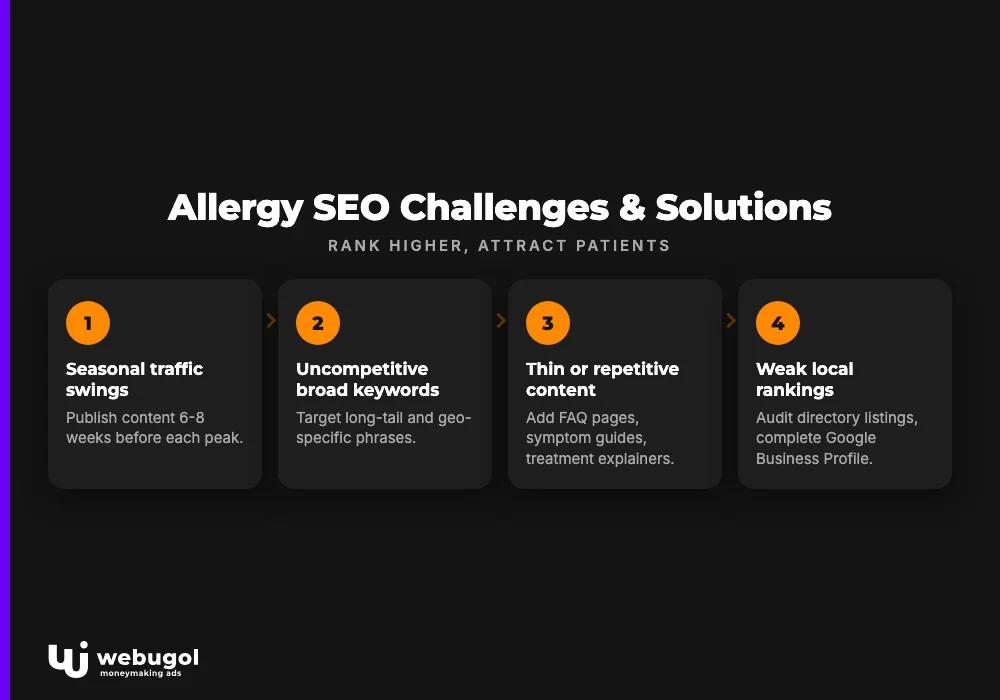
These four problems appear most consistently across allergy clinic websites. Each has a direct, practical solution.
| Challenge | Root cause | Solution |
|---|---|---|
| Seasonal traffic swings | Search volume spikes in spring and fall allergen seasons | Publish content 6-8 weeks before each peak |
| Uncompetitive broad keywords | Large health portals dominate generic allergy terms | Target long-tail and geo-specific phrases |
| Thin or repetitive content | Limited page variety on most clinic sites | Add FAQ pages, symptom guides, and treatment explainers |
| Weak local rankings | Inconsistent NAP data or incomplete Google Business Profile | Audit all directory listings and complete the GBP fully |
Mobile performance cuts across all four. Most allergy searches happen on phones, often during an active reaction. A slow or hard-to-navigate mobile experience loses patients before they reach your services. Every second counts.
What keywords do allergy patients use to find treatment?
Patients rarely type "allergist" into a search bar. They search symptoms, triggers, or specific treatment names. Allergy clinic marketing that maps patient language rather than clinical terminology starts from a stronger competitive position.
Broad terms like "allergy testing near me" drive high volume but face stiff competition from large health systems. Long-tail phrases such as "food allergy testing for children [city]" or "dust mite allergy relief options" carry clearer intent and convert at higher rates. Intent wins every time.
For asthma SEO, consistent entry queries include "asthma and allergy clinic near me" and "asthma specialist [city]." Seasonal modifiers like "spring tree pollen allergy relief" or "fall ragweed allergy doctor" capture patients at peak urgency.
An effective allergy SEO keyword strategy uses two tiers. Evergreen pages target stable, year-round high-intent terms. A content calendar pushes seasonal articles out 6-8 weeks before each allergen peak. That combination covers both the patient who plans ahead and the one reacting right now. Effective keyword research for healthcare websites details how to build that dual-tier approach.
How can allergy clinics rank higher on Google?
Ranking gains in allergy SEO come from three areas: content quality, on-page structure, and technical performance.
Content quality. Google applies E-E-A-T standards strictly to health pages. Content reviewed by a licensed allergist outperforms generic copy. FAQ sections work especially well for seo for allergy clinic websites because they match the question-format queries patients type. A thorough answer to "what happens during allergy testing" or "how does immunotherapy work" captures long-tail traffic while signaling genuine expertise. That format converts well.
Symptom guides, treatment comparison pages, and condition explainers build topical authority over time. Interactive tools like regional allergen calendars generate steady return traffic while providing real utility to visitors. Authority accumulates gradually.
On-page structure. Title tags must include the target keyword and stay under 60 characters. Meta descriptions earn clicks when they answer search intent within 120 characters. Header tags (H1, H2, H3) give both readers and crawlers a clear path through content. Use them to organize information, not to stack keywords. Structure signals matter.
Technical performance. Compress images, reduce unnecessary scripts, and use a content delivery network to cut load times. Apply LocalBusiness schema so search engines read your address, hours, and services accurately. MedicalCondition or Article schema on content pages can generate rich snippet displays in results, increasing click-through without requiring a higher ranking position.
Why is local SEO important for allergy practices?
Most allergy patients want in-person care. Local SEO for allergists is therefore one of the highest-return components of any allergy SEO plan. A patient searching "allergy clinic near me" during a reaction is ready to book. Missing from the local pack at that moment means the patient goes to the next result.
Start with your Google Business Profile. Complete every field, add high-quality photos, and keep hours accurate. Patient reviews directly influence local rankings. Reviews compound over time. Encourage satisfied patients to leave Google reviews and respond to every one, positive or negative.
Prompt, professional responses signal active engagement to Google and build confidence for prospective patients comparing options. A complete breakdown of ranking in local search as an allergy or medical practice covers the full process in structured detail.
For clinics serving multiple areas, build a dedicated landing page for each location. That page earns traffic. A well-built location page references local allergens, seasonal patterns, and community-specific resources. Keep NAP (name, address, phone) identical across every directory listing. Inconsistencies suppress local rankings. Build citations in medical directories and local business listings to reinforce location signals over time.
How to get more patients for an allergy clinic online?
Digital marketing for allergy clinic growth works best as a coordinated strategy. Social media keeps the clinic visible between patient visits and builds community around seasonal allergy awareness content. How social media and search reinforce each other for healthcare practices is worth understanding before allocating budget across digital channels.
Backlinks from authoritative sources accelerate ranking gains. Links build real authority. Practical approaches include guest articles in allergy or asthma publications, listings in respected medical directories, and community partnerships with schools, hospitals, and local health organizations. Each authoritative link adds credibility that search engines weigh when ranking your pages.
Seasonal planning is where consistent clinics separate themselves from reactive ones. Publish before the pollen spike, not during it. That timing changes outcomes. Allergy clinic marketing that operates year-round, with content timed to spring and fall allergen seasons, consistently outperforms reactive approaches.
Allergy SEO compounds. Authority, rankings, and patient trust all accumulate with sustained effort. A practice starting today will be significantly harder to displace in 18 months than one that waits.
Grow your allergy practice with search that works
Webugol builds tailored allergy SEO strategies for allergy clinics, allergists, and healthcare product businesses. If your practice is not visible during peak allergy season, that is a solvable problem. Contact Webugol to develop an SEO plan built around your clinic's location, services, and patient base. We will put your practice in front of patients who are actively searching for what you offer.
FAQ
What is allergy SEO?
Allergy SEO is a specialized form of search engine optimization for allergy clinics, allergists, and allergy-related businesses. It combines keyword strategy, local search optimization, and medical content authority to attract high-intent patients through organic search.
How long does allergy SEO take to produce results?
Most clinics see meaningful local ranking movement within 3-6 months of consistent effort. Broader keyword gains typically take 6-12 months, depending on competition level and the site's existing domain authority.
Why is local SEO critical for allergy practices?
Most allergy patients prefer in-person consultations, so location-based searches drive the majority of new patient acquisition. Local SEO for allergists ensures your clinic appears in Google's local pack when nearby patients search for allergy treatment.
What content performs best on an allergy clinic website?
Symptom guides, treatment explainer pages, FAQ sections, and seasonal allergy content consistently outperform generic clinic copy. Content published before peak allergen seasons captures high-intent traffic at the right moment.
Is asthma SEO different from allergy SEO?
Asthma SEO targets a related but distinct patient group using different search terms: "asthma specialist near me," "asthma and allergy clinic," and "asthma treatment options." Clinics treating both conditions should build separate content tracks for each to capture both patient audiences in search.