



How to Start a Mobile IV Therapy Business: Complete Operational Guide (2026)
A mobile IV therapy business runs at 60-80% gross margin per session with startup costs of $15,000-$40,000, a fraction of what a brick-and-mortar clinic requires to open. Most solo operators plateau within 12 months, not because local demand is thin but because they launched without a patient acquisition system. Route-density economics, the concentration of bookings within a tight geographic radius, is the central variable that determines whether the model generates a sustainable income or a busy calendar that never converts to profit. For a broader look at the IV hydration business model as a whole, including clinic and hybrid formats, that guide covers the full landscape; this article focuses on mobile-specific unit economics, legal structure, a step-by-step launch sequence, and the marketing infrastructure that fills routes.
Whether you are launching your first mobile IV therapy operation or running a clinic that has hit a growth ceiling, the structural gap is the same: a business built without an owned patient acquisition system has no floor on how far revenue can drop when word-of-mouth flattens. Both stages share the constraint, and both stages have the same fix.
What is a mobile IV therapy business, and is it right for you?
A mobile IV therapy business is a clinical delivery model in which a licensed provider travels to the client's location, whether a home, hotel room, corporate office, or event venue, to administer IV drips under a medical director's established protocols. The operator handles the booking, the equipment, and the clinical encounter on-site, eliminating the overhead of a permanent treatment space.
Three variables determine fit. First, your state's licensing environment: scope-of-practice laws vary significantly, and some states impose stricter supervision requirements on mobile operations than on clinic-based practice. Second, existing clinical relationships: a physician willing to serve as medical director early compresses the launch timeline considerably. Third, local demand density: a mobile IV therapy business in a dense urban corridor or resort market faces a structurally different cost structure than one operating across a 40-mile rural radius.
Who typically launches this model: registered nurses going independent after years of clinical employment, wellness entrepreneurs partnering with licensed clinicians to handle the business operations, and clinic owners adding a mobile arm to extend revenue without adding square footage.
Mobile vs. brick-and-mortar IV clinic: which model wins on profit?
The mobile model wins on startup cost and margin structure. Brick-and-mortar IV clinics require lease deposits, build-out costs, fixed medical-grade equipment, and staffed hours regardless of patient volume.
| Dimension | Mobile IV Business | Brick-and-Mortar Clinic |
|---|---|---|
| Startup cost | $15,000–$40,000 (kit-based) | $80,000–$200,000+ |
| Monthly fixed overhead | Low (no lease, minimal fixed staff) | High (rent, utilities, full-time staff) |
| Gross margin per session | 60–80% | 55–75% |
| Break-even timeline | 3–6 months | 12–24 months |
| Geographic reach | Flexible, service-area based | Fixed radius |
| Scalability ceiling | Multi-van, multi-clinician | Square footage and appointment slots |
The mobile format's structural advantage is that fixed costs stay low until you choose to scale. Profitability, however, is not a fixed attribute of the format. It is a function of local demand geography and route density, and that distinction is what separates a high-margin operation from one that grinds through sessions without building real business value.
Is a mobile IV therapy business profitable?
Yes, the gross margin structure is strong. At $150–$350 per session, each visit generates 60–80% gross margin before fixed costs. The real question is whether local demand supports the session volume needed to cover those fixed costs, which include medical director fees, malpractice insurance, and your tech stack.
The distinction between a solo income ceiling and a scalable mobile IV therapy business comes down to route density. Three sessions within a 5-mile radius in a single afternoon is a different operation than three sessions spread across 25 miles. The net margin difference is driven by drive time, fuel cost, and the total number of sessions physically completable in a working day.
Unit economics: cost per session, break-even, and annual revenue potential
A single session's cost structure breaks down as follows:
- IV kit and fluids: cost depends on drip type, additive mix, order volume, and supplier
- Medical director allocation: approximately $5 per session at $1,000 per month across 200 sessions; costs vary by state law and agreement scope
- Mileage: calculated at the current IRS federal reimbursement rate per mile driven to the client location
- Malpractice insurance proration: annual premium divided across projected annual sessions
- Booking platform fee: typically a per-booking charge or a monthly subscription
Gross profit per session is your session price minus the costs each visit triggers directly: supplies, mileage, and per-booking fees. The medical director and malpractice lines above are fixed costs spread across sessions, so they belong in the fixed-cost total, not in gross profit. Break-even by sessions per week at three price points (illustrative, based on $1,500 per month in fixed costs, run the numbers with your actual costs before drawing conclusions):
| Sessions/week | At $150/session | At $225/session | At $300/session |
|---|---|---|---|
| 5 | Negative | Near break-even | Positive |
| 10 | Near break-even | Positive | Strong positive |
| 15–20 | Positive | Strong positive | Scaling-ready |
A solo operator running 15–20 sessions per week at mid-range prices can generate $150,000–$250,000 in annual revenue. A two-van operation with two full-time clinicians roughly doubles the top-line figure while requiring structured dispatch and quality control systems that do not yet exist in most solo operations.
Before you finalize menu prices, get current quotes from your IV supply vendors and use them in the per-session cost breakdown above.

Legal and licensing requirements by state
For a full state-by-state licensing breakdown, see our guide on how to start an IV hydration business. Here, the focus is on the three compliance layers every mobile operator navigates simultaneously.
Three-layer compliance checklist:
- Business entity: LLC or professional entity (PLLC or PC) depending on your state's requirements for licensed healthcare providers; some states require a professional corporate structure for any clinician-owned business
- Scope-of-practice: the operating clinician's license type and state law determine who can administer IV therapy and under what supervision model
- Medical director agreement: a formal written agreement with a licensed physician required in most states for nurse-operated IV businesses
- Malpractice coverage: individual and business-level professional liability insurance must be in place before the first patient encounter
- Consent form requirements: written informed consent documented per session; digital systems must comply with state e-signature laws and HIPAA
Consult a healthcare attorney before launch. The cost of a legal review is small relative to the liability of launching under an incomplete compliance structure.
Do you need a medical director, and what does it cost?
In most US states, yes. A medical director is required for nurse-owned IV therapy businesses, with monthly costs typically ranging from $500 to $2,000 depending on state law, agreement scope, and the physician's specialty.
What a medical director agreement typically covers:
- Protocol review and approval: the physician reviews and signs off on your drip menu, dosing parameters, and contraindication screening process
- Supervision documentation: the required oversight level varies by state, from a collaborative arrangement to more direct supervision for certain procedures
- Emergency backup structure: a documented escalation pathway for adverse events during a mobile session
- Liability allocation: clarifies which party carries responsibility for protocol adherence versus individual clinical judgment at the patient encounter
The cost variance between $500 and $2,000 per month reflects whether the physician actively participates in protocol development and ongoing oversight or signs documents as a compliance formality. The latter carries more legal risk than the cost savings justify, especially for a mobile operation where the medical director is the only oversight layer between the clinician and the patient.
Who can administer IV therapy? RN, NP, and PA rules by state
Scope-of-practice law determines who can administer IV therapy in a mobile setting. RNs require medical director oversight in most states, while NPs and PAs can operate independently in full-practice-authority states.
State categories for clinical operations:
- Full practice authority: NPs and PAs can assess, diagnose, and treat independently, which allows nurse practitioner-owned mobile businesses to operate without a medical director in some states. Examples include Oregon, Washington, and Colorado, among roughly 25 states.
- Reduced practice: NPs must maintain a collaborative practice agreement with a physician; independent practice is limited. Examples include Florida and Georgia.
- Restricted practice: NPs must practice under direct physician supervision, which significantly increases the cost and complexity of a nurse-owned mobile operation. Examples include Alabama and Texas.
These laws change. Your state nursing or advanced practice licensing board is the authoritative source before launch, not a general guide.

How to start a mobile IV therapy business step by step
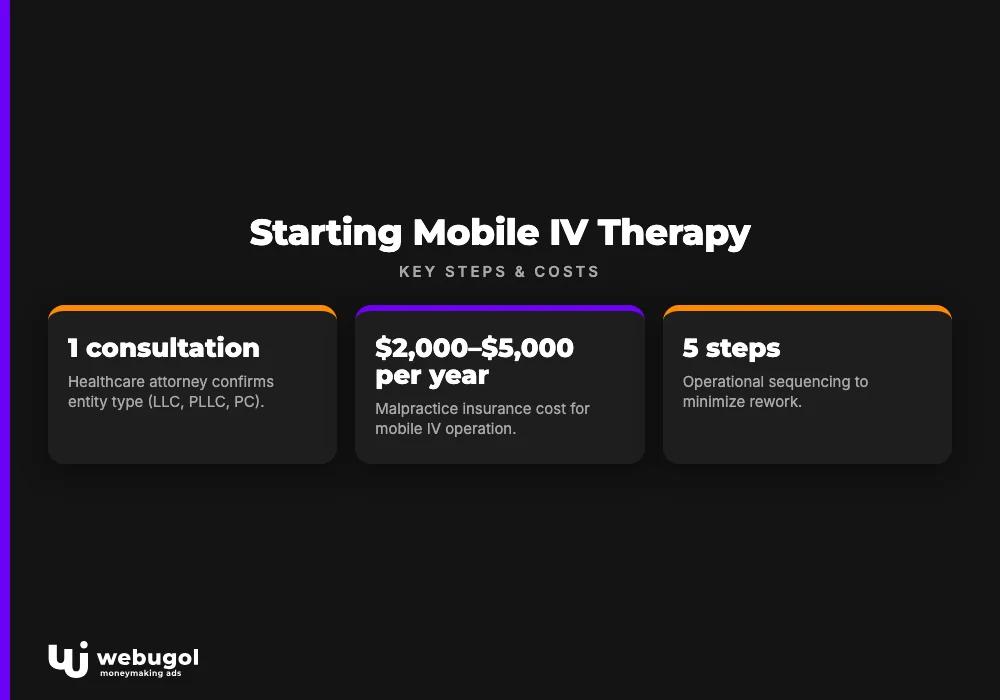
Operational sequencing matters. The five steps below are ordered to minimize rework: entity formation before marketing spend, tech stack before first booking, routing logic before adding a second clinician.
Step 1: Form your business entity and secure malpractice insurance
The LLC versus PLLC or PC decision turns on whether your state requires a professional entity for licensed healthcare providers. A healthcare attorney can confirm the requirement in a single consultation. Worth every dollar.
Malpractice insurance for a mobile IV operation typically runs $2,000–$5,000 per year depending on coverage limits, the number of clinicians covered, and the states where you operate. Standard coverage levels for IV therapy include per-occurrence and aggregate limits; confirm minimum requirements with your medical director and malpractice carrier before launch. A common mistake is delaying insurance while entity formation is pending. Both must be in place before any patient contact, not after.
Step 2: Source equipment, van setup, and cold-chain protocols
Core equipment for a kit-based mobile operation:
- IV access kits (catheters, tubing, tape, gauze, flush syringes)
- Fluid bags and additives (saline, lactated Ringer's, vitamins, glutathione)
- Cold-chain cooler with temperature logging capability
- Sharps disposal containers compliant with state biohazard waste requirements
- Blood pressure cuff and pulse oximeter
- Emergency kit with epinephrine and oxygen, per medical director protocol
- Digital consent device (tablet or phone with HIPAA-compliant consent application)
- Printed protocols and session documentation forms
Van versus kit-only is a cost and compliance decision. A kit-only setup keeps entry costs low and works in markets where sessions occur in hotel rooms or client homes. A van adds $10,000–$30,000 depending on vehicle condition and required buildout, but it expands your service radius and satisfies mobile workspace compliance requirements in stricter states. Cold-chain documentation is not optional in most states: temperature logs for IV fluids are part of the compliance record, not a best practice.
Step 3: Choose your tech stack: booking, EMR, consent, and CRM
HIPAA compliance applies at every layer of the tech stack, not just the EMR. An online booking tool that passes patient data through a non-compliant platform creates liability before the first session begins.
- Online booking: Jane App, Mindbody, or a GoHighLevel booking module all support HIPAA-compliant workflows with signed business associate agreements (BAAs)
- HIPAA-compliant EMR: Jane, DrChrono, or Practice Fusion for session documentation, intake records, and provider notes
- Digital consent: JotForm HIPAA or DocuSign Healthcare for electronic consent with full audit trails
- CRM for follow-up: GoHighLevel or HubSpot with a HIPAA BAA in place for email and SMS reactivation of past clients
The stack determines what you can legally track. If your booking tool lacks a BAA, you cannot pass booking completion events to your ad platform without a HIPAA exposure. Most mobile IV operators discover this only after running paid traffic for 60–90 days and receiving a platform policy notice.
Step 4: Set your pricing and menu of drips
IV drip menus typically tier across three to five product lines:
- Base hydration: standard saline or lactated Ringer's, lowest price point, broadest demand
- Recovery: electrolyte-enhanced formulations with B-complex or anti-nausea add-ons, mid-tier pricing
- Immune support: vitamin C, zinc, B12, moderate price point
- Performance: amino acids, B-complex, targeted add-ons
- High-ticket SKUs: NAD+ infusions and longevity protocols command the highest prices and longest session times
Anchor visible marketing to the high-ticket SKU to establish perceived value, then use add-ons like B12, glutathione, and zinc to raise the average ticket across all drip types. Package pricing and monthly membership plans drive rebooking rates well above single-session pricing, which directly improves route density. Keep all service names and descriptions free of medical treatment claims; FDA and FTC guidelines restrict outcome language for IV therapy services.
Step 5: Build dispatch and routing operations
This is the mobile-specific operational dimension no top-10 competitor covers. Route efficiency is the core variable. Everything else in the model optimizes around it.
Booking window structure matters more than most operators anticipate. Offering 2-hour arrival windows rather than point-in-time appointments allows realistic scheduling that accounts for drive time, session duration variability, and occasional extended IV access attempts. Defining your service radius by drive-time threshold rather than raw mileage lets your booking system reject out-of-zone requests automatically, preventing the common pattern of a clinician spending 45 minutes in transit between sessions.
Route sequencing for session density is the primary profitability lever in this model. Three sessions within a 5-mile radius in the same afternoon generate significantly higher net margin than three sessions spread across 25 miles, even at identical per-session prices. Fuel, drive time, and clinician hours consumed by an inefficient route are direct costs that do not appear in per-session calculations but show up clearly in monthly net margin.
Before adding a second van or clinician, document the dispatch protocol in writing. Who assigns sessions to which clinician? What is the escalation path for a delayed session or an adverse event? What documentation must be completed before the next session is accepted? The operator who cannot answer these questions at one van will face compounded operational fragility at two.
Operators who fill routes consistently build their marketing infrastructure before they need it. HIPAA-compliant tracking, a booking flow that converts, and a follow-up sequence that reactivates past clients are rarely launch-day priorities for solo operators. They become urgent six months in, when word-of-mouth flattens and the route calendar empties. The structural gap that stalls a solo operator at 10 sessions per week is the same gap that stalls a $500,000-per-month clinic at its growth plateau: no owned acquisition channel, no reliable booking funnel, no attribution that separates what works from what burns budget. The Healthcare Growth System is the 90-day program built to install that acquisition infrastructure at both stages.
How to get your first clients: marketing that complies with HIPAA
Google and Meta restrict health-condition targeting under their own platform policies, independently of HIPAA. A mobile IV therapy business navigates two compliance layers simultaneously: federal HIPAA requirements and ad platform policies that can change with limited advance notice. Understanding both before launching paid traffic is not a compliance checkbox. It determines whether your campaigns stay live past the first 90 days.
HIPAA-safe digital acquisition: what you can and cannot track
HIPAA-compliant IV therapy marketing requires server-side conversion tracking, exclusion of condition-based signals from ad audiences, and consent mode on the booking flow. Most operators skip this setup and run paid traffic directly, then face account restrictions within 60–90 days when the platform's automated compliance systems flag the pattern.
You can track and use:
- Session booking completions as conversion events, tied to the booking action rather than a specific drip type
- Phone call duration as a proxy conversion
- Email opt-in events from non-condition-specific forms
- Hashed customer lists for broad audience matching with proper consent documentation in place
You cannot do:
- Retarget users based on page views that imply a specific condition, such as visitors to a hangover drip page
- Create custom audiences derived from data tied to specific health conditions
- Pass unhashed contact data containing health identifiers to ad platforms
- Run conversion events that link patient identity to a specific health service without explicit prior consent
Most mobile IV operators encounter this boundary after receiving an ad account policy violation notice. Building the compliant tracking layer before the first campaign eliminates that disruption and the cost of rebuilding audience data from scratch.
Local SEO, Google Business Profile, and event partnerships
A Google Business Profile configured as a service-area business, with no physical storefront listed, is an effective local SEO asset for a mobile IV therapy business. No physical address is required. Service-area setup, consistent review velocity, and active Q&A content are the three levers that move local pack rankings for mobile operators. Neighborhood-level service pages, content tied to proximity events, and GBP posts aligned to local demand spikes (marathon weekends, festival schedules, wedding season) generate organic bookings without ad spend.
Event partnerships function as a route-density anchor at launch. Corporate wellness accounts, wedding group bookings, sports team partnerships, and festival contracts provide guaranteed session blocks with pre-sold demand. A single corporate wellness account can generate more sessions in a month than the equivalent time invested in paid search at the same stage.
Marketing channels ranked by estimated time to first booking:
- Google Business Profile organic (no ad spend; 2–6 week ramp to first rankings)
- Direct referral from medical offices, hotels, and fitness centers
- Event and corporate wellness contracts (pre-sold demand; fastest channel at launch)
- Google Local Services Ads (faster compliance path than standard Google Ads for health services)
- Meta advertising with HIPAA-compliant setup (2–4 week ramp after tracking verification)
- Email and SMS reactivation of past clients (fastest rebooking channel once a client base exists)
- Monthly membership program (builds rebooking velocity and route predictability over time)
How to scale beyond a solo operator
The inflection from solo to multi-van is where most mobile IV therapy businesses either accelerate or break. Systems built for one operator rarely transfer to two without explicit documentation. Dispatch, quality control, and patient communication need to be written down and repeatable before a second clinician starts seeing patients independently.
Hiring RNs, training protocols, and quality control
Clinician hiring and onboarding checklist:
- Current active license verification by state, including any telehealth states if applicable
- Individual malpractice coverage confirmation before the first patient encounter
- HIPAA training with documented completion
- Written protocol review and sign-off with the medical director
- Supervised orientation sessions, with the number determined by the medical director based on state supervision law
- Emergency response review and documentation prior to solo patient contact
Training protocol covers IV access technique, fluid and additive selection per your approved drip menu, emergency response procedures and escalation pathways, and session documentation requirements. Medical director involvement in onboarding typically satisfies state supervision requirements and reduces the operator's liability exposure when adding new clinicians to the team.
Quality control after onboarding does not require owner presence at every session. Digital documentation review, a structured client feedback cadence, and periodic chart audits by the medical director create an oversight layer that scales with the operation. Understanding how patients experience the full booking-to-session touchpoint sequence is equally important; the patient journey mapping framework applies directly to mobile operations where every patient interaction occurs outside a clinical facility.
The system fragility that stops a solo operator at 10 sessions per week is structurally identical to the fragility that stalls a $500,000-per-month clinic at its growth plateau. The constraint in both cases is not clinical capacity. It is the absence of an owned acquisition channel, a reliable booking flow, and attribution data that separates profitable demand from wasted spend. This is the diagnostic pattern that a Webugol-led funnel and tracking audit surfaces consistently, whether the business is at launch stage or at scale.
Build the patient acquisition system that fills your routes
A mobile IV therapy business with clinical excellence and no predictable demand is a scheduling problem, not a business. Operators who grow past solo do not wait for word-of-mouth to compound. They install a HIPAA-compliant acquisition system: tracking that attributes every booking to the channel that generated it, a conversion-optimized booking flow, and paid and organic channels that run without requiring owner involvement on every campaign cycle.
The Healthcare Growth System delivers that infrastructure in 90 days. Month one covers market intelligence and funnel foundation. Month two covers tracking setup, dashboards, and campaign launch. Month three scales what is proven. Book a Strategy Call to see whether the program fits your current stage.
FAQ
How much does it cost to start a mobile IV therapy business?
Startup costs typically range from $15,000 to $40,000 for a kit-based setup, covering equipment, initial supply inventory, malpractice insurance, business entity formation, and a HIPAA-compliant tech stack. A van-based operation adds $10,000 to $30,000 depending on vehicle condition and any buildout required for mobile workspace compliance in your state.
Do you need a medical director to run a mobile IV therapy business?
In most US states, yes. Nurse-owned IV therapy businesses require a supervising medical director under a formal written agreement, with monthly costs typically ranging from $500 to $2,000 depending on state regulations, agreement scope, and the physician's specialty.
How profitable is a mobile IV therapy business?
Gross margins per session typically run 60 to 80 percent, with session prices ranging from $150 to $350. A solo operator running 15 to 20 sessions per week can generate $150,000 to $250,000 in annual revenue; net profitability is determined primarily by route density and patient rebooking rate.
What equipment do you need to start a mobile IV therapy business?
Core equipment includes IV kits, fluid bags, a HIPAA-compliant digital consent system, sharps disposal containers, a cold-chain cooler with temperature logging, and an emergency kit with epinephrine and oxygen. Most states also require written protocols and session documentation as part of operating compliance.
Who can legally administer IV therapy in a mobile setting?
Scope-of-practice law varies by state. Registered nurses can administer IV therapy in most states under medical director oversight. Nurse practitioners and physician assistants may operate independently in full-practice-authority states. Confirm current requirements with your state licensing board or a healthcare attorney before launch.

