



Why weight loss clinics lose "near me" searches to better-optimized competitors
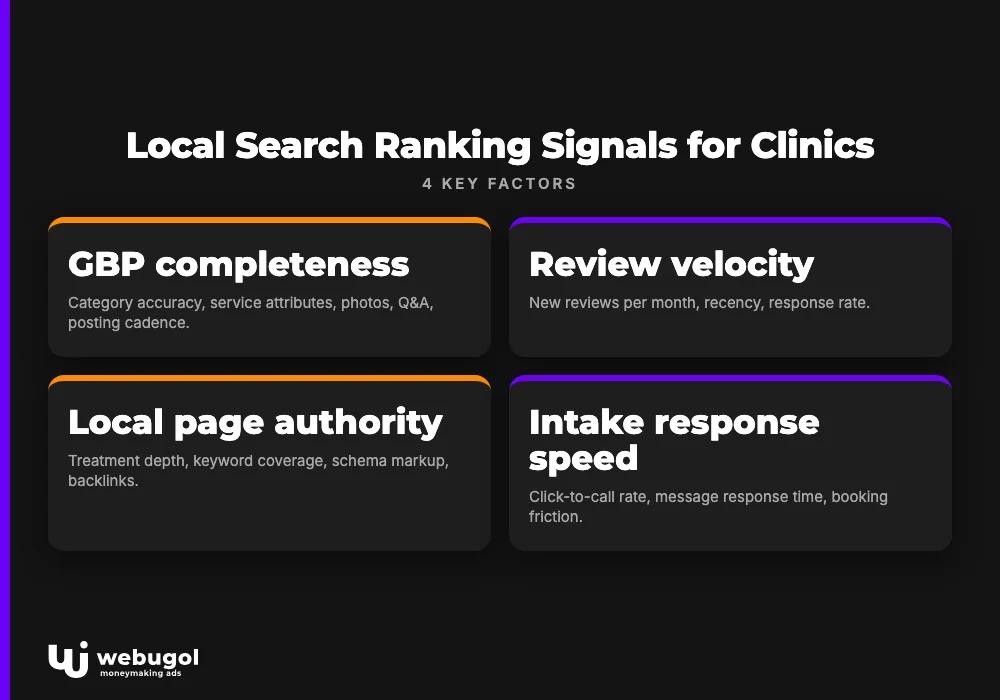
Local rank for a weight loss clinic near me is set by four measurable signals: Google Business Profile (GBP) completeness, review velocity, local landing page authority, and intake response speed. None of these involves ad spend. Google's restrictions on GLP-1 and weight management advertising on both Google and Meta have made organic local the most reliable acquisition channel in this category, and those restrictions are tightening. If your clinic relies on paid search to cover local intent, that assumption is what competitors are using to take map pack positions you should own.
The map pack gap is structural. Most clinics optimize local SEO after the ad account. Competitors who treat it as the primary channel win bookings at zero marginal cost per click, and the gap between them and you compounds each month the signals go unattended.
What determines local search rankings for weight loss clinics?
Google's local map pack ranks clinics on proximity, relevance, and prominence, but the levers within those categories are specific and measurable. Ad spend does not appear among them. The four signals below determine where a medical weight loss clinic near me query places your listing relative to every competitor in your market.
| Local Rank Signal | What Google Measures | Typical Clinic Gap | Fix Priority |
|---|---|---|---|
| GBP completeness | Category accuracy, service attributes, photos, Q&A, posting cadence | Missing GLP-1 service attributes; under 20 photos; no Q&A seeded | High (fastest to fix) |
| Review velocity | New reviews per month, recency, response rate | Sporadic requests, no post-visit sequence, low monthly volume | High (compounding benefit) |
| Local page authority | Treatment depth, keyword coverage, schema markup, backlinks | Generic service page, no treatment comparisons, missing candidate criteria | Medium (content work required) |
| Intake response speed | Click-to-call rate, message response time, booking friction | Manual routing, no after-hours coverage, multi-step intake forms | Medium (high indirect impact) |
No competitor in the current top-10 for this query provides clinic operators a framework for diagnosing which of these signals they are losing on. That gap is expensive. Each month a GBP goes uncompleted or a review sequence sits idle, the next clinic in the map pack captures the booking.
As GLP-1 ad restrictions tighten, organic local search and ai visibility on AI-powered discovery tools are becoming the two channels that capture weight loss patient intent with no policy interference.
How to optimize your Google Business Profile for weight loss searches
GBP completeness is the fastest-to-fix ranking signal. Changes take effect within days, not weeks. Most clinics complete the required fields and stop, leaving the high-value attributes that distinguish a GLP-1 clinic from a general wellness center entirely blank.
The highest-impact incomplete fields in most weight loss GBP listings:
- Primary category: select "Weight Loss Service" rather than a generic medical category; add "Medical Clinic" as a secondary category
- Service attributes: explicitly list semaglutide, tirzepatide, Ozempic, Mounjaro, phentermine, and any compound GLP-1 options by name
- Service area: confirm all cities and zip codes served, including telehealth coverage if you offer remote prescribing
- Business description: include the primary keyword phrase and your top two or three treatment names within the 750-character limit
- Photos: publish at least 25 photos covering exterior, interior, staff, and treatment environment; refresh monthly to signal active listing management
- Google Posts: publish at least two posts per month on treatment topics and program updates
- Q&A section: seed five to eight anticipated patient questions and answer each within the listing before patients ask publicly
- Appointment link: connect directly to your intake or booking form, not the homepage
- In-person vs. telehealth distinction: if you offer both formats, create separate GBP listings with separate category and service configurations; Google treats these as different service types and ranks them differently
Clinics offering telehealth GLP-1 programs alongside in-person visits need distinct listing configurations. A single listing trying to cover both will underperform against competitors with dedicated entries for each format.

Which treatments must appear on your local landing page?
A local landing page earns map pack eligibility partly through content depth. Google evaluates whether the page answers the specific treatment queries that follow a "near me" search. The current top-10 has zero side-by-side treatment comparisons. That leaves more than 1,500 monthly searches across GLP-1 and phentermine near-me queries going unserved by every existing competitor.
Treatment content checklist for a local landing page targeting this query cluster:
- Mechanism and candidate profile for each GLP-1 injectable offered
- Semaglutide vs. tirzepatide comparison with published outcome ranges from trial data
- Phentermine and non-injectable alternative section with candidate criteria and mechanism
- Retatrutide status and candidacy criteria, framed as an emerging category
- Pricing transparency: program monthly cost, first-visit fee, and insurance vs. self-pay tracks
- First-visit walkthrough describing what happens, in what order, and how long it takes
- Booking form or intake link with minimal friction
Converting local organic traffic into booked consults is the patient acquisition challenge. Getting the page to rank is the prerequisite. Both need to work before the channel delivers a measurable cost per booking.
GLP-1 injections: semaglutide and tirzepatide pages
Patients searching for a semaglutide weight loss clinic near me or a tirzepatide weight loss clinic near me already know what they want. Your page needs to answer the comparison they will ask next: what is the difference, and which is right for them.
Semaglutide (Ozempic, Wegovy) is a GLP-1 receptor agonist. The STEP 1 trial (Wilding et al., 2021) showed mean body weight reduction of approximately 15% over 68 weeks in adults with obesity. Tirzepatide (Mounjaro, Zepbound) activates both GLP-1 and GIP receptors. The SURMOUNT-1 trial (Jastreboff et al., 2022) showed mean weight reductions up to 22.5% at the highest dose.
For local page content, include mechanism, the published outcome range from trial data, and the candidate profile for each drug. Avoid clinic-specific outcome claims, which create compliance exposure. Patients searching for a weight loss clinic ozempic near me or for Mounjaro specifically are comparison-shopping; your page wins when it gives the most structured answer in local results.
What is retatrutide and should your clinic's page include it?
Yes. Retatrutide is a triple agonist targeting GLP-1, GIP, and glucagon receptors simultaneously. It drives 206 monthly searches with no strong competitors targeting it, making this a rare zero-competition AEO opportunity.
Phase 2 trial data (Jastreboff et al., 2023) showed weight reduction up to 24.2% at 48 weeks. As of this writing, retatrutide is not FDA-approved; it is available through select research programs. Frame your page section to cover the clinical trial context, current prescription status, and comparison to dual-agonist GLP-1 therapies. Patients searching for a retatrutide clinic near them are sophisticated early adopters; a well-sourced page builds trust even when the drug is not yet on your formulary.
Phentermine and non-injectable alternatives
A weight loss phentermine clinic near me search signals a different patient profile: cost-sensitive, injection-averse, or seeking a bridge therapy alongside a GLP-1 taper. These queries add more than 570 monthly searches that most clinic pages ignore entirely.
Your local page needs a phentermine section covering FDA-approved use, typical candidate profile with BMI criteria and contraindications, mechanism as a sympathomimetic appetite suppressant, and comparison context relative to injectables. Patients who search weight loss clinic phentermine near me want confirmation the clinic prescribes it before they book; omitting this answers no one's question and misses measurable keyword coverage.
If the full acquisition funnel is not yet mapped against this checklist, an audit of local page content alongside intake conversion rates is the right starting point. That diagnostic is exactly what shows you how to get more patients from existing traffic before raising spend.

Does showing treatment prices help a weight loss clinic rank locally?
Yes. Pricing transparency is the single largest content gap in the current top-10 for this query. Only one competitor approaches it, and none provides a structured breakdown. Google rewards pages that answer purchase-intent queries, and transparent pricing self-qualifies patients before booking, which reduces no-show rates and tends to improve downstream review quality.
Pricing page elements that convert for weight loss programs:
- Monthly program cost per treatment track (semaglutide compound, branded tirzepatide, phentermine)
- First-visit fee or consultation cost
- Out-of-pocket vs. insurance track, with clear separation between what insurance typically covers and what it does not
- Membership vs. pay-per-visit model structure
- Payment plan availability and accepted payment methods
- What is included vs. billed separately (labs, follow-up visits, medication cost)
Avoid price ranges so wide they communicate nothing. Use actual program tiers or "starting from" with the entry-level option clearly labeled.
What does insurance cover for weight loss programs?
Most commercial insurance covers GLP-1 medications only when prescribed for Type 2 diabetes, not weight management, though coverage is expanding under ACA mandates and employer plan updates. Coverage for tirzepatide as a weight loss treatment (Zepbound) is more variable and often requires prior authorization with documented BMI and comorbidity criteria.
Include a plain insurance vs. self-pay breakdown on your local page with no coverage guarantees. State what your team will help patients verify, not what you guarantee coverage for. This section captures adjacent queries around insurance coverage for Ozempic and tirzepatide, both high-intent and both unserved in the current top-10.

How review velocity affects your map pack position
New reviews per month outranks total review count in local ranking impact. A clinic with 60 total reviews and 10 new ones last month outperforms a clinic with 200 total reviews and 2 new ones; recency signals active patient throughput to Google.
A realistic monthly velocity target in competitive weight loss markets: 8 to 12 new reviews per month. The operational system to get there:
- Identify the optimal moment in patient journey mapping, typically after a 4-week or 8-week treatment milestone when early results are visible
- Send a two-step post-visit SMS sequence: a check-in message at day 3, then a direct review request at day 7 if no response
- Use a compliant review request template that asks about the experience rather than soliciting a specific star rating (HIPAA does not prohibit review requests, but clinics cannot incentivize or condition care on reviews)
- Route negative responses to a private feedback channel before they reach a public platform
- Respond to every new review within 48 hours; response rate is a GBP engagement signal
- Track velocity monthly alongside map pack position to observe the correlation over time
Healthcare-specific guardrail: never acknowledge that the reviewer is a patient, and never reference a specific treatment or diagnosis in a review response. Both create HIPAA exposure.
How intake response speed becomes a local ranking signal
Intake speed affects local rank through two mechanisms. First, GBP engagement rates, including click-to-call and message response time, feed Google's prominence signal directly. Second, fast intake drives higher show rates, which drive review volume, which cycles back into map pack position.
The speed-to-lead benchmark for weight loss clinics: a lead who does not receive a response within five minutes is significantly more likely to book with the next clinic in the map pack. The problem is rarely a staffing issue. It is a routing issue. Manual triage, no after-hours coverage, and intake forms that dump into a shared inbox rather than triggering an immediate automated confirmation create gaps that look like disinterest to the patient.
What most clinics are missing is not better ad targeting. It is accountability for the full path from a "weight loss clinic near me" search to a booked appointment, covering intake routing, follow-up confirmation, and the review request that follows a treatment milestone. Those handoffs sit between vendor scopes, and no individual specialist is paid to close them.
Closing the gap without a full CRM rebuild: add an automated SMS confirmation on form submission, route GBP message inquiries to a monitored channel with a defined response time target, and audit whether your booking link goes directly to a calendar or to a form that takes 48 hours to trigger a human response.
Get a local SEO audit before your next location launch
If you are launching a new location or diagnosing an organic traffic drop without a clear cause, auditing all four local signals before adjusting ad spend is the highest-leverage first step. Most traffic collapses have a structural cause: an incomplete GBP, a stalled review sequence, or a landing page that covers the brand name but not the treatment keywords patients actually search.
Webugol runs this audit as part of the Healthcare Growth System, covering GBP completeness, review system, local page content, and intake speed in the first sprint, with the diagnostic complete before media spend increases. Book a strategy call.
Frequently asked questions
How long does it take a weight loss clinic to rank in the local map pack after optimization?
Most clinics see meaningful map pack movement within 60 to 90 days of consistent GBP and review velocity work. Competitive markets with established incumbents may require 90 to 120 days, particularly when the total review count gap is significant.
What is the minimum number of Google reviews a weight loss clinic needs for map pack placement?
There is no published minimum. A competitive benchmark is 50-plus total reviews with a 4.3-plus average and 8 to 12 new reviews per month. Velocity matters more than total count; a newer clinic with consistent monthly reviews will often outrank an older one that has stopped collecting them.
Can a weight loss clinic run Google Ads and still win organic "near me" rankings?
Yes, both channels are independent and do not interfere with each other. Google and Meta restrictions on GLP-1 and weight management advertising reduce paid reach in this category, making organic local a higher-priority investment than in less restricted verticals. Running ads does not suppress organic rank.
Does each clinic location need its own dedicated landing page to rank locally?
Yes. Google evaluates local relevance per location, and a shared multi-location page cannot rank for city-specific queries. Each location needs a dedicated page with location-specific content, local schema markup, and a matching GBP listing tied to that address.
How do Google's GLP-1 ad restrictions affect local search strategy for weight loss clinics?
GLP-1 and weight management ad restrictions reduce paid reach and limit certain claim types on both Google and Meta, making organic local the more reliable channel for high-intent "near me" traffic. Clinics that treat local SEO as the backup to paid search have it backwards in this category; organic local is now the primary channel, with paid search as a supplement.

