



Marketing automation for healthcare: what "HIPAA-compliant" actually requires
HIPAA-compliant marketing automation tools require more than a vendor's signed Business Associate Agreement. Compliance extends to every tool, pixel, and integration point in your stack that collects, routes, stores, or transmits protected health information. This guide breaks down what "compliant" actually means, compares platforms by function, and gives you a checklist to audit what you already have before it surfaces in a compliance review. If your martech stack was built by addition and never audited end-to-end, the exposure points described here are almost certainly already present.
What does "HIPAA-compliant" actually mean for marketing software?
HIPAA compliance for marketing software is not a product certification vendors can self-issue. It describes a configuration the covered entity must maintain across every tool, workflow, and data-passing event in its stack. The HIPAA Security Rule groups requirements into three safeguard categories: administrative (policies, training, access controls), physical (server and device security), and technical (encryption, audit logs, data integrity). Marketing platforms address the technical layer within their own environment, but they cannot address what happens on your website, inside your ad platform integrations, or during the transit of form data before it reaches their servers.
The compliance team at a practice running aggressive paid acquisition typically approves new tools based on vendor claims, not on a data-flow map showing every touchpoint where PHI travels. That gap is where most violations originate. The compliance team often focuses on new automation tools while the legacy stack that handles PHI daily goes unreviewed. That inversion is the structural risk that surfaces in a CRM migration or a formal audit, when no one can explain where PHI has been going for the last 18 months.
Vendors are not the problem. The integration layer between them is.
Does signing a BAA make your marketing platform HIPAA-compliant?
Signing a BAA transfers partial liability for the vendor's data handling within their platform, but it does not cover your website's client-side tracking pixels, third-party ad platforms receiving conversion data, or form submissions in transit before they reach the platform. A BAA is a prerequisite, not a compliance finish line.
Consider what happens in a typical telehealth martech stack. The email platform has a signed BAA, and a Meta Pixel fires on the GLP-1 program landing page. The BAA covers email handling within that platform, but the pixel transmits identifiers to Meta's servers and builds a retargeting audience from visitors who indicated interest in a specific treatment.
No BAA exists between the practice and Meta for that data transfer. These two exposures coexist in martech stacks that were never audited end-to-end, and the email platform's BAA provides no protection for the second one.
What you can and cannot automate without touching PHI
The practical split healthcare marketing teams miss is not between "marketing" and "clinical." It is between automation that never touches PHI and automation that does. Getting that separation right determines which tools require BAA-backed configurations and which can run on standard marketing infrastructure.
Safe to automate without PHI safeguards:
- General brand awareness drip sequences where content is not condition-specific
- Review requests triggered by a non-clinical interaction (a completed consultation that did not result in a treatment recommendation)
- SEO content distribution, blog RSS-to-email newsletters, and educational sequences
- General retargeting on non-condition-specific content pages, subject to a pixel audit of those pages
- Social publishing and appointment reminder opt-in flows before clinical details are captured
Requires compliant tooling with BAA-backed configuration:
- Appointment reminders referencing a scheduled service, provider name, or specific clinic
- Intake follow-up sequences that mention a treatment, program, or clinical pathway
- GLP-1 or weight-loss program onboarding sequences that tie a contact to a clinical protocol
- TRT intake follow-up flows that reference lab results, dosing schedules, or progress check-ins
- Any email or SMS that pairs an identifier (name, phone, or email) with a health condition, diagnosis, or treatment detail
The telehealth-specific cases are where most stacks fail silently. A GLP-1 program welcome sequence that references "your program" alongside the subscriber's name constitutes PHI under most interpretations of the HIPAA Privacy Rule. A standard email platform deployment, without a HIPAA-tier configuration, transmits that combination through infrastructure with no BAA in place. The practical implication is that many clinical operations need HIPAA-compliant marketing automation tools only for the PHI-adjacent subset of their workflows, not across every marketing system in the stack.
HIPAA-compliant marketing automation tools: stack by function
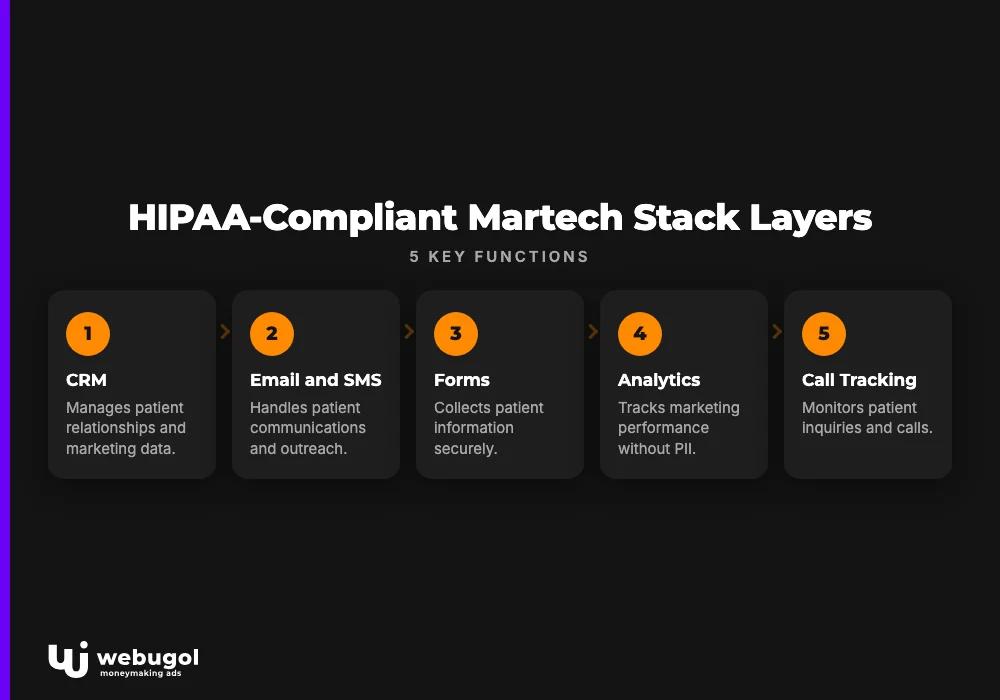
A compliant martech stack for a telehealth or clinic operation covers five functional layers: CRM, email and SMS, forms, analytics, and call tracking. Each carries different PHI exposure, different BAA requirements, and different levels of telehealth readiness. Evaluating them separately, then mapping how data passes between them, closes gaps that a tool-by-tool vendor review misses entirely.
The five evaluation criteria that matter most when selecting HIPAA-compliant marketing automation tools across these categories:
- BAA availability, which plan tier includes a BAA, if any
- PHI segregation, how the platform isolates PHI from general marketing data
- Encryption standard, data at rest and in transit
- Entry pricing model, per-seat, per-call, enterprise, or quote-based
- Telehealth-ready integrations, EHR connectivity, intake support, or clinical-workflow APIs
Comparison table: BAA availability, PHI handling, encryption, pricing, and telehealth fit
| Tool | Category | BAA Available | PHI Segregation | Encryption | Entry Pricing | Telehealth-Ready |
|---|---|---|---|---|---|---|
| HubSpot | CRM + Marketing | Plan-limited (Enterprise) | Dedicated environment option | AES-256 / TLS 1.2+ | Enterprise pricing | Yes |
| GoHighLevel | CRM + Email/SMS | Yes (HIPAA add-on required) | Sub-account isolation | AES-256 / TLS | Per-location model | Yes |
| ActiveCampaign | Email + SMS + CRM | Yes (eligible plans) | Restricted data mode required | AES-256 / TLS | Per-seat model | Partial |
| Jotform | Forms | Yes (paid plans) | Field-level encryption option | AES-256 / TLS | Per-seat model | Yes |
| Piwik PRO | Analytics | Yes | IP anonymization; no PII tracking | AES-256 / TLS | Quote-based | Yes |
| Freshpaint | Analytics (server-side) | Yes | Server-side PHI filter layer | AES-256 / TLS | Quote-based | Yes |
| CallRail | Call Tracking | Yes | Recording controls + PII scrubbing | AES-256 / TLS | Per-call model | Yes |
| Typeform | Forms | Yes (Business tier+) | Access controls; no field encryption | TLS in transit | Per-seat model | Partial |
For a CRM-specific breakdown of evaluation criteria and platform configurations, see the hipaa compliant crm comparison.
If HubSpot is already in your stack, is hubspot hipaa compliant covers which plan tier and configuration steps are required before the platform can handle PHI.

The telehealth stack for $10k–$100k/mo ad spend
Stack decisions at $10k/mo are not the same decisions you face at $100k/mo. Compliance exposure scales with volume, and the integration points that create PHI risk multiply as you add channels, vendors, and automation layers. The three tiers below outline where the typical risk appears and what it requires at each level.
$10k/mo tier (early growth, one to two active channels):
The typical stack at this stage is a form tool (Jotform or Typeform with BAA), a lightweight CRM (GoHighLevel with HIPAA add-on, or HubSpot moving toward Enterprise), and a semi-automated intake process. The primary compliance risk is the form-to-CRM data pass. If form submissions route through integration middleware that lacks BAA coverage, PHI is in transit through an unprotected layer. General-purpose automation tools frequently exclude BAA coverage from standard plans.
$30k–$50k/mo tier (scaling, multi-channel):
At this spend level, GLP-1 and TRT programs are typically running Google and Meta simultaneously, with call tracking layered in. CallRail with a signed BAA handles inbound call attribution without sending caller identity to ad platforms. The critical failure point is offline conversion imports. If the CRM pipes appointment-booked or consultation-completed events back to Google Ads or Meta with any identifier that could be linked to a health condition, that is a PHI disclosure to a third party without a BAA. Server-side offline conversion APIs that strip or hash identifiers before transmission are the fix.
$100k+/mo tier (at scale, full funnel):
At this level, weight-loss programs are typically running email and SMS nurture, retargeting, and paid acquisition as integrated layers. The same contact record may be touched by seven to ten tools across the funnel. Each integration point between those tools is a potential PHI exposure vector. A formal data-flow map, updated quarterly, is the operational tool that keeps the compliance team and the marketing team aligned on what has actually been reviewed and approved.
For how HubSpot fits into a telehealth CRM and email workflow specifically, hubspot for healthcare covers the HIPAA configuration steps and integration requirements.
Can you use Google Analytics or Meta Pixel on a healthcare website?
Not in their default client-side configuration on pages where users can indicate a health condition, search for a treatment, or submit personal information. Standard client-side pixels transmit identifiers to Google and Meta servers without a BAA in place. Per HHS Office for Civil Rights guidance issued in 2022 and updated in 2023, this transmission constitutes a PHI disclosure for covered entities.
The URL path alone can constitute PHI when it reveals that a user visited a page for a specific condition or clinical service. A session recording tool that captures keystrokes on an intake form is capturing PHI at the point of collection, before the submission ever reaches the CRM.
Pixel audit checklist: what to remove, restrict, and replace before launch
Review each tag in this list before any paid campaign goes live on a healthcare domain. For google analytics permissions and account structure, that audit starts at the data-stream and event level before any tagging decisions are made.
- Google Ads conversion tags: replace client-side firing on PHI-adjacent pages with a server-side offline conversion API; conversion events should fire from the CRM, not the browser
- Meta Pixel: remove from all pages where a user can indicate a health condition or submit contact information; use Meta's Conversion API server-side for conversion events only, with PII fields hashed or stripped before transmission
- LinkedIn Insight Tag: remove from intake, consultation, and results pages; acceptable on general marketing pages with no PHI exposure
- Google Analytics 4: configure with IP anonymization, disable URL collection on condition-specific paths, and implement server-side tagging to prevent raw event data from hitting GA4 endpoints directly; GA4 does not offer a BAA
- Session recording tools (Hotjar, FullStory, Microsoft Clarity): remove from any page that includes form fields, medical questions, or condition-related content; some vendors offer BAA-backed masked recording, but default configuration captures everything
- Third-party chat widgets: remove from intake flows unless the vendor provides a BAA and the implementation includes a PHI firewall before session content is logged to external servers
- Tag manager containers: audit every firing rule; a tag manager delivers tags but does not make them compliant; each tag inside the container requires its own BAA review

How HIPAA-compliant automation affects your funnel performance
The assumption most healthcare marketing teams carry into a compliance conversation is that compliance and performance are in tension. The actual dynamic runs the opposite direction. Poor compliance architecture is one of the most common causes of CPA inflation, attribution breakdown, and slow speed-to-lead in telehealth and clinic funnels.
Consider attribution first. A team spending $50k/mo in paid acquisition without server-side offline conversion imports is optimizing against browser-based signals that miss a substantial share of actual bookings. Phone consultations, intake form completions on session-limited pages, and CRM-triggered appointments all fall outside what the pixel sees. The ad platform underreports conversions and misallocates budget. Rebuilding attribution through compliant server-side imports restores the signal without passing PHI to the platform.
Speed-to-lead is the second dimension. Manual handoffs between marketing tools and intake systems are the main source of delay in stacks we diagnose. A form submission routes to a CRM, which triggers a Slack notification, which prompts a manual call from the intake coordinator. Each step adds minutes. A properly configured compliant CRM with automated routing and instant assignment cuts that delay without routing PHI through any non-BAA-covered middleware. Show rates improve when time-to-first-contact drops.
Attribution accuracy and show rate tie directly to cost per booking. That is the number the owner and the marketing lead actually care about. Compliance architecture built right from the start is not a constraint on performance. It is the infrastructure that makes consistent, scalable performance measurable.
If your stack was never audited end-to-end, Webugol builds the compliance layer into the growth system from month one, so the marketing team has attribution it can trust and the compliance team has documentation it can defend. Book a strategy call.
5 mistakes healthcare marketers make (that a BAA won't fix)
Even properly selected HIPAA-compliant marketing automation tools create exposure when they are configured or connected incorrectly. The five patterns below appear in martech audits after a compliance incident or a CRM migration, and each looks minor until it becomes a formal finding.
1. Assuming the BAA extends to the full platform rather than the specific module that handles PHI. A BAA with HubSpot covers HubSpot's handling of PHI within the modules and plan tier covered by that agreement. It does not extend to every integration, native widget, or third-party connection deployed through the platform. A HubSpot-native chat widget that sends session content to a third-party AI provider operating under no BAA is outside the scope of the HubSpot BAA, regardless of where the widget was installed.
2. Using pixel-based retargeting on condition-specific pages. Retargeting audiences built from visitors to GLP-1, TRT, or weight-loss program pages are built from PHI. The act of building that audience and uploading it to Meta or Google constitutes a PHI disclosure without a BAA. The fix is not to stop retargeting; it is to build retargeting audiences from non-condition-specific pages or from hashed CRM contacts through compliant custom audience APIs.
3. Passing identifiable field data to ad platforms as custom audiences. CRM syncs that push email lists to Meta or Google for custom audience matching are routine in direct-response marketing. When those lists include contacts acquired through a clinical intake, or contacts tagged with condition-related fields, the sync transmits PHI. Field-level filtering before the sync and confirmed BAA coverage for the audience-matching API endpoint are both required.
4. Skipping data-flow documentation so the compliance team cannot evaluate what they are approving. Compliance teams cannot approve what they cannot see. A marketing stack without a current data-flow map gives the compliance approver no surface to work from. Every new tool request becomes a negotiation based on vendor claims rather than actual data handling. A one-page data-flow diagram, updated each time a new tool is added, removes that friction and shortens the approval cycle.
5. Deploying AI chatbots or LLM personalization without a PHI firewall.
Using AI chatbots or LLM personalization without a PHI firewall
AI chat tools and LLM-driven personalization engines process raw user input to generate responses. Any intake question, symptom mention, or treatment inquiry a user enters can be transmitted to a third-party model host operating under no BAA. The model processes the content, may retain session data, and in some configurations uses it for model refinement. Each of those steps is a PHI disclosure.
A compliant implementation requires three elements. The model must sit behind a PHI firewall that strips or classifies incoming content before the model receives it. The model must be hosted under a signed BAA or self-hosted. The provider must confirm that session content is not retained beyond the response window. Most off-the-shelf chat integrations satisfy none of these requirements in their default configuration.
This risk is directly relevant for ai visibility strategies that use on-site chat or LLM-driven content to improve discovery through AI search channels. The same architecture that creates a discovery opportunity creates PHI exposure when a visitor has identified themselves as a patient or prospective patient.

How to audit your current stack for HIPAA gaps (checklist)
This checklist is for practices that already have a martech stack, not teams building one from scratch. It also applies when you are evaluating new HIPAA-compliant marketing automation tools and need to confirm that each addition does not open a gap in the layers you have already secured. The goal is to find current exposure. Run each step in order; findings from earlier steps inform later ones.
- Inventory every tool that receives or transmits user data. Start with the CRM, email platform, forms tool, analytics, and call tracking. Add ad platform pixels, chat widgets, session recording tools, and integration middleware.
- Verify BAA status for each vendor. Confirm a current, signed BAA exists. Confirm which plan tier the BAA covers. Some vendors issue BAAs only on enterprise or add-on tiers; a standard-plan deployment may have no BAA coverage even if the vendor offers one at a higher tier.
- Map every data-passing event between tools. For each integration, identify what fields pass, in which direction, and whether the receiving system has a BAA. Form-to-CRM, CRM-to-email, CRM-to-ad-platform audience syncs, and webhook callbacks all require individual review.
- Review pixel and tag configurations on every page template. Use browser DevTools or a tag auditing tool to log every tag firing across your domain. Flag tags on PHI-adjacent pages: intake forms, condition-specific landing pages, portal pages, and results pages.
- Audit integration data-passing behavior for ad platforms. Check whether any CRM-to-Google or CRM-to-Meta sync passes email, phone, or any field that could be correlated with a health condition. Check offline conversion event schemas for PII fields before they fire.
- Document findings in a format the compliance team can act on. A spreadsheet with one row per tool, columns for BAA status, data types handled, and identified gaps gives the compliance approver a clear surface. Flag which gaps require tool reconfiguration, which require BAA execution, and which require workflow redesign.
The audit typically surfaces two or three gaps requiring immediate action and several requiring a configuration change or BAA execution. The common outcome is not a stack replacement; it is a remediation plan that closes specific integration-layer exposures.
Is your marketing stack exposing PHI without you knowing?
Healthcare teams running paid acquisition typically discover compliance gaps during a forced stack review. A compliance audit flags pixel behavior. A CRM migration surfaces undocumented data flows. A platform policy enforcement action blocks an ad account and forces an internal review that nobody wanted to run proactively.
The pattern is consistent. HIPAA-compliant marketing automation tools were added one at a time over 18 to 36 months, each solving a specific problem, and no single person ever mapped the full picture. The compliance team approved individual tools in isolation. The marketing team connected those tools in ways that created data flows the compliance team never evaluated. Neither team was wrong within their own scope. The handoff between them is where the exposure lives.
Healthcare Growth System starts month one with a full tracking and martech audit: mapping every data flow, verifying BAA status at the tool and plan level, flagging pixel and integration gaps, and rebuilding the compliance layer before ad spend scales. The outcome is a stack the compliance team can defend and an attribution layer the marketing team can use to optimize cost per booking, speed-to-lead, and show rate.
Book a strategy call before the audit is forced by someone else.
FAQ
What does HIPAA-compliant marketing automation actually require?
HIPAA-compliant marketing automation requires a Business Associate Agreement with every vendor that handles PHI, technical safeguards covering encryption at rest and in transit, and a data-flow architecture that prevents PHI from reaching ad platforms or non-BAA-covered services. Compliance is a configuration the covered entity must maintain across its entire stack, including client-side pixels, integration middleware, and ad platform data syncs. Signing a BAA with one platform does not cover the integrations connecting it to the rest of the stack.
Does signing a BAA make my marketing platform HIPAA-compliant?
A signed BAA covers the vendor's handling of PHI within their platform but does not extend to your website's client-side pixels, third-party ad platforms, or data in transit before it reaches the platform. The practice remains responsible for every touchpoint between the user and the BAA-covered environment. A BAA is a prerequisite for using the platform with PHI, not proof that the full workflow is compliant.
Can I use Google Analytics or Meta Pixel on a healthcare website?
Not in their default client-side configuration on pages where users can indicate a health condition, search for a specific treatment, or submit personal information. Standard pixels transmit identifiers to servers owned by Google and Meta without a BAA, which HHS guidance establishes as a PHI disclosure for covered entities. The compliant alternative is server-side tagging that strips PHI before firing conversion events to these platforms.
Which marketing automation tools are HIPAA-compliant for telehealth practices?
HIPAA-compliant marketing automation tools with BAA coverage include HubSpot Enterprise, GoHighLevel with its HIPAA add-on, ActiveCampaign on eligible plans, and Jotform on paid tiers. BAA availability is necessary but not sufficient; the platform must also be configured to restrict PHI to compliant data-handling workflows, with client-side pixels removed from PHI-adjacent pages. The comparison table above covers the five criteria that determine actual fitness for a telehealth stack.
How do I know if my current marketing stack is HIPAA-compliant?
Run a data-flow audit: inventory every tool that receives or transmits user data, verify BAA status at the specific plan tier you are on, and map every integration data-passing event to confirm no PHI reaches a non-BAA-covered endpoint. A stack that has never been audited end-to-end almost certainly has at least one gap, typically in the pixel layer, the CRM-to-ad-platform sync, or the form-submission transit path. HIPAA-compliant marketing automation tools are only as compliant as the integrations connecting them.